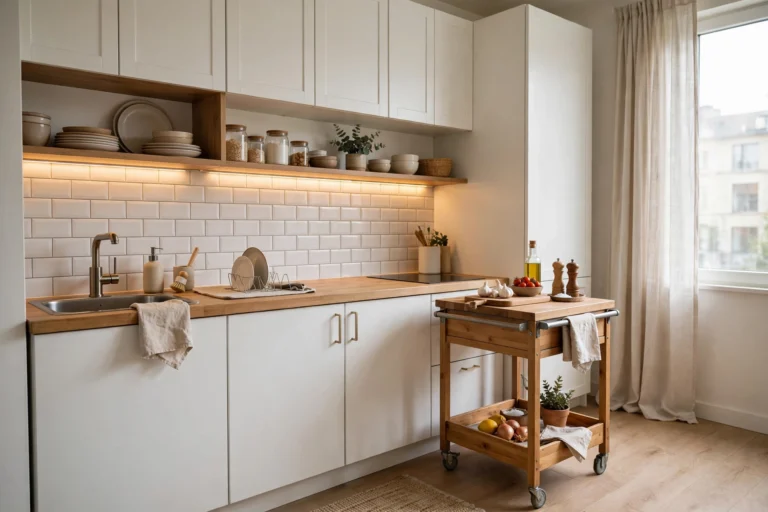
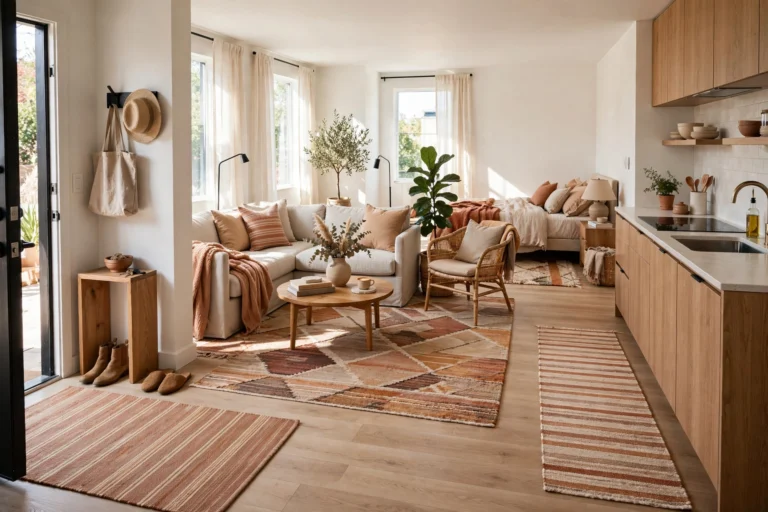
30 Cozy Studio Apartment Ideas for Couples
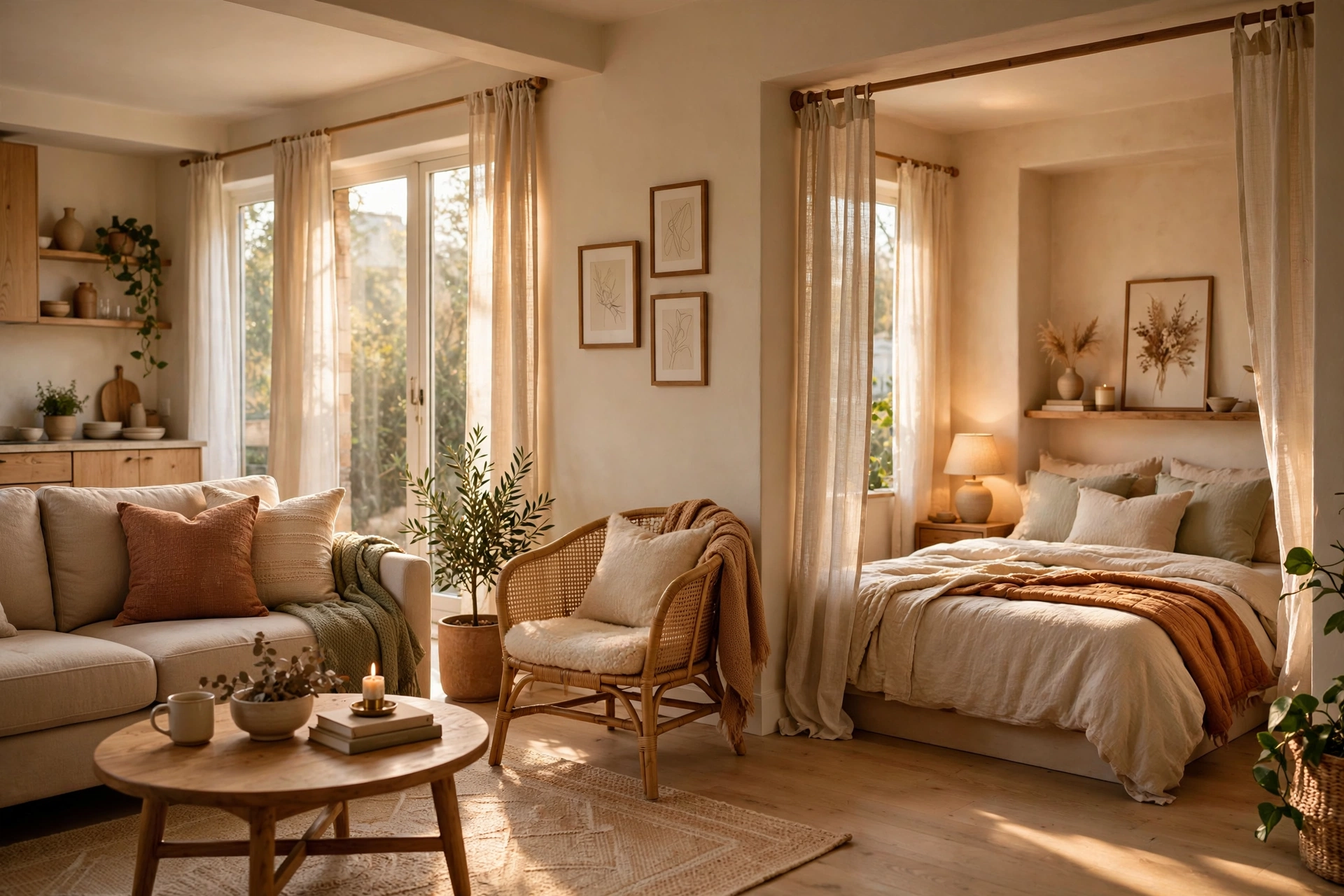
One room, two people, zero walls — sharing a studio apartment as a couple is the ultimate relationship stress test and, done right, the coziest way to live. The secret isn’t square footage; it’s design that respects both people. Every choice, from bed size to closet split to where each of you recharges alone, either prevents friction or quietly builds it.
These 30 cozy studio apartment ideas for couples cover the real stuff: sharing the sleep zone without sleep-divorce, carving out two-person living areas, style compromises that make both of you happy, his-and-hers storage that ends the “where is my charger” wars, alone-time corners in a one-room home, and romantic touches that keep the spark alive. Every idea includes realistic prices and a pro tip, so you can build a studio that feels like it was designed for two — because it was.
Sharing the Sleep Zone
1. Settle the King-vs-Queen Debate With Math
In a studio, bed size is a relationship decision: a king gives each of you real elbow room, but it can eat the entire sleeping zone. Measure first — a queen (60×80 in) leaves roughly 30 inches per person, while a king (76×80 in) gives 38 inches each but needs 16 extra inches of floor width. If your studio is under 450 sq ft, a queen plus a quality mattress topper usually wins; over 500 sq ft, the king is worth it. Budget $400–$900 for a good queen mattress in a box. Pro tip: couples who disagree on firmness should look at split-firmness mattresses — each side gets its own comfort level, argument over.
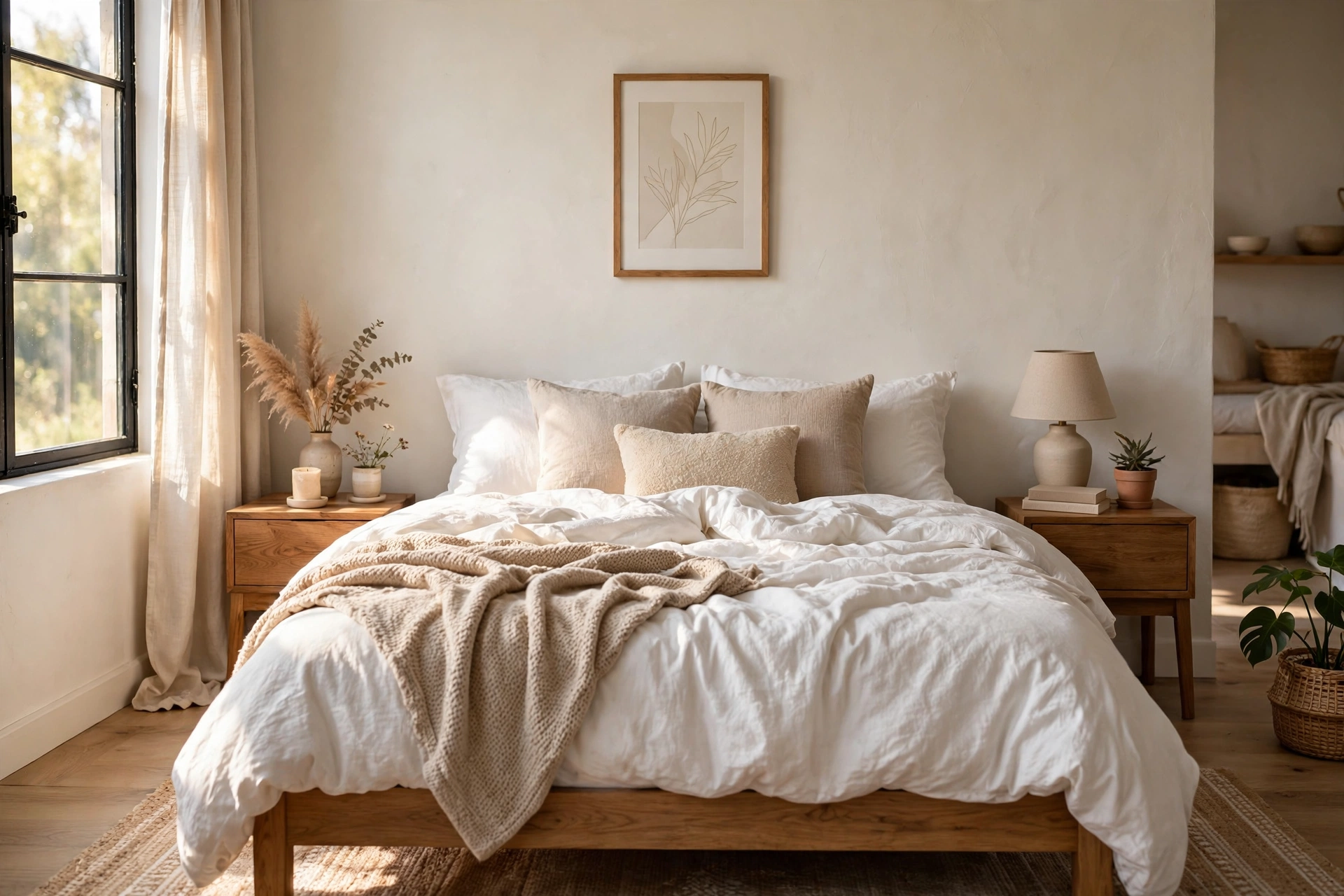
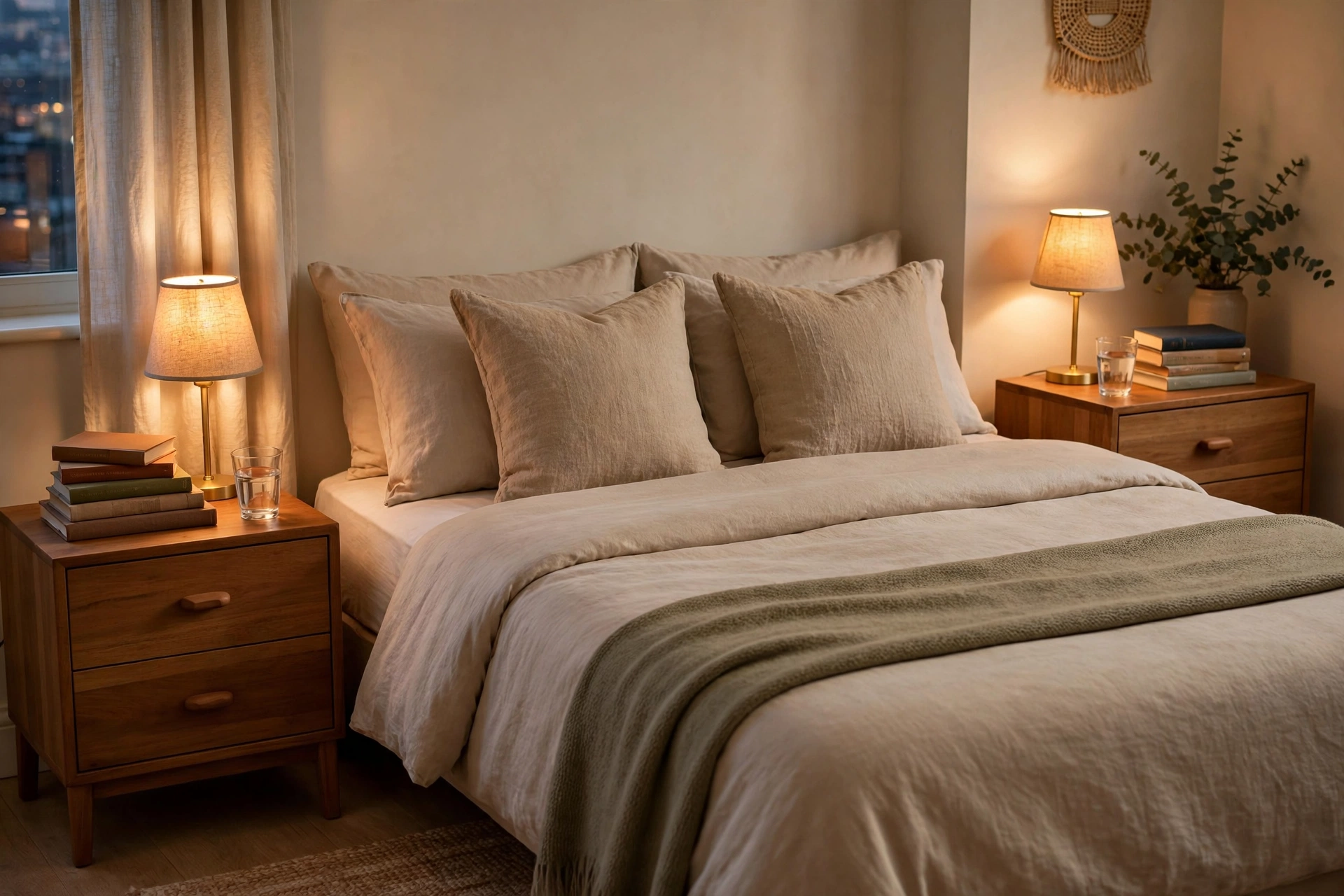
2. Give Each Person a Real Nightstand
Nothing breeds resentment like one partner’s phone, book, water glass, and lamp crammed onto a single tiny nightstand while the other’s stuff lives on the floor. Two matching nightstands — even slim 16-inch ones — signal that both people equally own the bedroom zone. IKEA’s MALM or HEMNES nightstands run $40–$80 each and fit tight spaces. Pro tip: mount wall sconces above each nightstand instead of table lamps — you free the entire surface for books, glasses, and phones, a trick that also shows up in these small studio bedroom ideas.
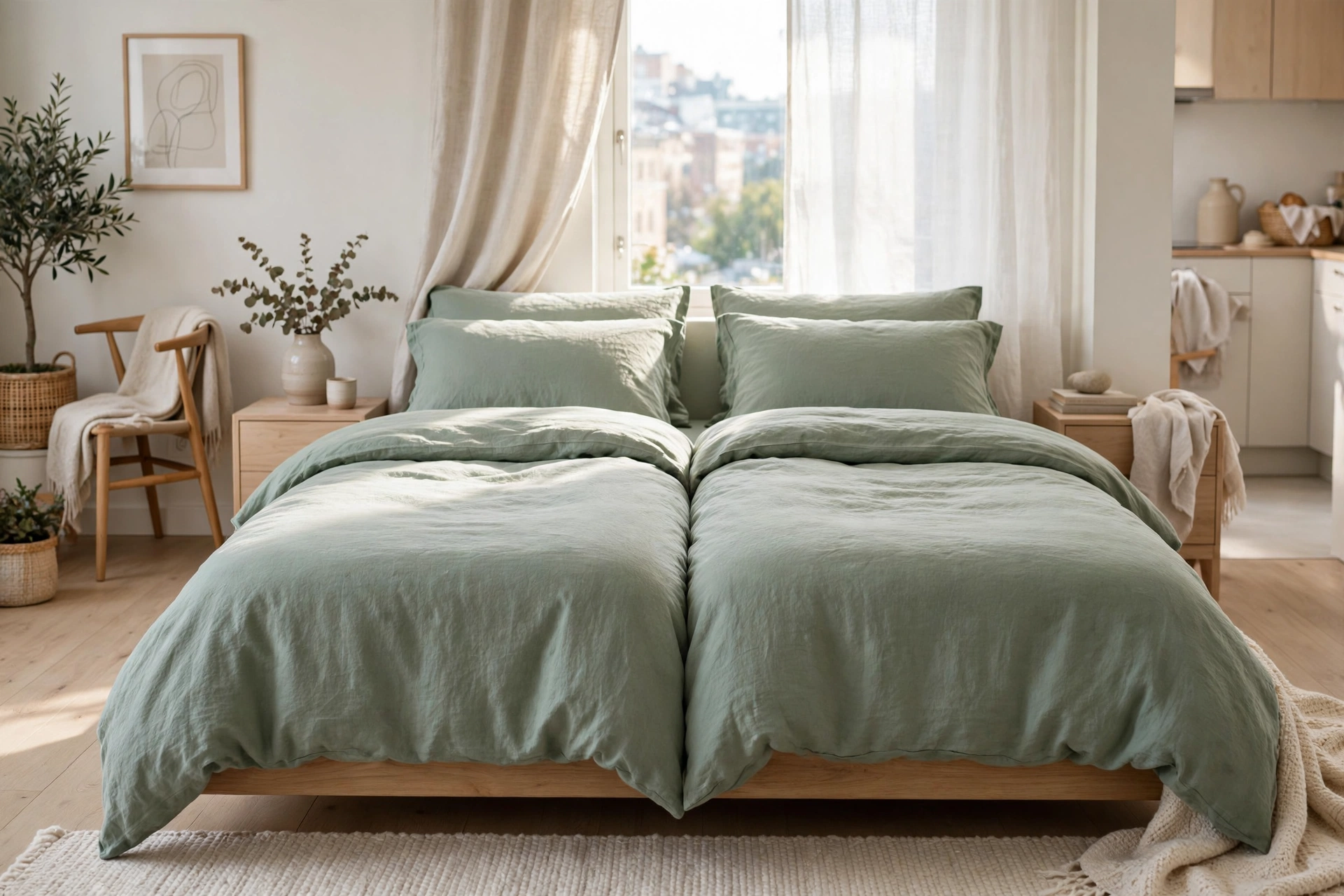
3. Try the Split-Duvet Compromise
The Scandinavian sleep method — two separate duvets on one bed — is a marriage saver disguised as bedding. One partner runs hot, the other steals covers; with individual duvets (twin XL size on a king, or two full/queen duvets on a king), both problems vanish overnight. Two quality down-alternative duvets cost $60–$120 total, and matching duvet covers keep the bed looking unified. Pro tip: use the same duvet cover set in the same color for both duvets — guests will never know you’re sleeping Scandinavian-style, and the bed still photographs as one.
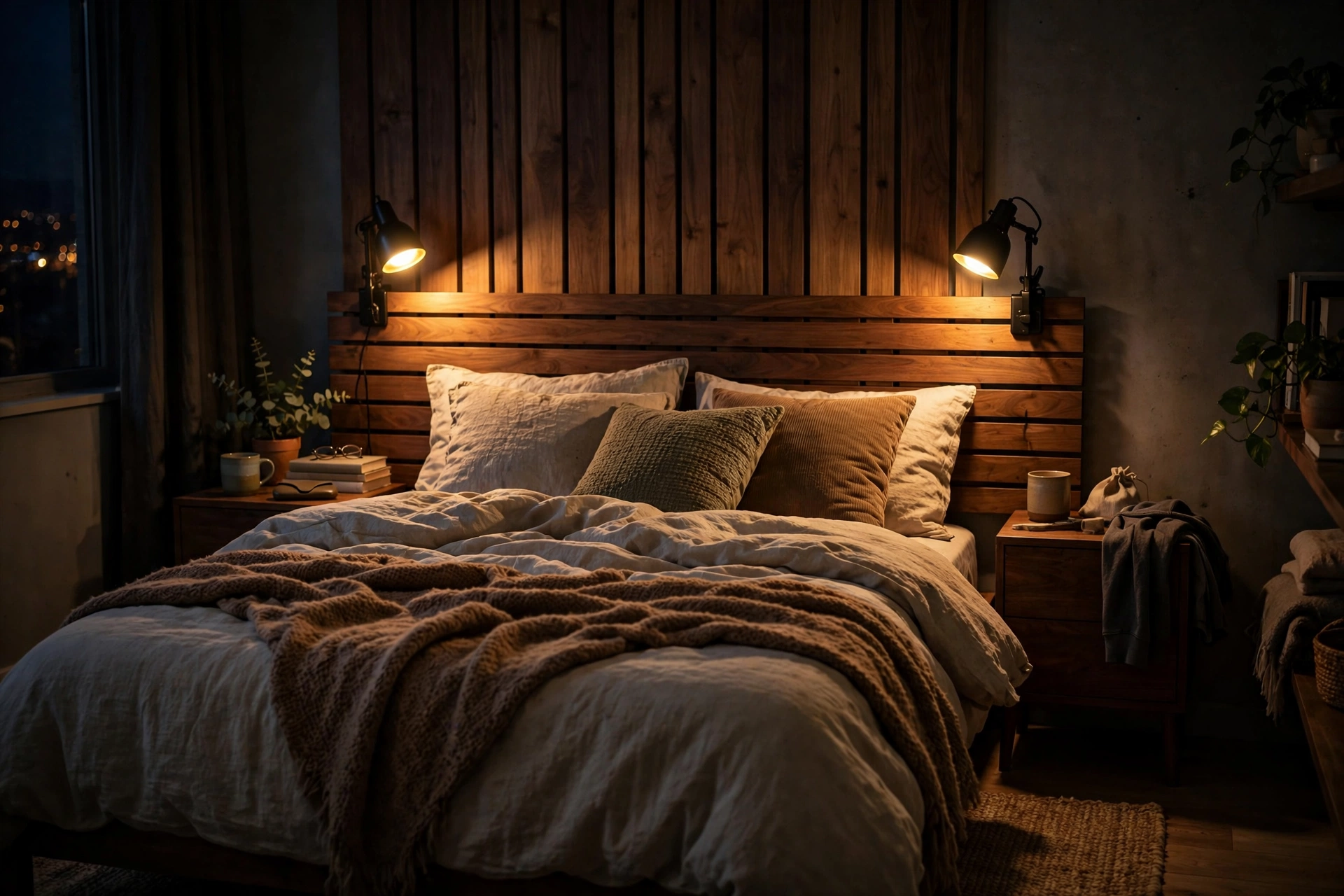
4. Create Separate Reading-Light Zones
One partner reads until midnight, the other needs darkness by ten — the classic studio standoff. The fix is directional lighting: a focused clip-on or wall-mounted reading light on each side of the bed with a warm 2700K bulb, plus a blackout sleep mask in the nightstand drawer as backup. Clip-on LED reading lights cost $15–$25 each and aim light at the book, not the partner. Pro tip: put each reading light on its own switch or smart plug — fumbling for one shared switch at midnight wakes everyone up.
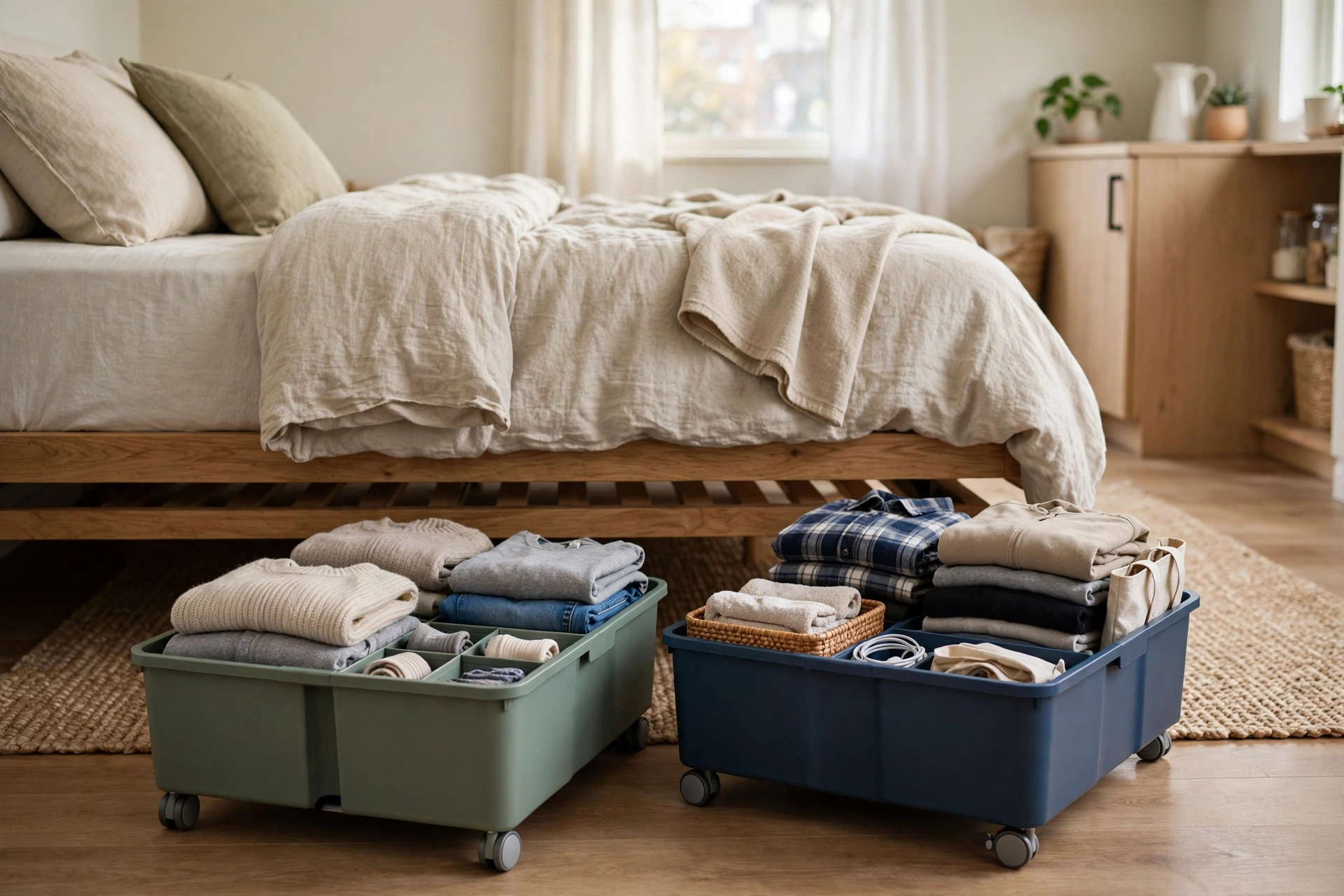
5. Split Under-Bed Storage Down the Middle
Under-bed space is prime real estate in a studio — and the fastest way to fight over it. Divide it formally: two low rolling bins per person, labeled or color-coded, so each partner’s off-season clothes and keepsakes have a defined home. Slim under-bed boxes (about 6 inches tall) run $15–$25 for a two-pack at Target or IKEA. Pro tip: use different colored bins per person — no labels needed, no “I thought that one was mine” debates at 7 a.m.
Two-Person Living Zones
6. Choose a Loveseat Plus Accent Chair Over One Big Sofa
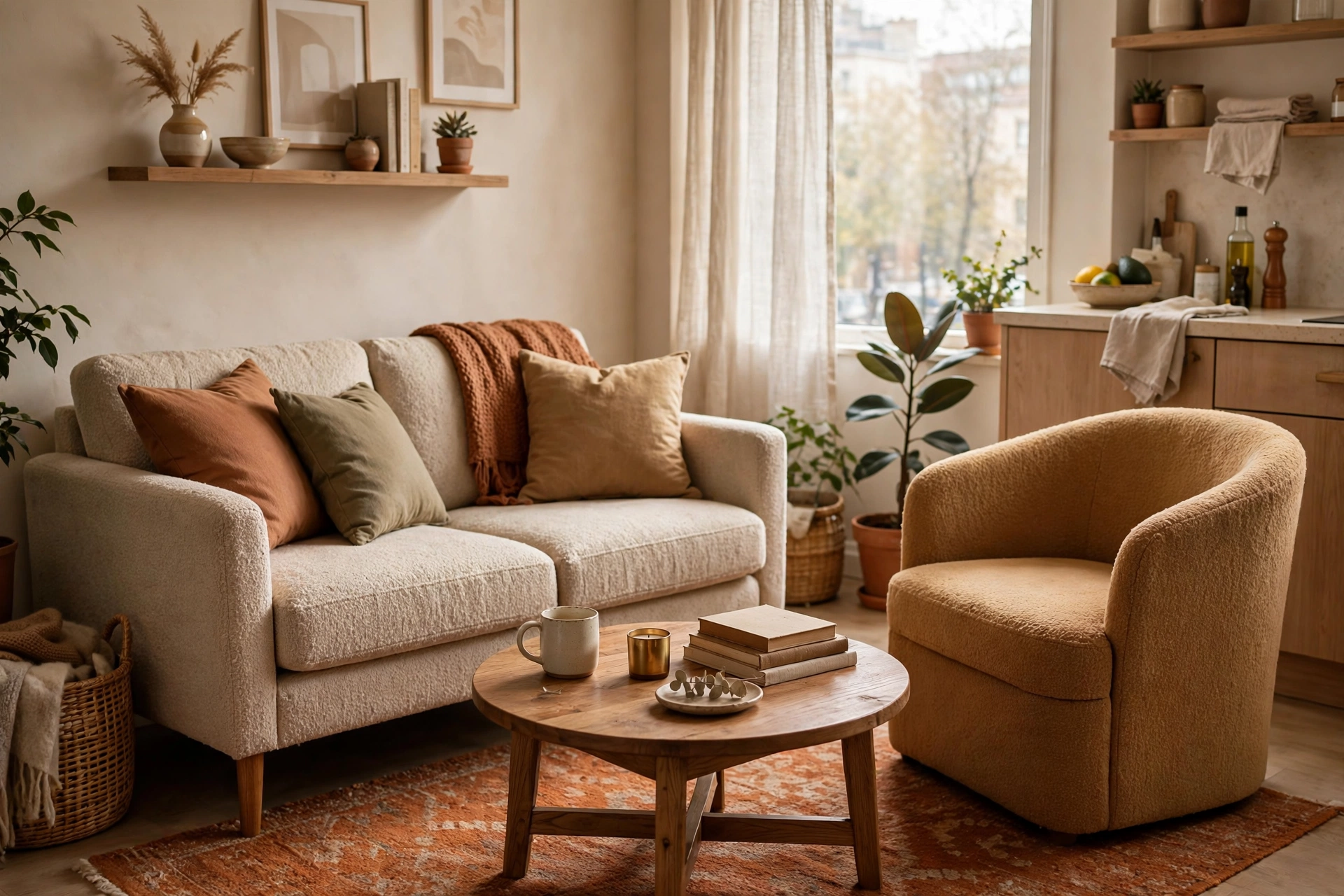
A full-size sofa in a studio often leaves no room for anything else — and couples end up fighting over the “good” corner. A loveseat plus a separate accent chair gives each person their own seat, angles easily for conversation or TV, and fits better in tight floor plans. A decent loveseat runs $350–$700; pair it with a $150–$300 accent chair in a complementary fabric. Pro tip: pick chairs with similar seat heights so neither partner feels like they’re sitting in the kids’ seat — this seating balance is a quiet theme across these cozy apartment living room ideas.
7. Set a Dining Table for Two That Seats Four
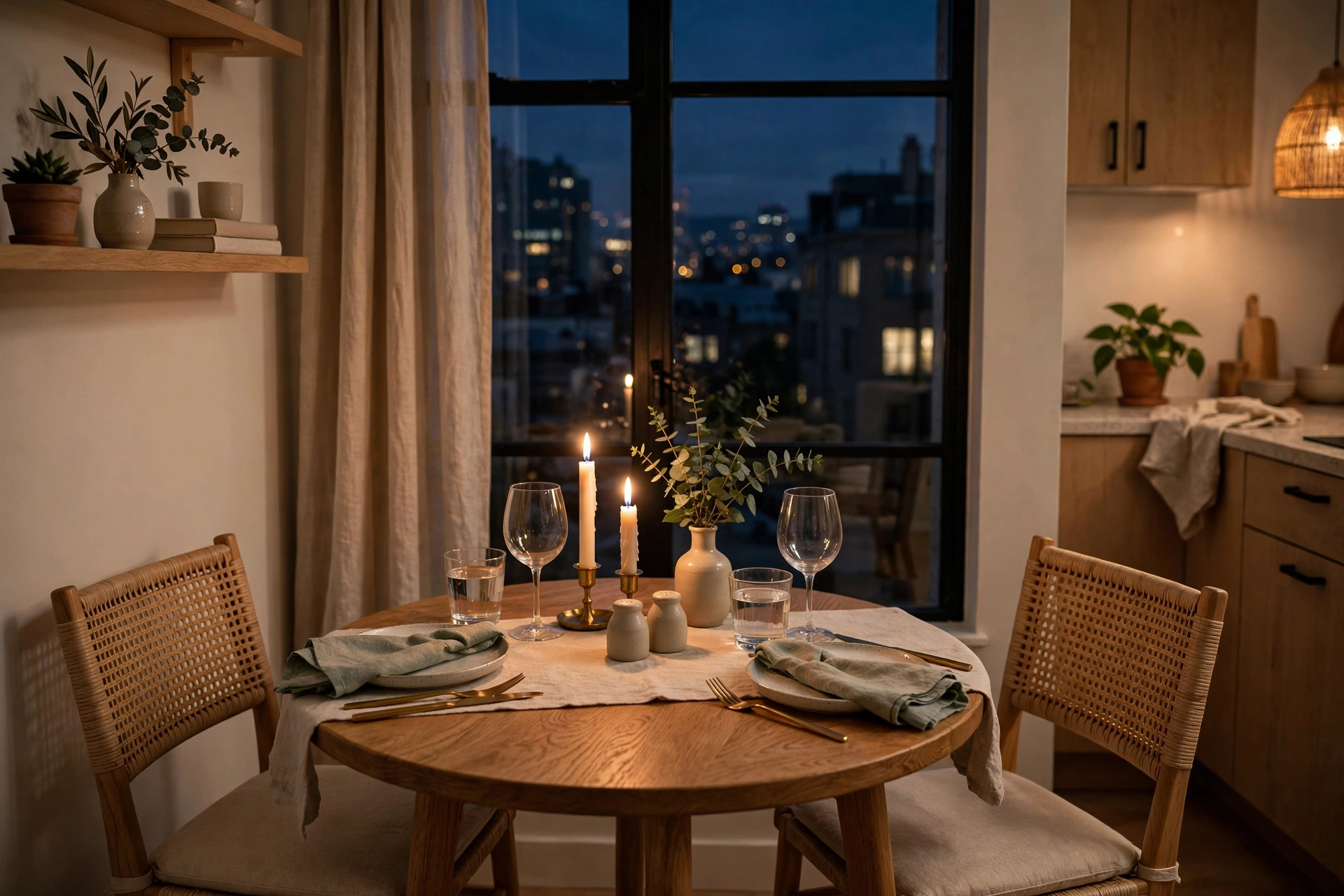
Daily life needs an intimate two-person table; couple life needs the occasional dinner with friends. A 36-inch round drop-leaf or extendable table seats two comfortably every day and stretches to four when friends come over. IKEA’s NORDEN gateleg or a similar extendable runs $150–$300. Keep two daily chairs plus two folding chairs stored in the closet. Pro tip: a round table is the couples’ shape — no “head of table” hierarchy, better conversation, and it fits studio corners that rectangles can’t.
8. Build Two Desk Nooks for WFH Couples
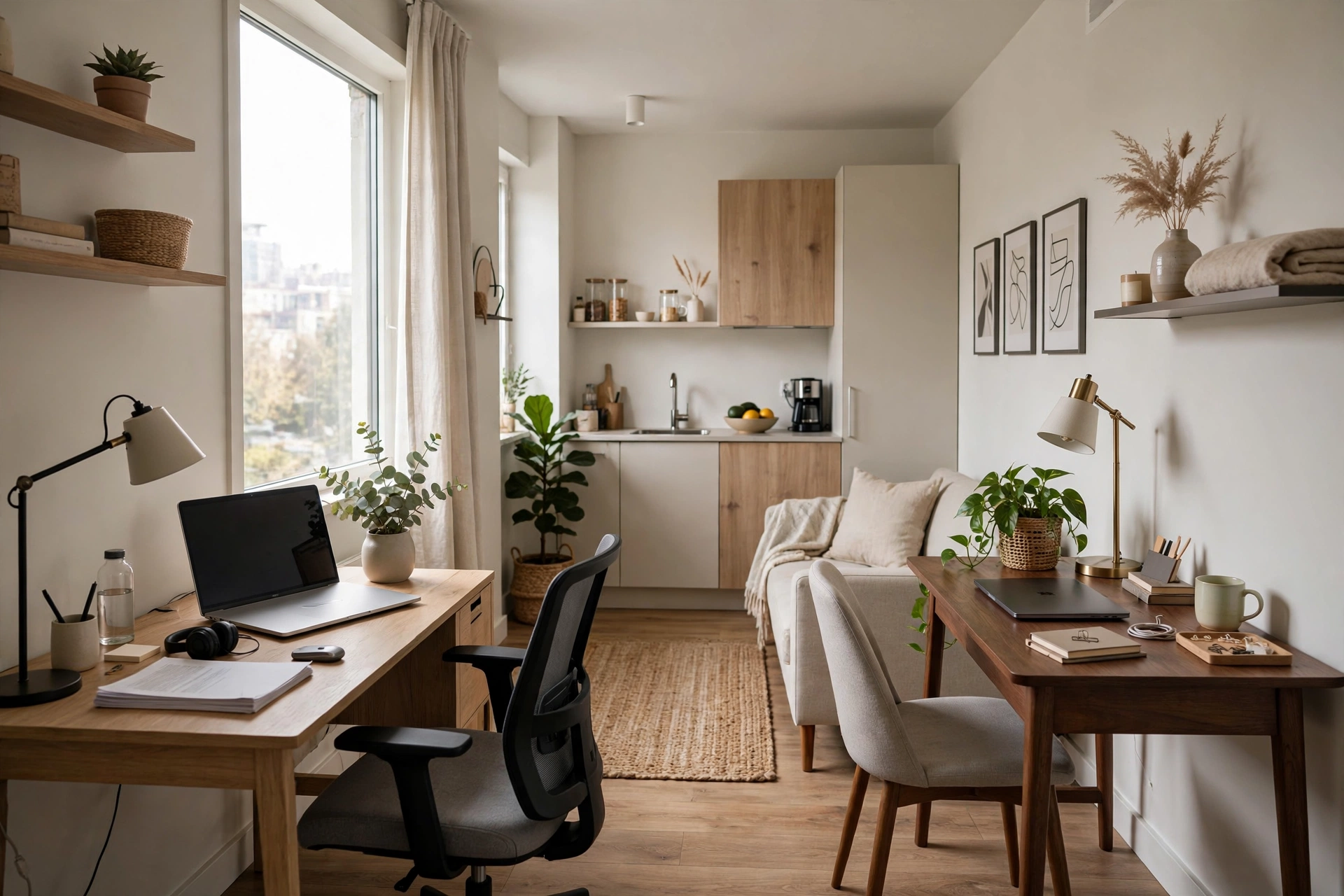
Two partners on video calls at one table is a recipe for mutual meeting-bombing. If both of you work from home, you need two distinct work spots — even if one is a 32-inch wall-mounted fold-down desk and the other is the dining table with a laptop. A secondhand desk plus a decent chair can be set up for under $200; fold-down wall desks start around $80. Pro tip: face the two workstations away from each other (or put a bookshelf between them) — back-to-back or angled setups cut audio bleed far better than side-by-side, a layout trick borrowed from these studio apartment layout ideas.
9. Angle the TV for Two Viewing Sweet Spots
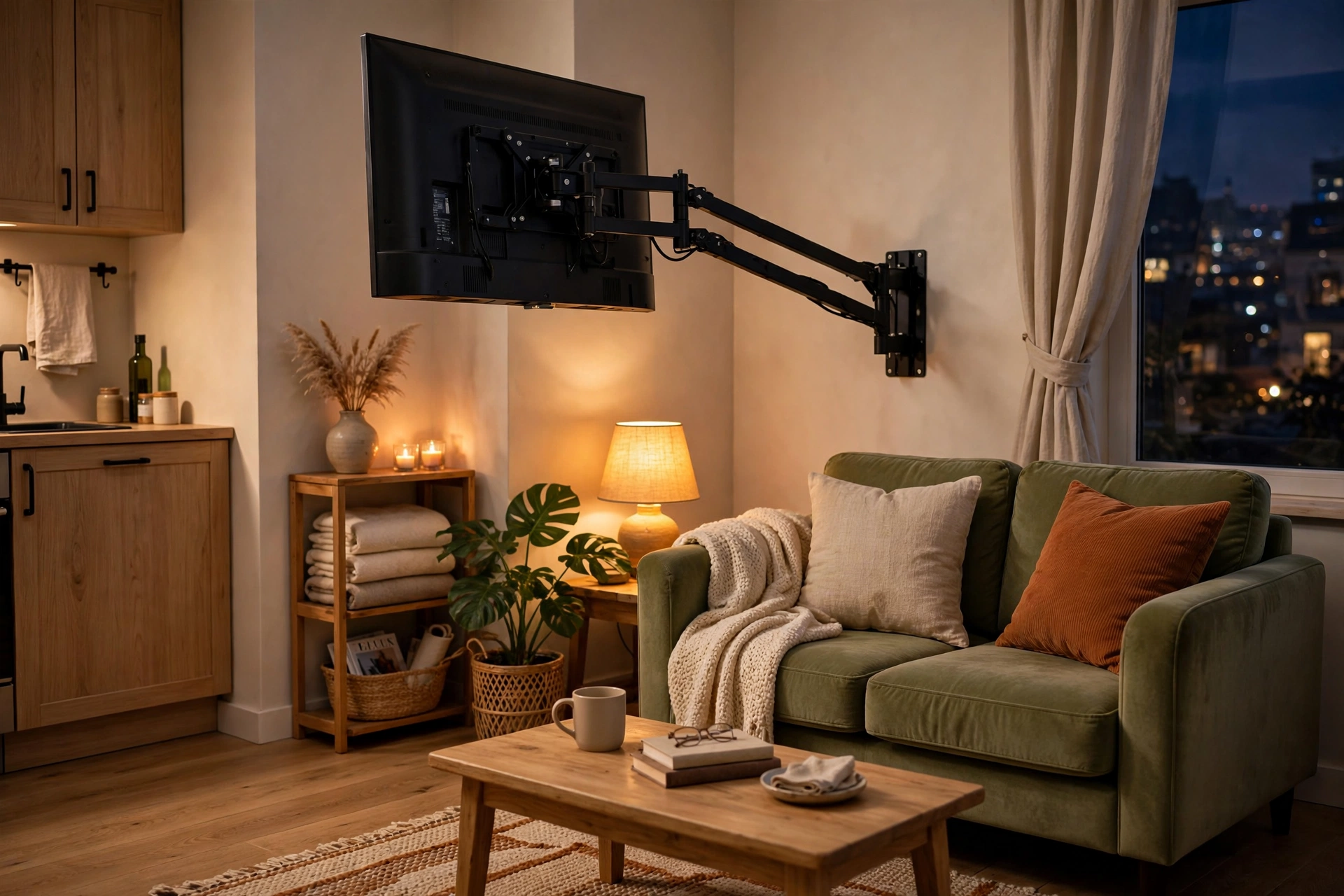
One TV, two viewers, one tiny room — a fixed TV position means one of you always watches at an angle. Mount the TV on a full-motion articulating arm ($30–$60) so it swings toward the loveseat for movie night and back toward the dining nook for cooking-show background viewing. A 43–50 inch TV is the sweet spot for studios; bigger overwhelms the wall. Pro tip: add a $20–$40 soundbar — in a small room it makes dialogue crisp at low volumes, so late-night watching doesn’t require headphones or fights.
10. Design a Date-Night-at-Home Corner
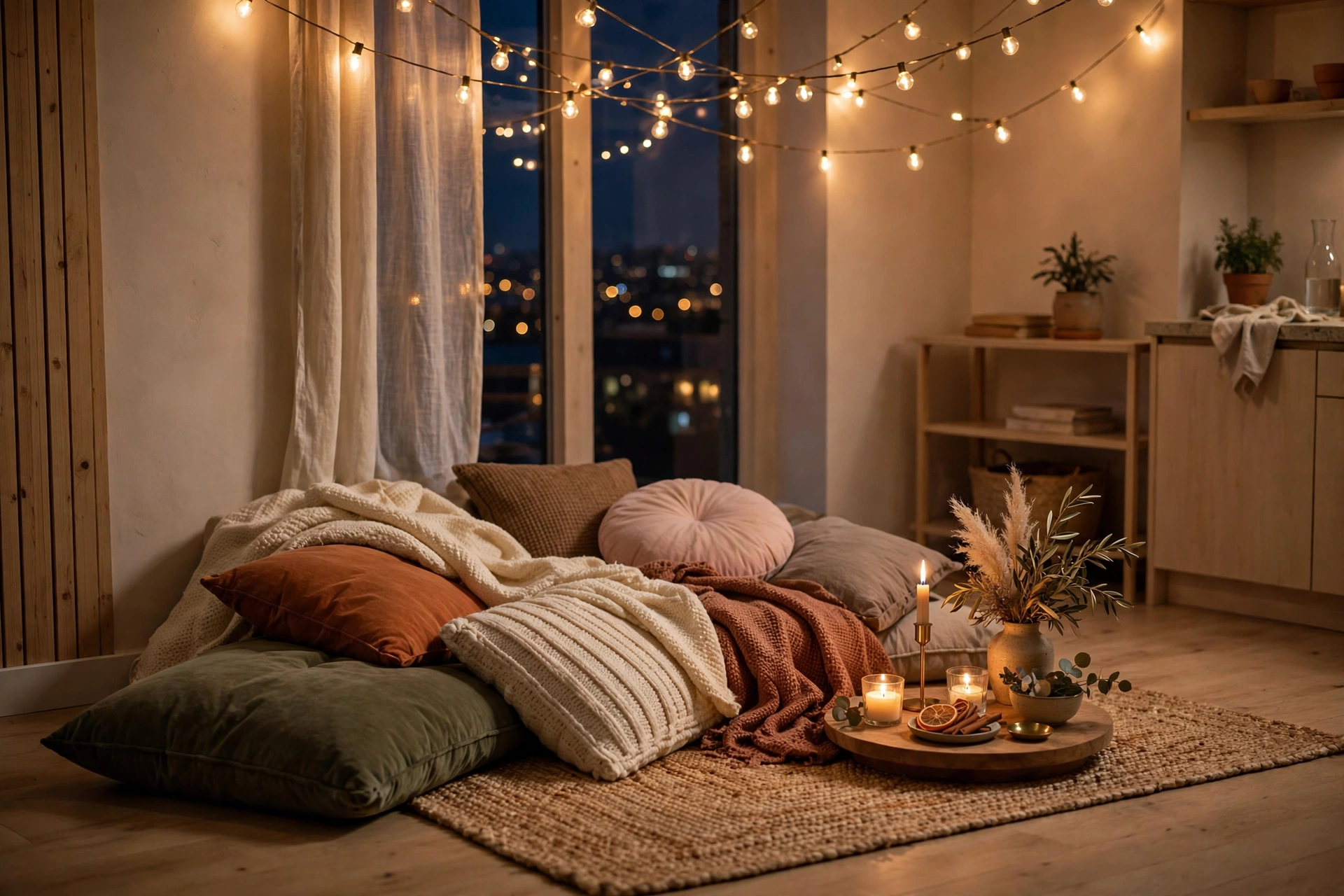
When going out means navigating a whole city, the best date nights happen at home — if the space allows it. Dedicate one corner to romance: two floor cushions or a loveseat facing the window, a small side table for wine and snacks, and a dimmable lamp or string lights overhead. Floor cushions run $30–$60 each; warm-white fairy lights cost under $15. Pro tip: keep a “date-night kit” in a nearby basket — candles, a Bluetooth speaker, a card game — so the corner transforms in two minutes without a planning committee.
Style Compromises That Work
11. Use the 70/30 Style Split Rule
When tastes clash — minimalist vs. maximalist, modern vs. rustic — don’t aim for 50/50, which looks like two apartments collided. Instead, let one partner’s style lead 70% of the space (usually the calmer, more neutral one) and give the other 30% as bold accent territory: their art, their chair, their shelf. The result reads intentional, not compromised. Pro tip: the partner with the stronger visual style usually takes the 30% — a little of a loud taste goes a long way, while a little of a quiet taste disappears entirely.
12. Build a Compromise Color Palette Together
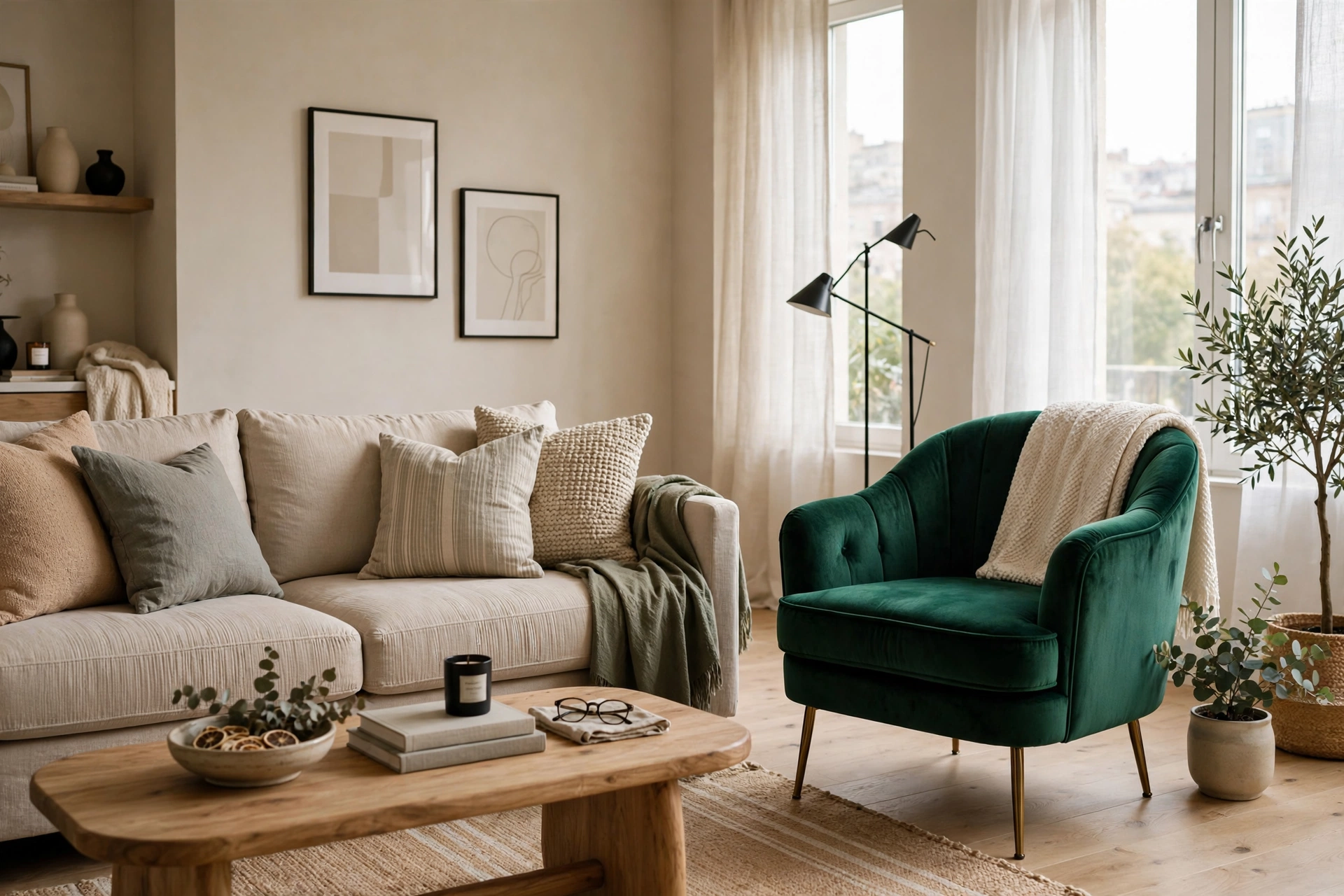
Color fights are the most common couples-decor dispute, and the fix is a shared palette built before shopping: pick three neutrals you both tolerate, then let each partner choose one accent color. She loves terracotta, he loves navy? Both can live in the same room if the base is warm white and oak. Paint swatches are free; a shared Pinterest board costs nothing and prevents 90% of arguments. Pro tip: test the palette with small, cheap items first — two cushion covers in the accent colors ($15–$25 each) — before committing to a rug or curtains.
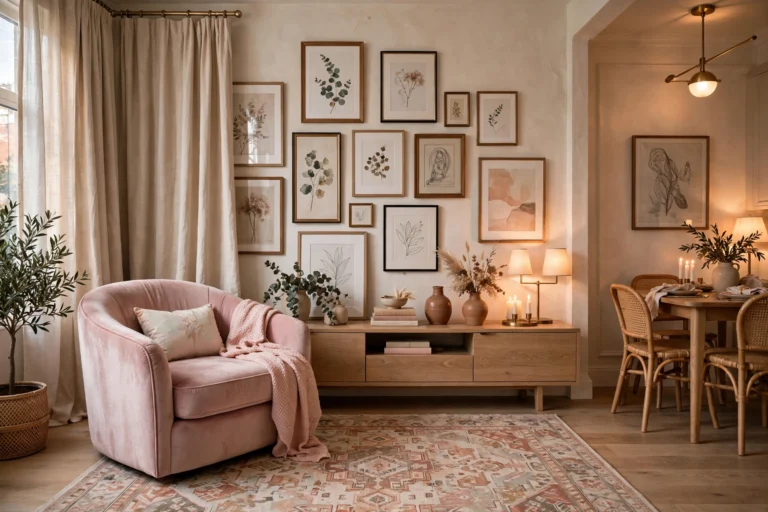
13. Hang a Gallery Wall With Both Tastes
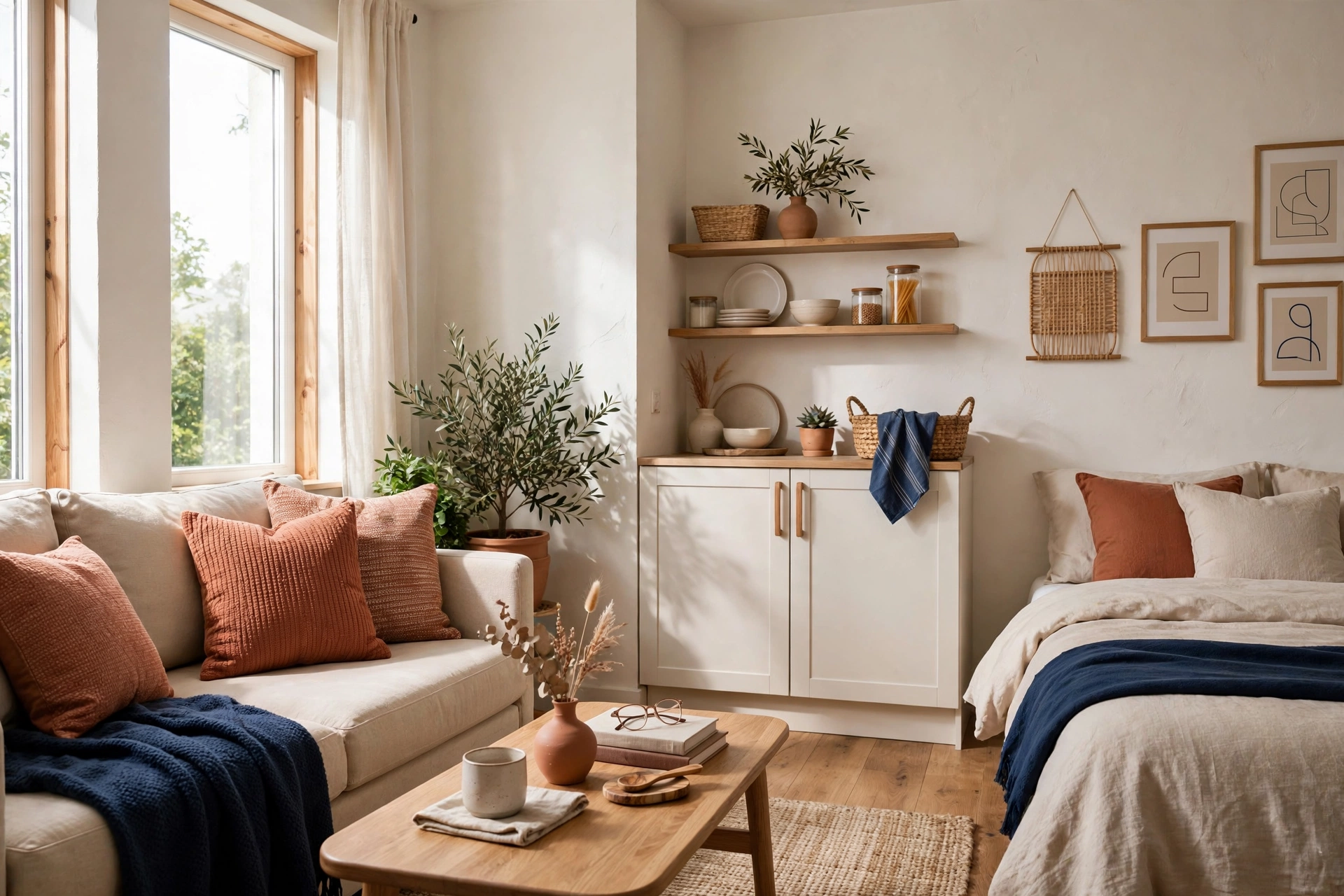
A gallery wall is the perfect compromise canvas: her botanical prints next to his concert posters, unified by matching frames. The frames do the diplomatic work — identical thin black or oak frames ($8–$15 each at IKEA) make wildly different art look like a curated collection. Plan the layout on the floor first with painter’s tape outlines on the wall. Pro tip: give each partner equal linear feet of wall — measure it. “Equal wall space” is the kind of fairness that prevents the gallery wall from becoming a scoreboard.
14. Keep the Base Neutral, Split the Accents
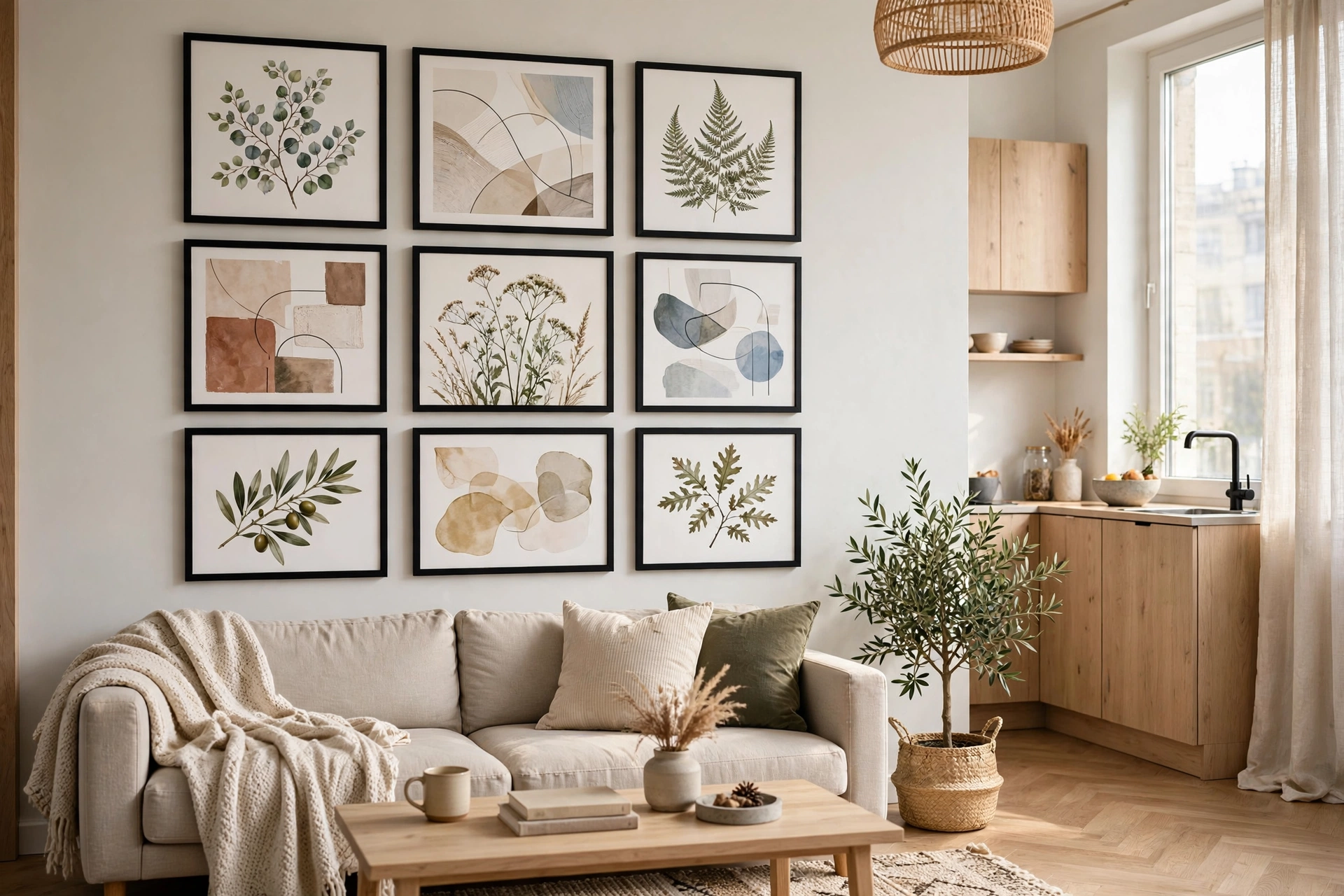
The most durable compromise in a shared studio: big, expensive pieces (sofa, rug, curtains, bedding) stay neutral and agreed-upon, while each partner gets full control of their accent zone — their side of the bed, their desk, their shelf. A neutral sofa ($400–$800) plus two sets of accent cushions and throws ($60–$120 per person) gives both people visible ownership without visual chaos. Pro tip: revisit the accents yearly — tastes evolve, and a $50 throw swap is cheaper than couples therapy over a sofa neither of you loves anymore.
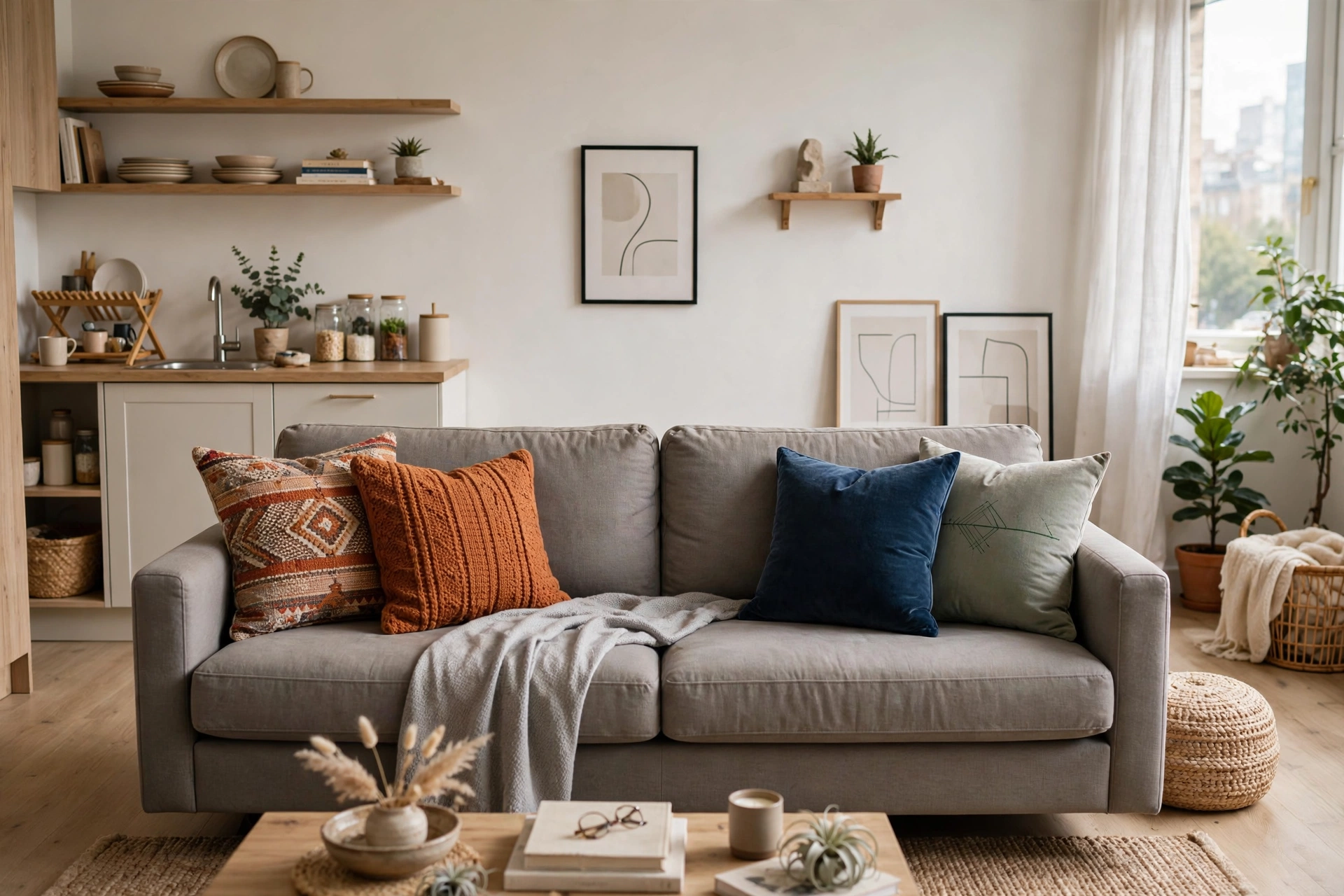
15. Rotate Statement Pieces Seasonally
Can’t agree on the bold rug or the dramatic art print? Don’t choose — rotate. Each partner gets a “statement season”: their pick takes the spotlight for three to six months, then swaps to storage while the other’s takes over. This works for art, throws, cushion covers, even small furniture. A storage bin for off-season decor costs $12–$20. Pro tip: make the swap a ritual — a glass of wine, 20 minutes, both of you. What could be a recurring argument becomes a fun refresh the apartment gets twice a year.
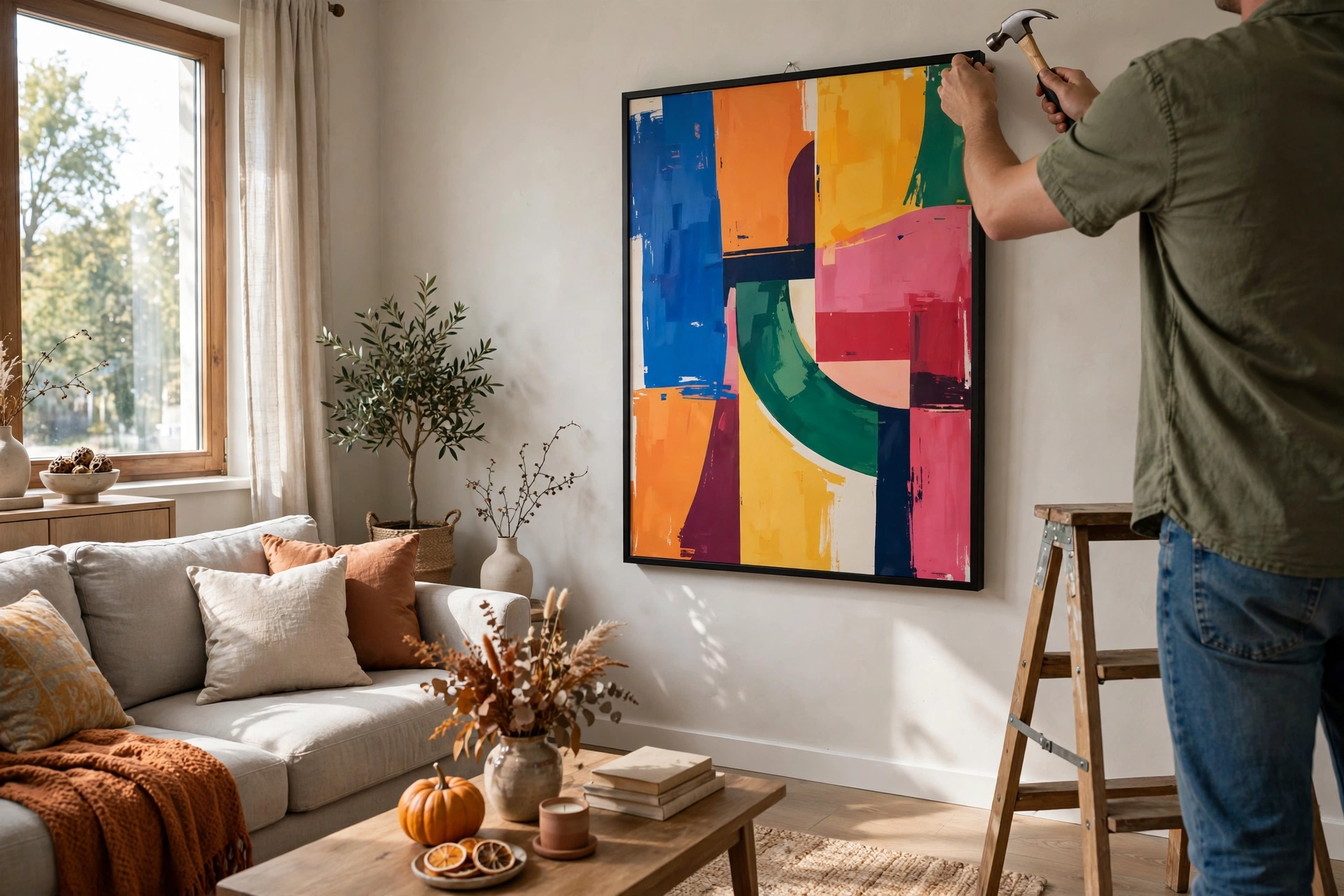
His-and-Hers Storage
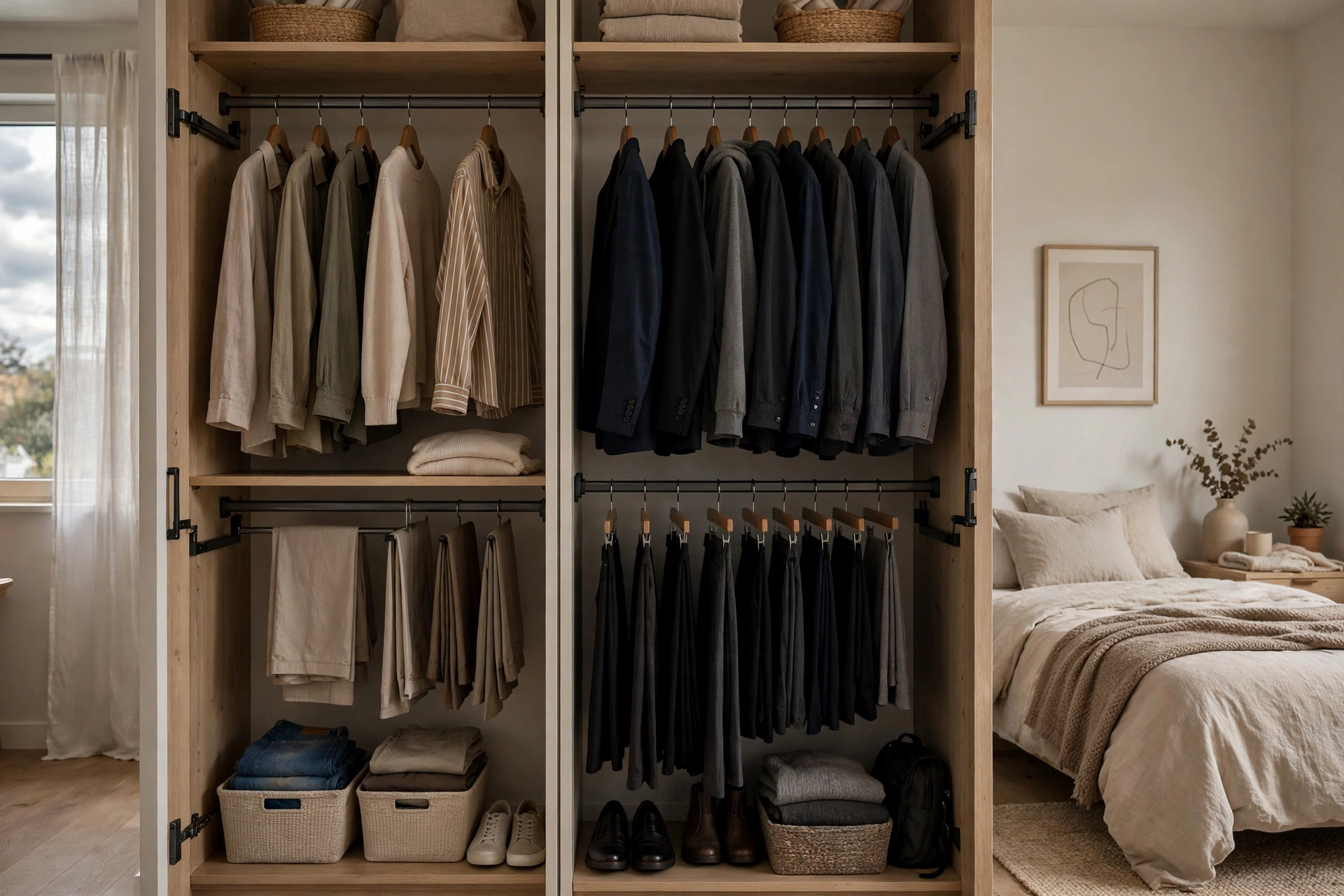
16. Split the Closet: His Side, Hers Side
One shared closet in a studio needs a formal treaty, not good intentions. Divide it physically — a vertical hanging organizer or even a strip of washi tape down the middle of the shelf — and allocate by real wardrobe size, not 50/50. The partner with more clothes gets more space; fairness is proportional. A double-hang closet rod ($20–$35) instantly doubles hanging capacity for both sides. Pro tip: revisit the split when seasons change — the winter-coat partner needs more room in December than in July, and resentment builds in the gap between.
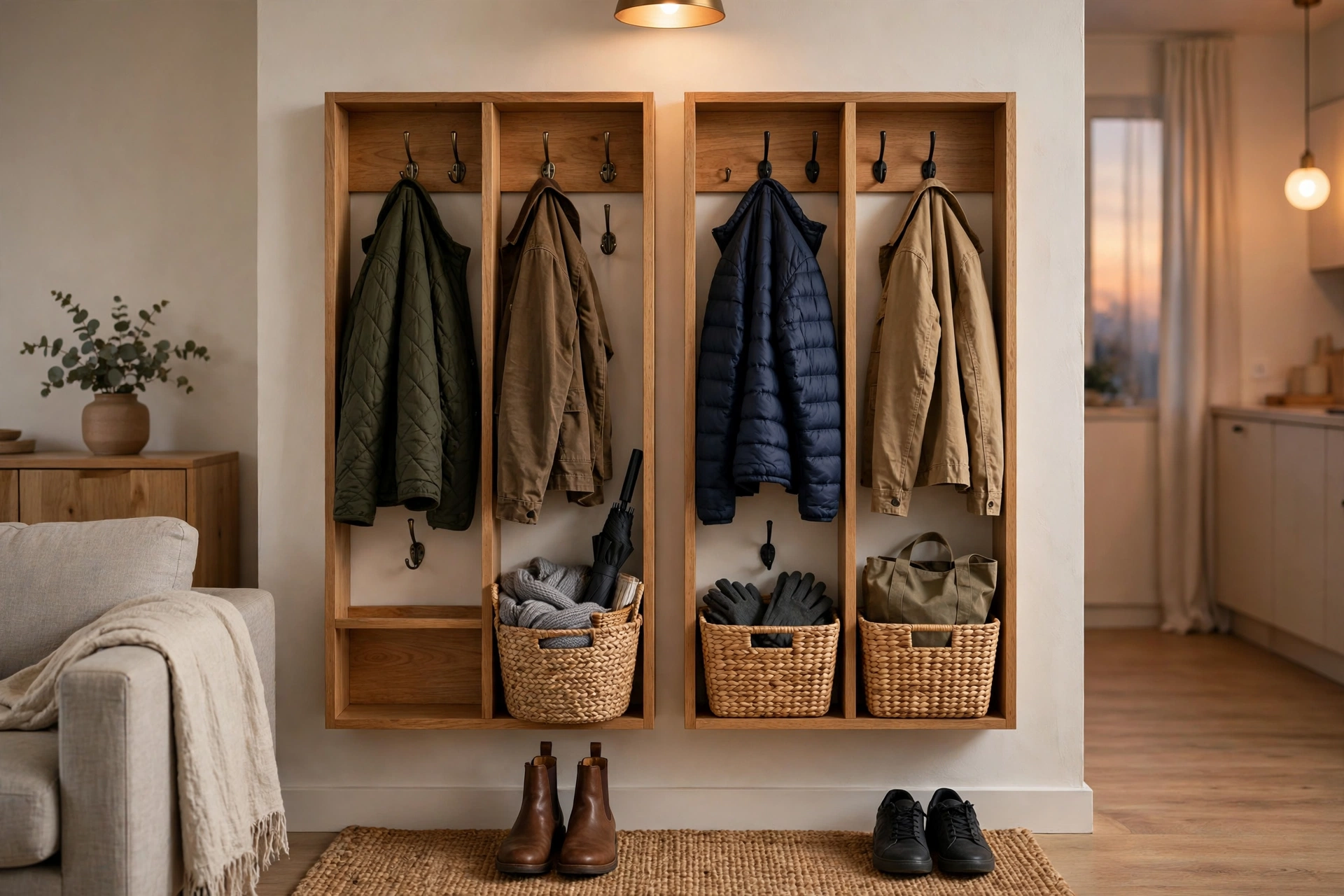
17. Set Up Two Entry Stations
The front door is where couple-chaos concentrates: two sets of keys, two bags, two jackets, one tiny wall. Install two hooks, two small baskets, or a double-cubby organizer so each person has a defined landing spot. A wall-mounted organizer with two sections costs $25–$45. Pro tip: add a tiny bowl or magnetic tray per person for keys — the “have you seen my keys” conversation disappears within a week, and you’ll wonder why you didn’t do it years ago.
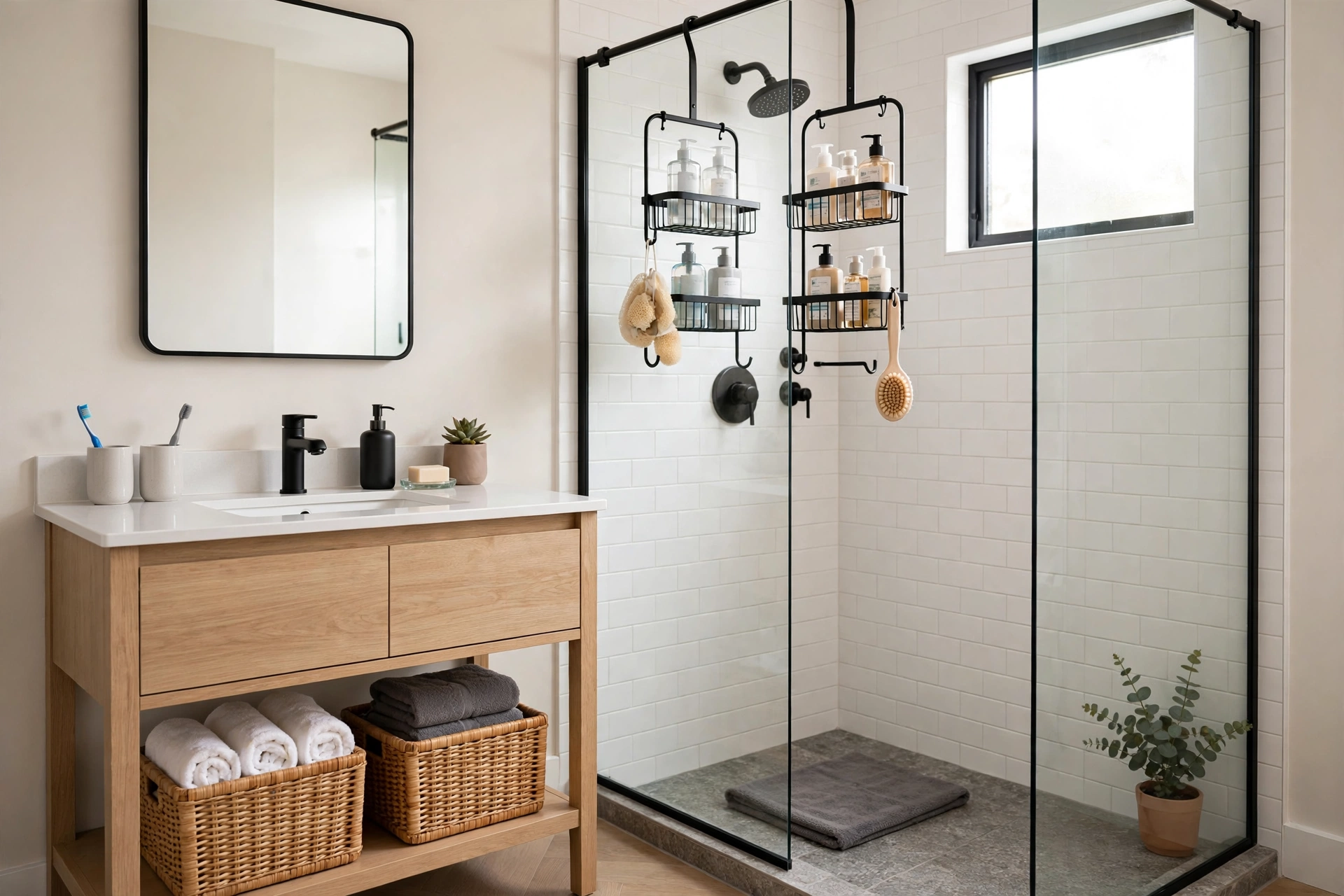
18. Give the Bathroom Two Caddies
Studio bathrooms are small, and two people’s toiletries will colonize every surface without a system. Two shower caddies (one per person) plus two small under-sink bins keep products separated and the counter clear. Hanging shower caddies run $15–$25 each; stackable under-sink bins cost $10–$18 for a set. Pro tip: if there’s only one medicine cabinet, add a small mirrored cabinet ($40–$70) on the adjacent wall — doubling mirror storage ends the morning bottleneck for couples on the same schedule.
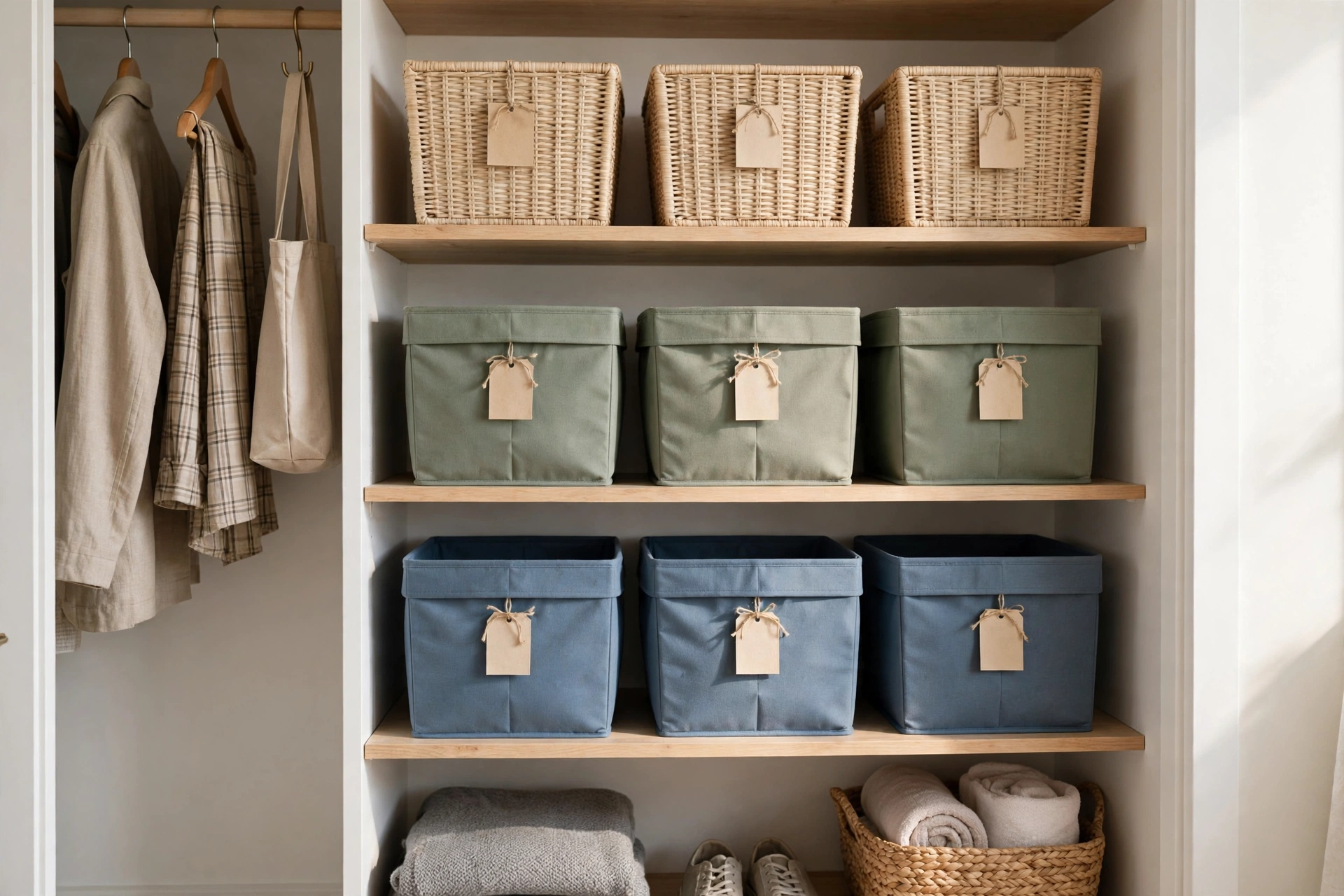
19. Label Bins to End the “Where Is My…” Wars
In a shared studio, unlabeled storage becomes nobody’s responsibility — and everybody’s frustration. A $10 label maker (or $5 for chalk labels) turns anonymous bins into a system: “His cables,” “Her craft supplies,” “Shared tools.” It sounds fussy; in practice, it’s the difference between a tidy apartment and a daily scavenger hunt. Pro tip: label the inside categories too — a bin labeled “chargers” with a divider for “his” and “hers” prevents the tangle of identical white cables, a small win covered in more depth by these clever studio storage ideas.
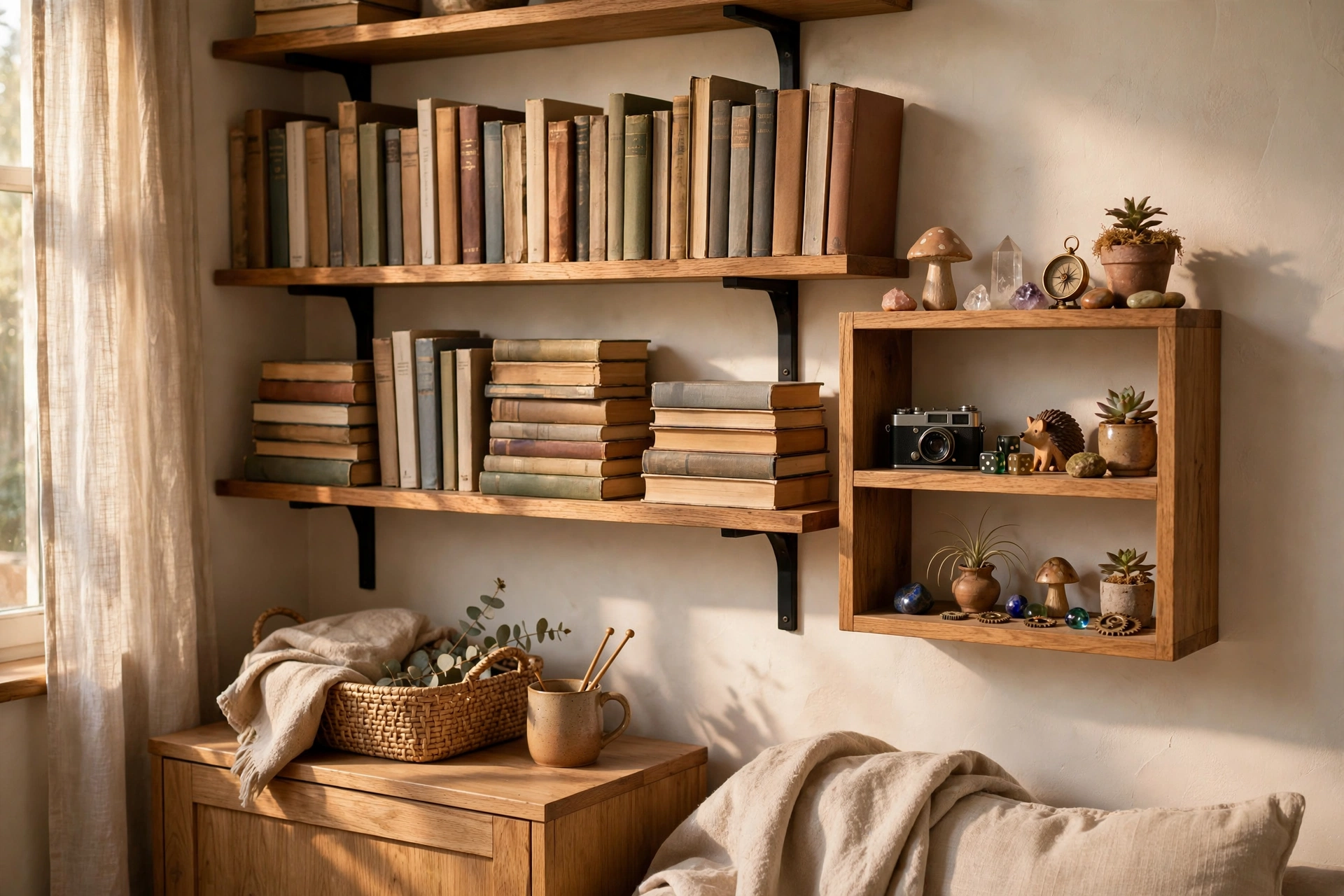
20. Mix Shared Shelves With Personal Shelves
Not everything needs to be communal. Designate the living-zone shelves as shared (books you both read, decor you both chose) and give each partner one personal shelf — for trophies, collections, hobbies the other doesn’t share. A small wall shelf costs $15–$30; the relationship value is much higher. Pro tip: the personal shelf is sacred ground — no “suggestions” about what belongs there. Respecting it builds the trust that makes the shared spaces work.
Alone-Time Corners
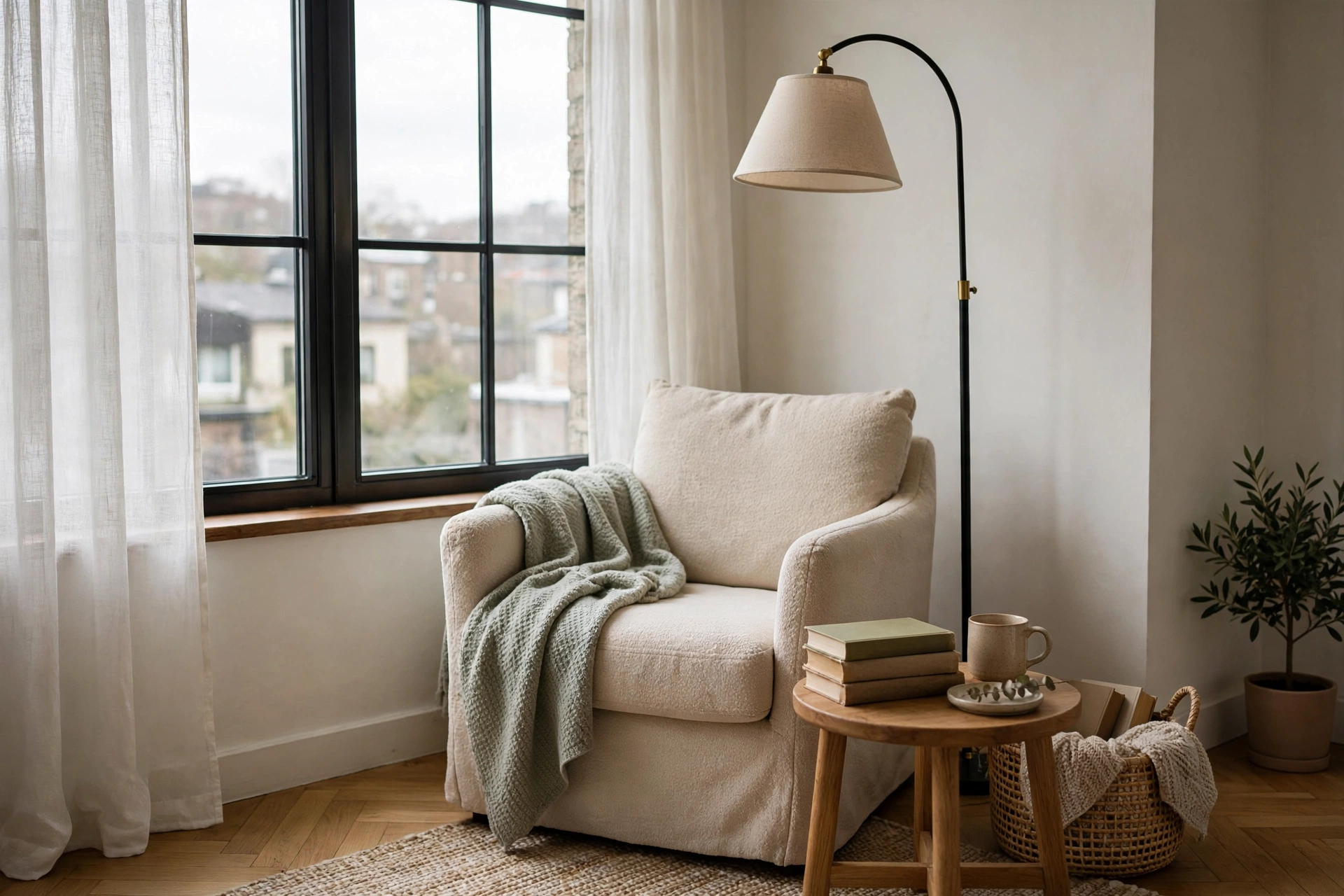
21. Carve Out a Reading Nook for One
Even the happiest couples need solo recharge time, and in a studio that means a deliberate one-person spot: a comfortable chair, a good lamp, and a small side table, tucked in a corner or by the window. A cozy reading chair runs $120–$250; a floor lamp $40–$80. Pro tip: establish the social rule that the nook means “recharging” — when someone’s in the chair with a book, the other gives space. The chair only works if the boundary is respected.
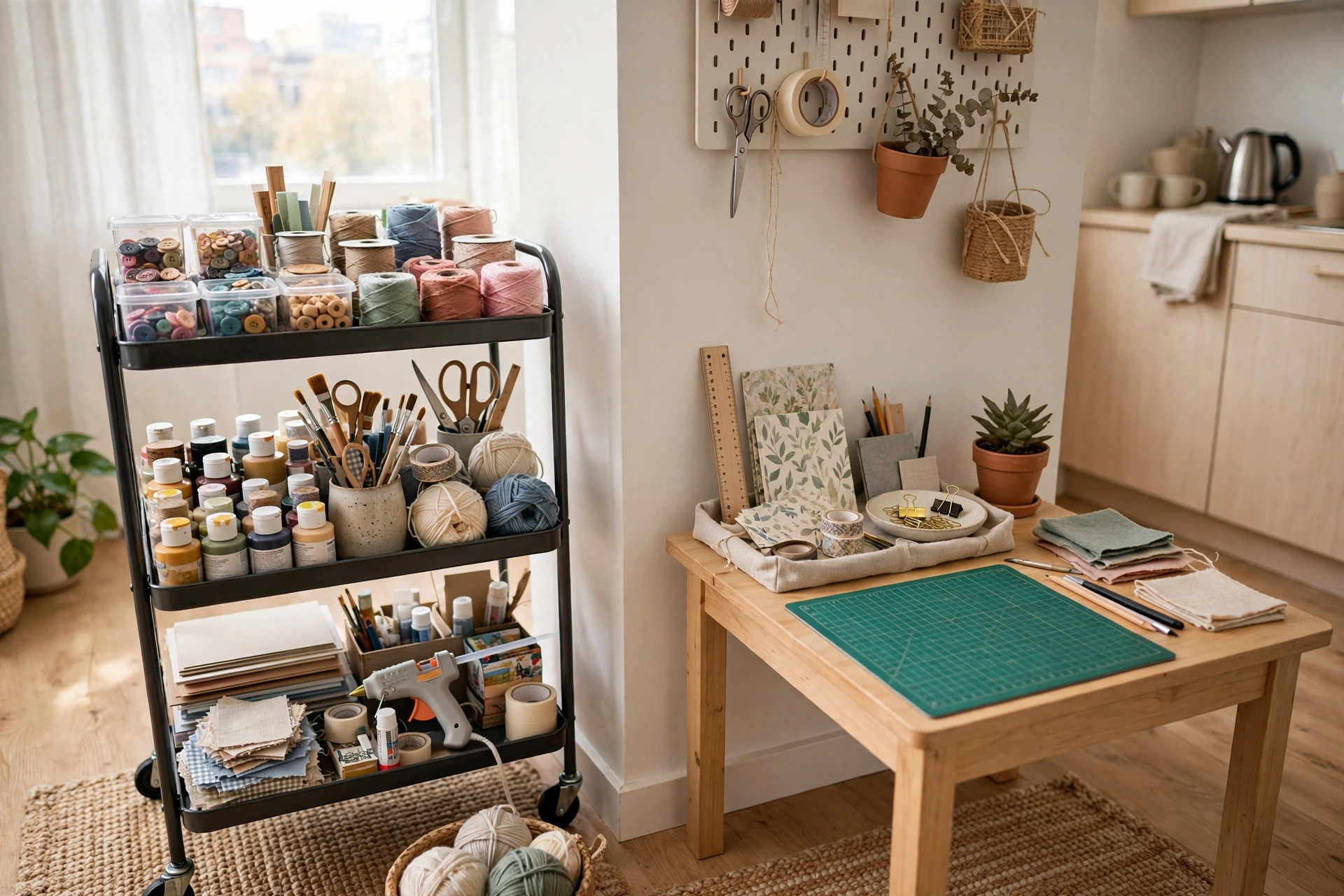
22. Make Room for One Solo Hobby Corner
His gaming setup, her sewing corner, their shared nothing — every couple has at least one hobby the other doesn’t share, and it deserves a real home rather than the dining table. A 3×3-foot zone with the right storage (a rolling cart, $30–$50, is perfect) keeps the hobby contained and the apartment peaceful. Pro tip: contain the hobby’s footprint with a rug or mat — the visual boundary says “this is the hobby zone,” and it makes cleanup a two-minute job instead of an apartment-wide event.
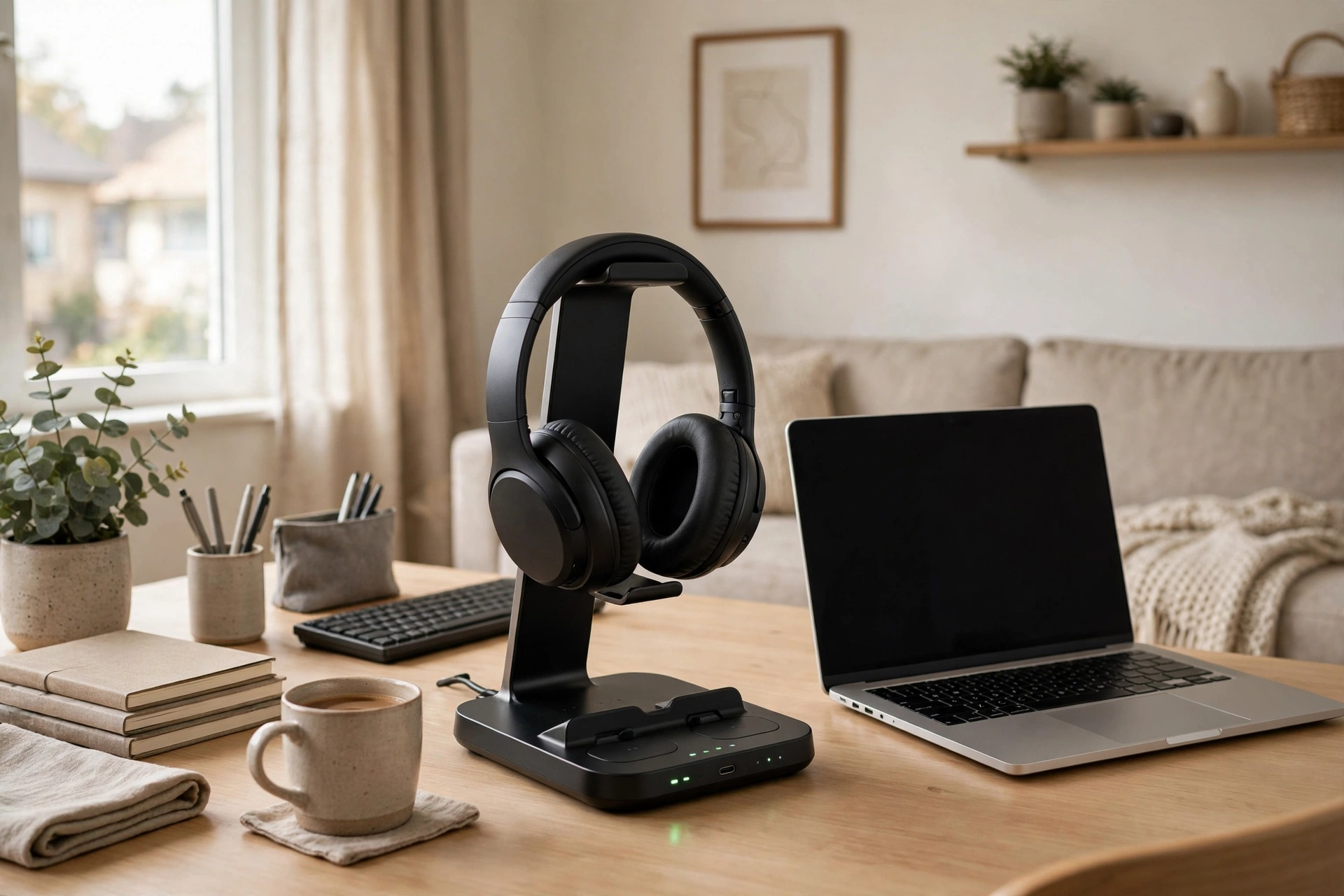
23. Create a Headphone Station
Sound is the invisible roommate in a studio — one person’s music, calls, or gaming audio is the other person’s noise. A dedicated headphone station (a hook by each desk plus a shared charging spot, $15–$25 for a headphone stand with USB charging) normalizes the “I’m putting headphones on” signal. Good noise-cancelling headphones run $100–$250 but pay for themselves in harmony. Pro tip: agree on headphone etiquette early: headphones on means “don’t interrupt unless urgent.” It’s a tiny rule that prevents a thousand micro-annoyances.
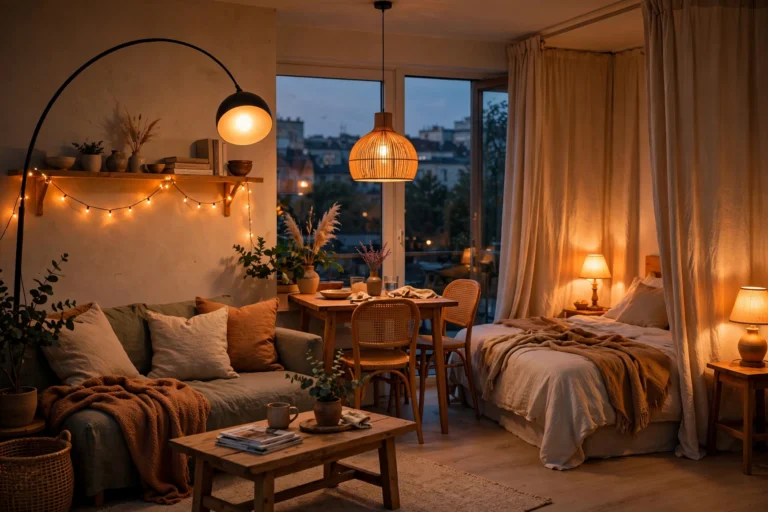
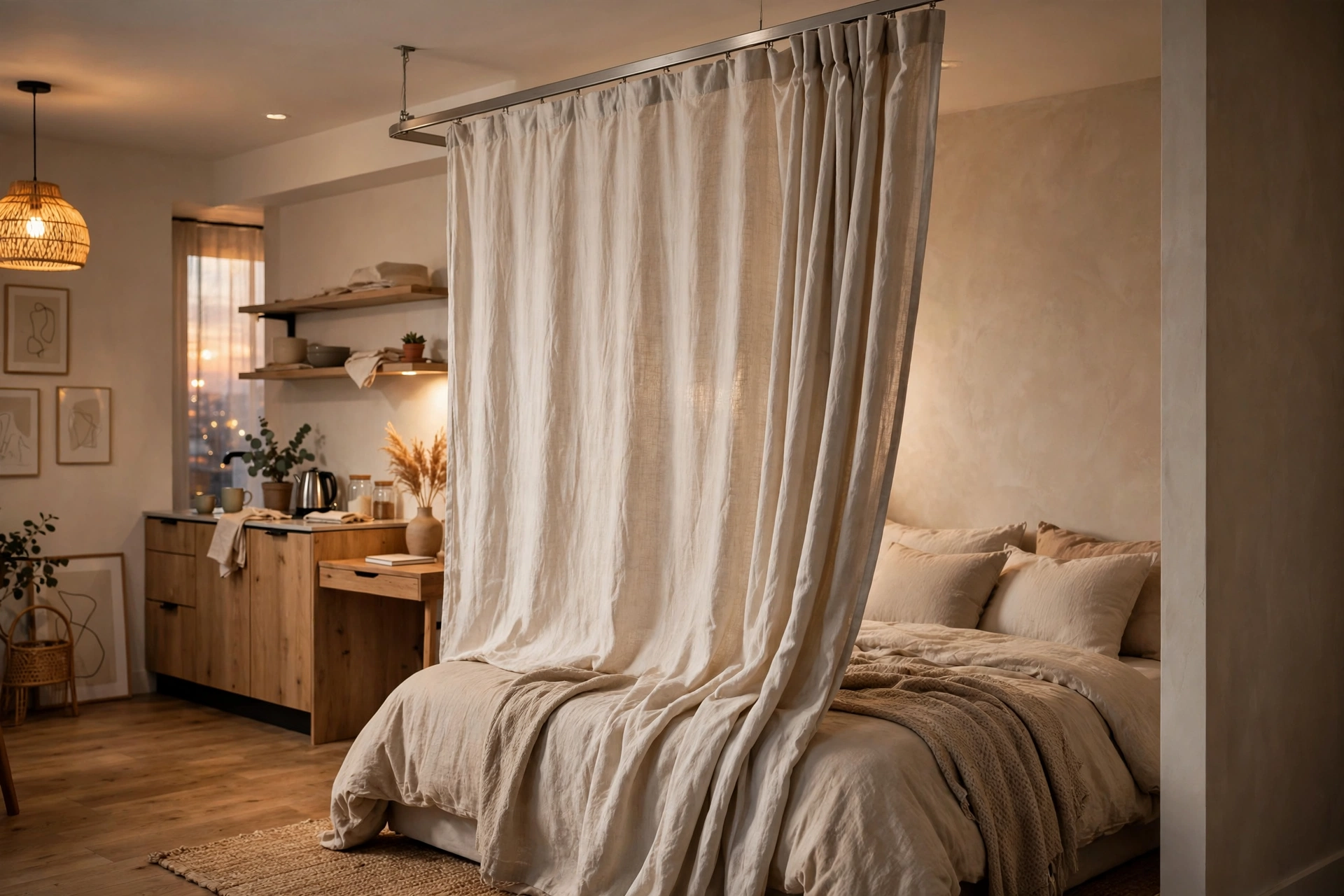
24. Hang a Curtain Divider for “Me Time”
Sometimes alone time needs a visual boundary, not just a chair. A ceiling-mounted curtain on a track ($40–$70 for track plus panels) can close off the sleeping zone or a corner in seconds — one partner gets genuine privacy for a nap, a call, or just quiet, while the other keeps the living zone. Pro tip: choose a soft, opaque fabric in a neutral tone so the divider feels like design, not a wall of separation — and pair it with the zoning strategies in these studio apartment layout ideas for maximum flexibility.
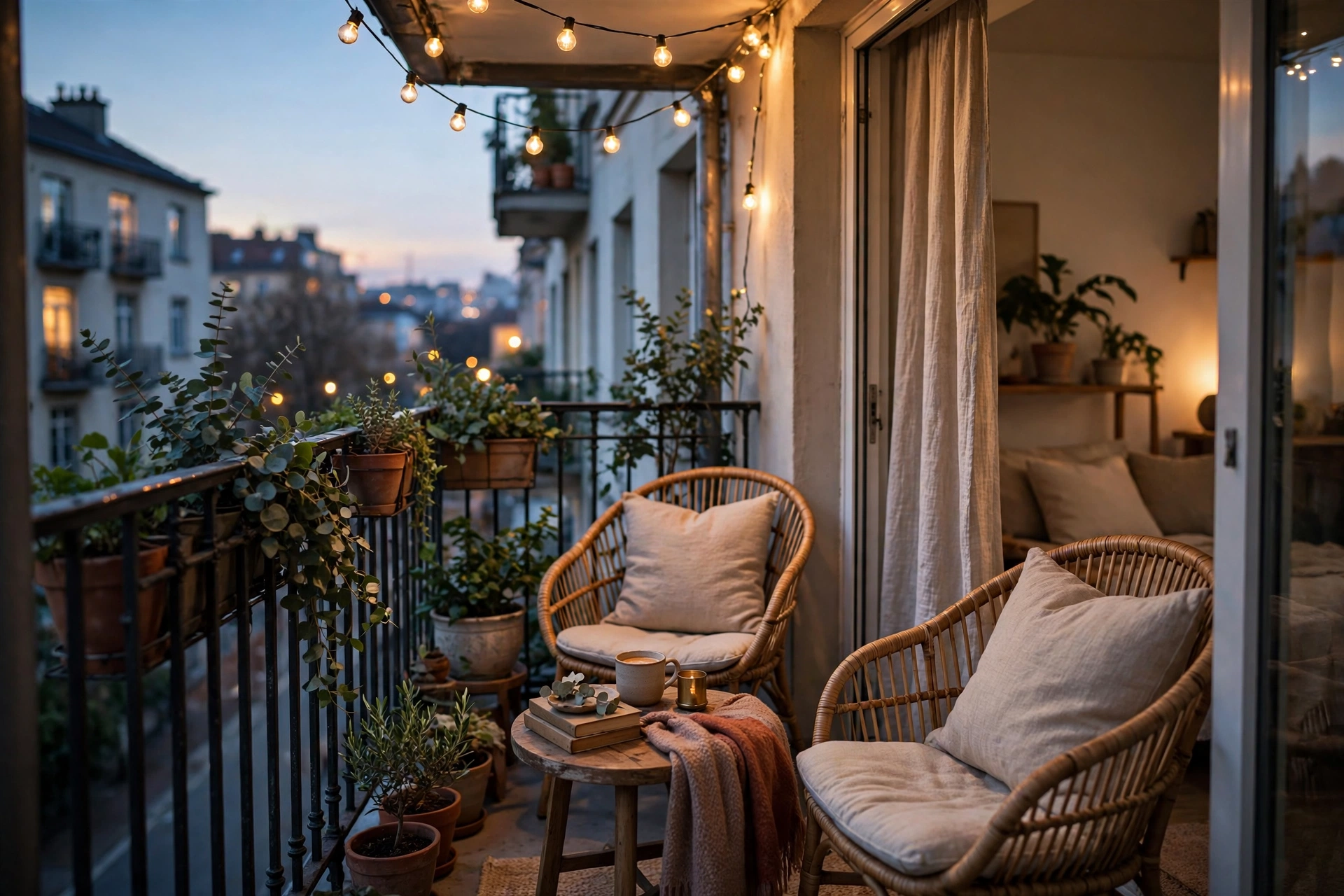
25. Treat the Balcony as a Second Room
If your studio has a balcony, patio, or even a deep windowsill, treat it as gold: it’s the only “other room” you have. Two small chairs and a side table ($80–$150 total) create an escape pod for morning coffee alone or evening wind-down while the other cooks inside. Add an outdoor rug and string lights for year-round appeal. Pro tip: even a tiny Juliet balcony fits a fold-down rail table ($30–$50) — one person, one coffee, one railing, and suddenly the studio feels twice as big.
Romantic Touches & Daily Life
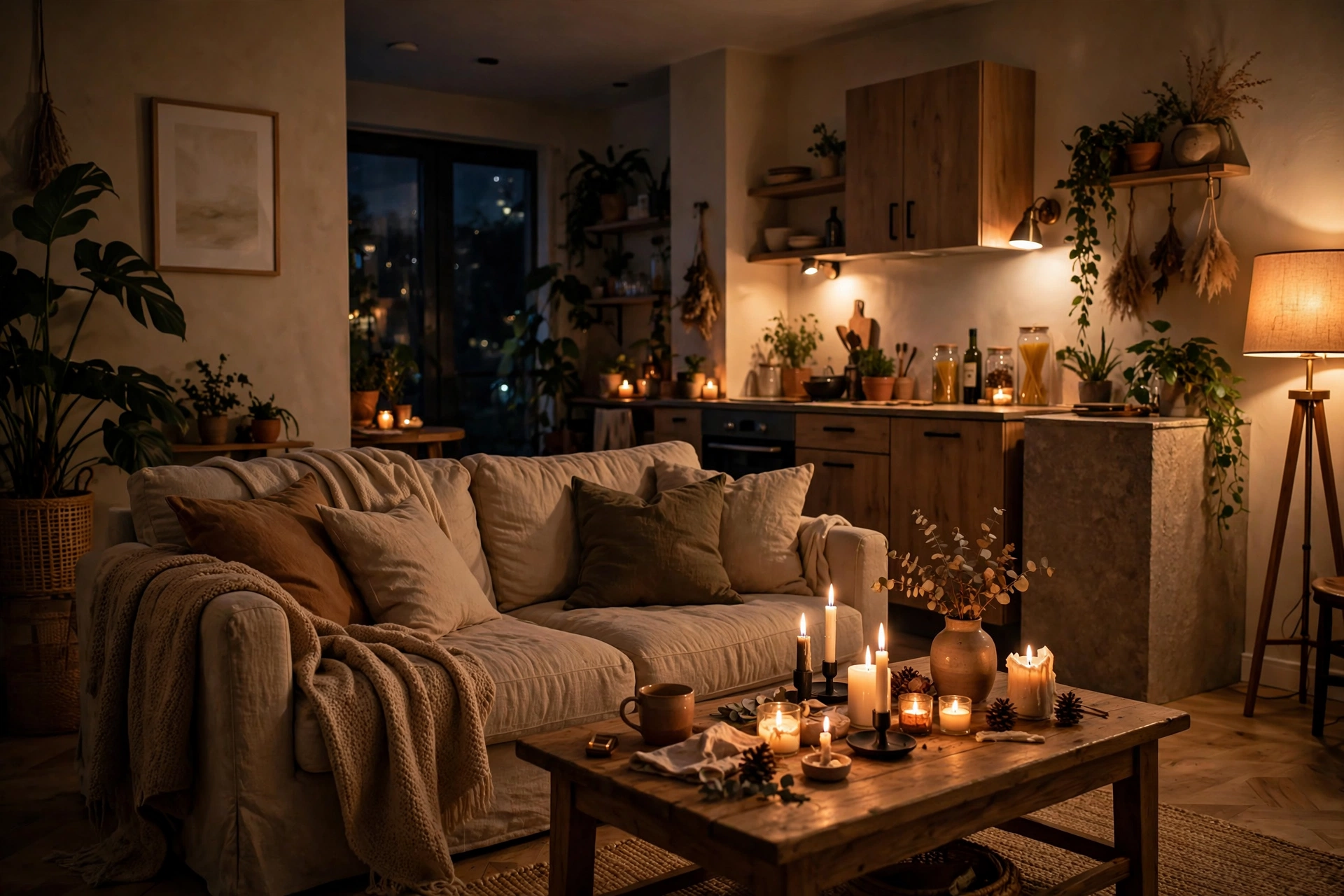
26. Install Dimmer Switches for Instant Romance
Overhead lighting at full blast kills romance faster than anything in a studio — and you’re always in the same room as the light. Dimmer switches ($15–$25 each, renter-friendly plug-in versions exist) on the living-zone lamps let you drop from “cleaning mode” to “date-night mode” in seconds. Pair with warm 2700K bulbs everywhere. Pro tip: smart bulbs ($10–$15 each) are the renter’s dimmer — no wiring, app-controlled scenes like “movie night” and “dinner,” and each partner can control them from their phone.
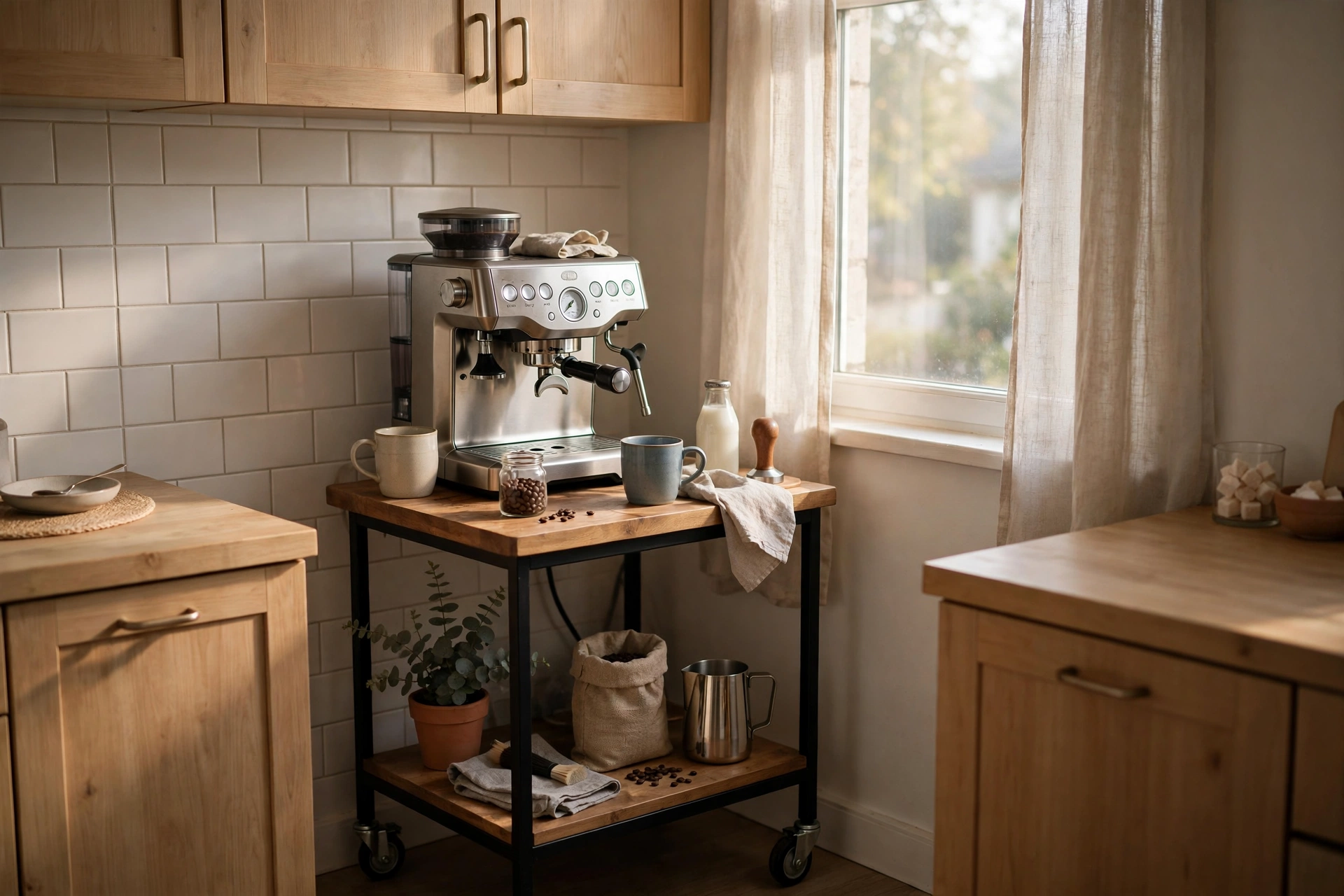
27. Build a Shared Morning Coffee Station
The first 20 minutes of the day set the tone — and in a studio, you’re sharing them in about 40 square feet of kitchen. A dedicated coffee station (a small cart or a counter corner with the machine, mugs for two, and supplies) turns the morning shuffle into a ritual instead of a traffic jam. A rolling cart costs $35–$60; two favorite mugs, priceless. Pro tip: set it up the night before together — grinding beans, filling the water. The two-minute evening ritual becomes a small daily moment of teamwork.
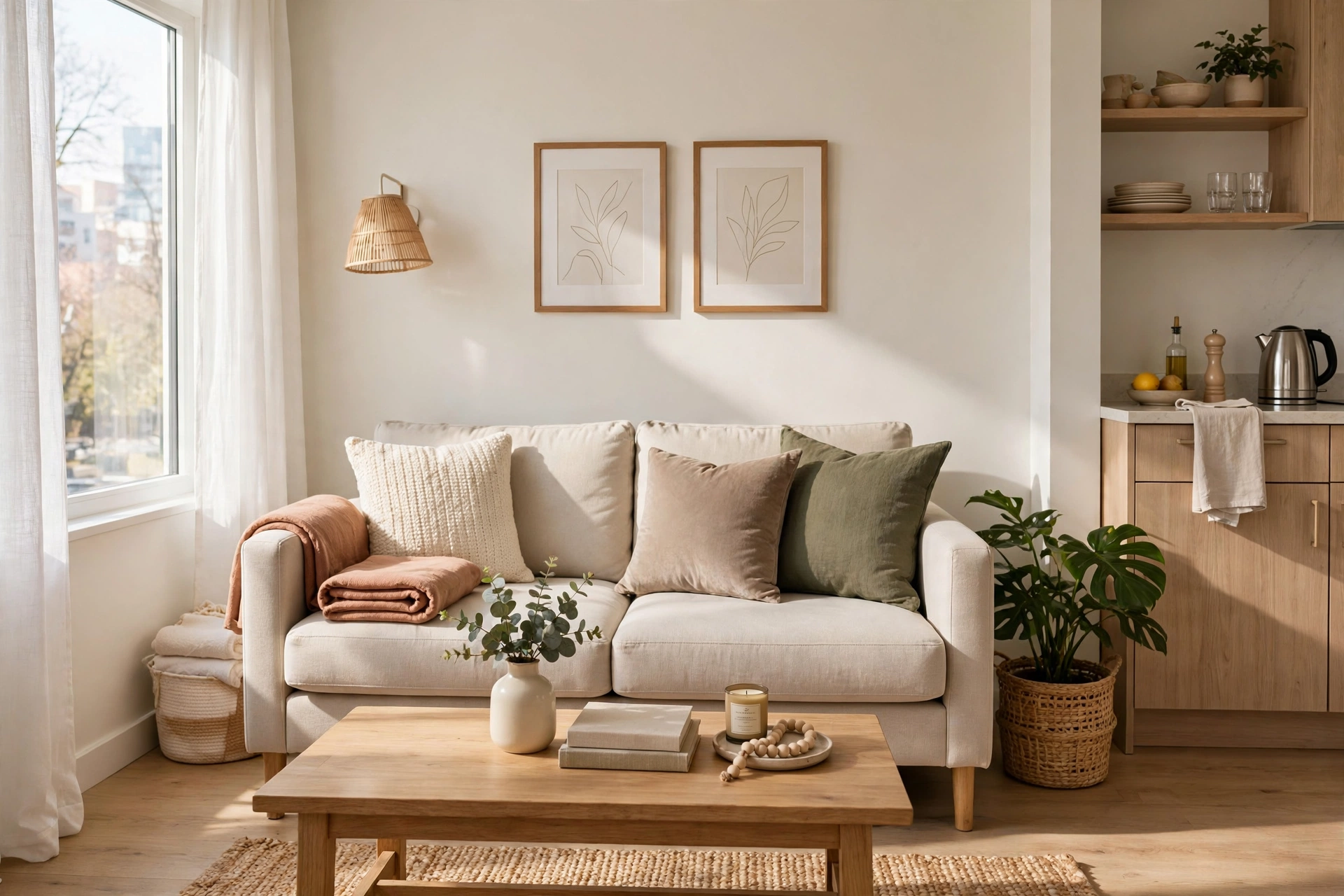
28. Stay Guest-Ready in 15 Minutes
Couples host together, which means the studio needs to flip from “lived-in” to “guest-ready” fast. The system: a lidded basket per zone for quick clutter sweeps ($12–$20 each), bedding that looks made with one throw pull, and a bathroom caddy that hides in a cabinet. Practice the 15-minute reset together once — it becomes a game, not a chore. Pro tip: keep a spare set of guest towels and a folded throw blanket in one dedicated spot — when friends text “we’re nearby,” you’re hosts, not panickers.
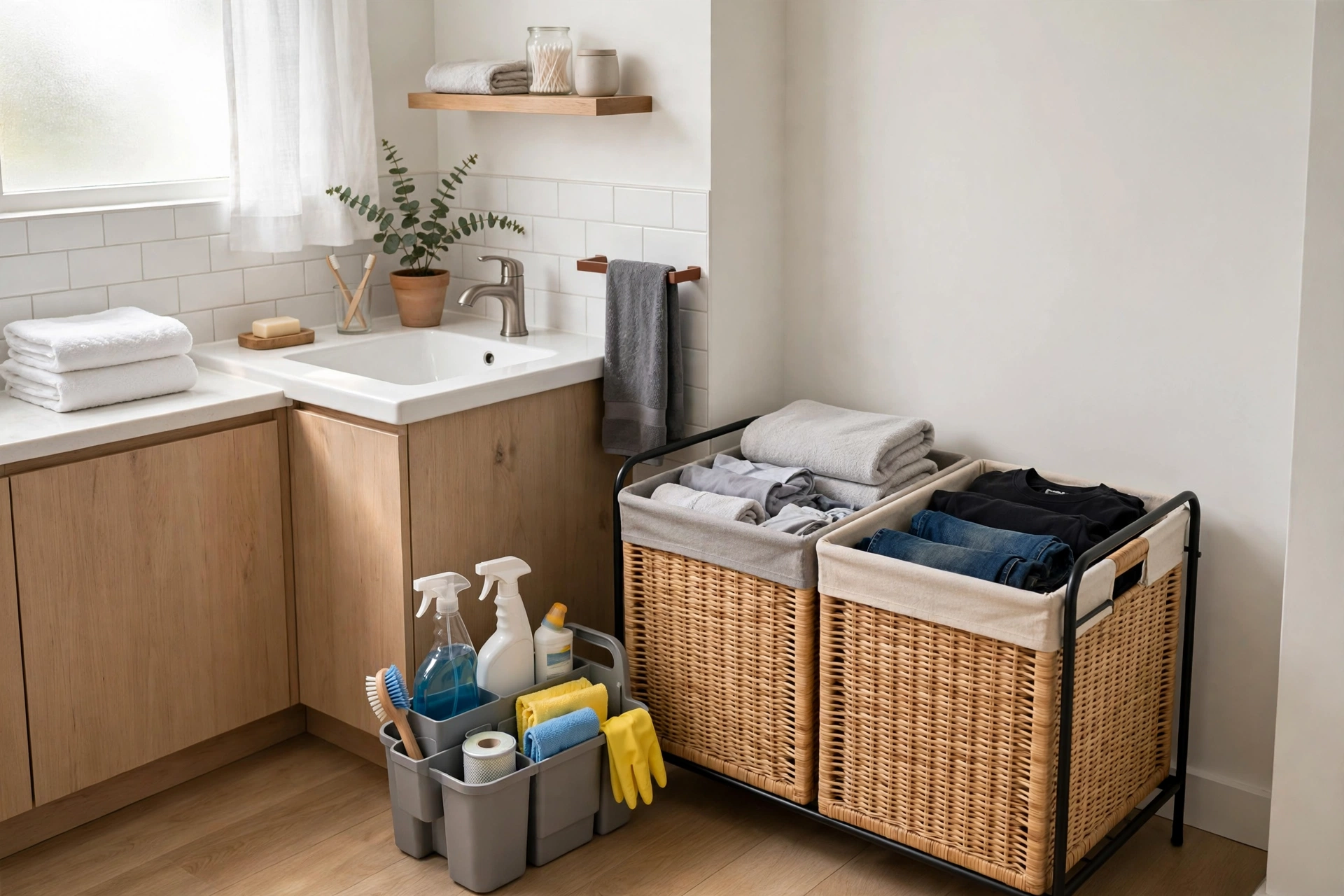
29. Design a Chore Zone That Both of You Use
In a one-room home, chores are unavoidably visible — and unavoidably shared. Design for it: a slim laundry hamper with two compartments ($30–$50), cleaning supplies in one caddy under the sink (not scattered), and a small folding drying rack that lives in the bathroom. Visible systems get used; hidden messes get ignored. Pro tip: split chores by preference, not by tradition — the partner who hates dishes but doesn’t mind laundry takes laundry. Chore harmony in a studio is 90% playing to strengths.
30. Create a Memory Wall of Shared Moments
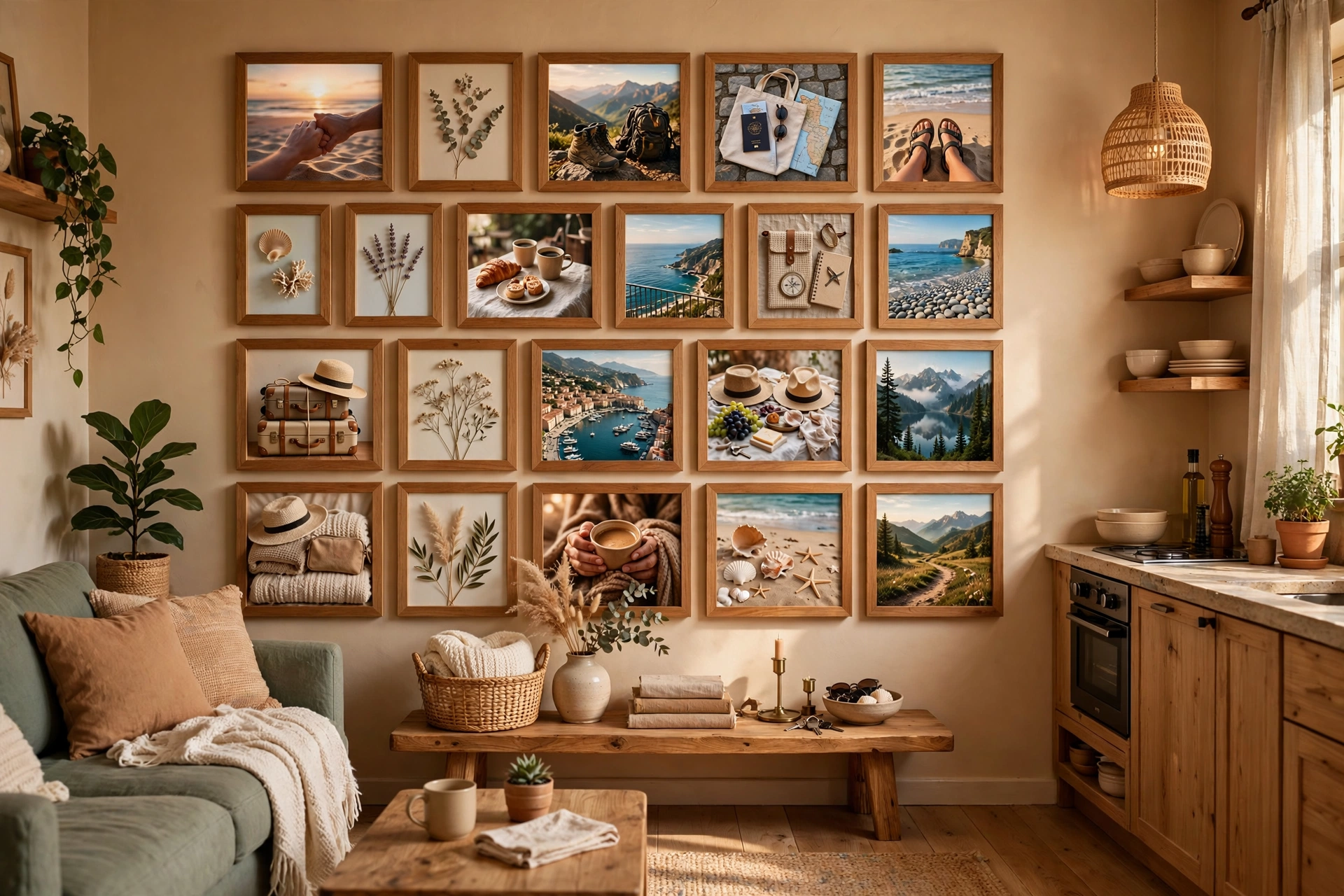
The most romantic thing in a couple’s studio isn’t furniture — it’s proof of the life you’re building together. Dedicate one small wall (or even the inside of the entryway) to framed photos, ticket stubs, and mementos: the trip, the concert, the adoption-day photo of the cat. A set of matching small frames costs $20–$40; the daily reminder of why you chose this tiny apartment together is free. Pro tip: leave intentional empty space on the memory wall — a wall that’s “still growing” feels hopeful, and adding to it together becomes its own little ritual.
Frequently Asked Questions
How do couples survive living in a studio apartment?
With systems, not just love: defined storage per person, agreed quiet hours, two work spots if you both work from home, and at least one solo recharge corner. The couples who thrive in studios treat the space like a shared project — weekly 10-minute tidy-ups, honest conversations about friction points, and design choices that give both people equal ownership of the space.
What size bed is best for a couple in a studio?
A queen works for most couples in studios under 500 square feet — it’s the best balance of sleep comfort and floor space. If your studio is larger and the sleeping zone can spare 76 inches of width, a king genuinely improves sleep quality for two. Couples with very different sleep needs (temperature, firmness, schedules) should also consider the split-duvet method or even two twin XLs pushed together.
How can two people work from home in a studio apartment?
You need two distinct workstations facing away from each other — even if one is a fold-down wall desk. Add noise-cancelling headphones for each person, agree on meeting schedules (a shared calendar blocks surprises), and use a bookshelf or curtain as an acoustic divider. Staggering deep-work hours so one person takes calls while the other does focused work also helps enormously.
How do couples compromise on decor style?
Use the 70/30 rule: one partner’s (usually calmer) style leads most of the space, the other gets bold accent territory. Build a shared color palette before buying anything, keep big-ticket items neutral, and give each person full control of their personal zones. Rotating statement pieces seasonally lets both tastes shine without permanent commitment.
Where does each person get alone time in a one-room apartment?
Designate micro-retreats: a reading chair in the corner, a hobby zone, the balcony, or a curtain-divided nook. Noise-cancelling headphones create instant mental privacy anywhere. The key is the social contract — when someone is in their spot with headphones on or a book open, the other respects it. Many couples also stagger schedules so each gets regular solo time at home.
How do couples split storage in a studio apartment?
Formally, not hopefully: divide the closet by real wardrobe size (not 50/50), split under-bed bins by person with color coding, give each partner an entry station and bathroom caddy, and label everything. Shared shelves hold communal items; each person also gets one personal shelf that’s entirely theirs. Revisit the split seasonally as needs change.
Final Thoughts
A studio apartment won’t test your love — but it will test your systems. The couples who are happiest in small spaces aren’t the ones with the most square footage; they’re the ones who designed for two from the start: two nightstands, two work spots, two storage zones, and one shared vision for the space. Every idea in this guide is really about the same thing — making sure both people feel at home in the same home.
Start with the sleep zone, since that’s where friction hits hardest, then work outward to storage and solo corners. And remember the secret ingredient no floor plan provides: talk about what’s working and what isn’t, early and often. A 400-square-foot studio with honest communication feels bigger than a 1,000-square-foot apartment without it.