43 Mid-Century Modern Studio Apartment Ideas for Timeless Style
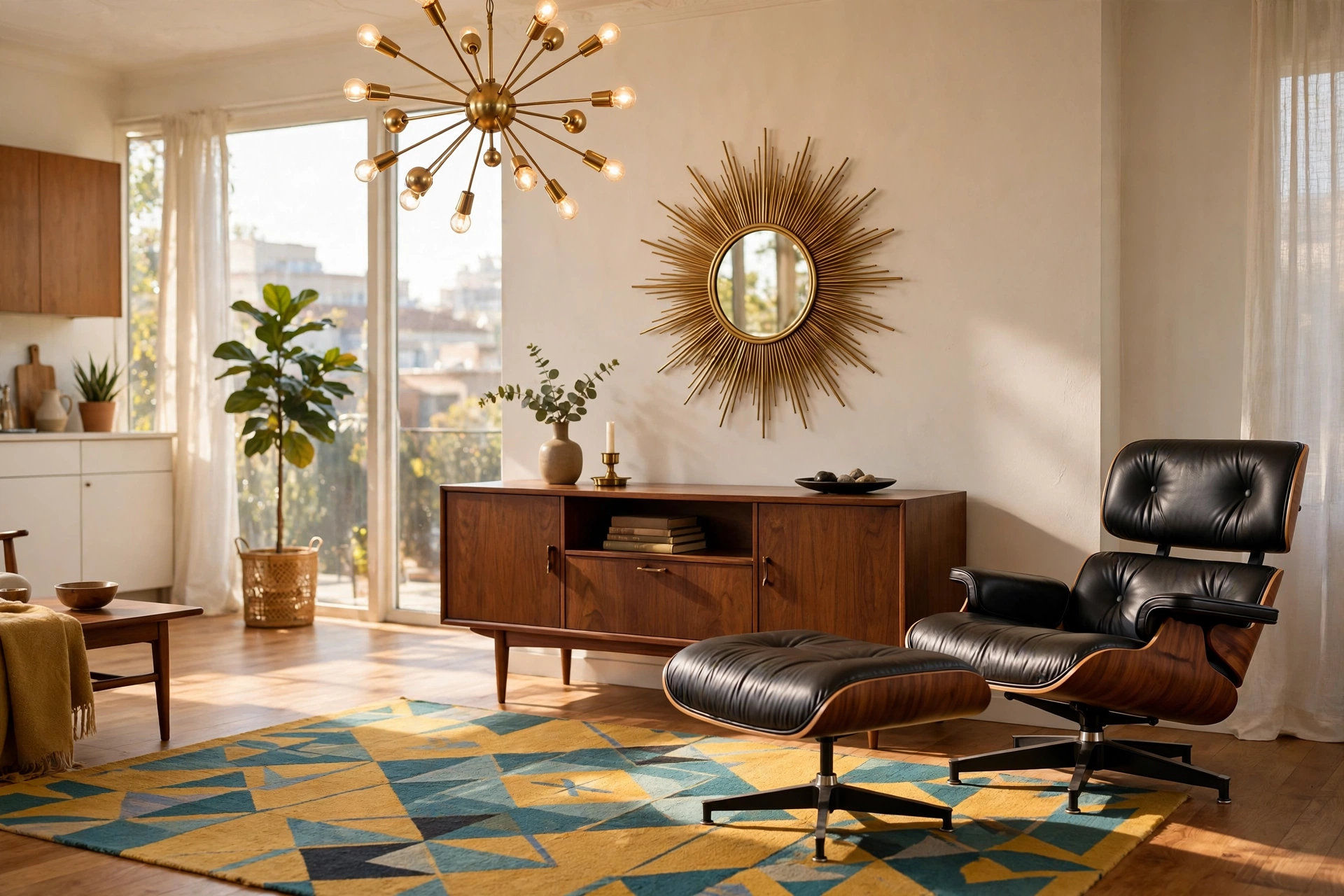
Mid-century modern is the style that made small spaces cool — born between 1945 and 1969, when designers like Charles and Ray Eames, Eero Saarinen, and George Nelson reimagined furniture for real postwar life: compact homes, open plans, and rooms that had to work hard. Clean lines, organic curves, tapered legs, and warm woods like teak and walnut aren’t just good-looking — they’re a small-space survival kit. Low profiles keep sightlines open, leggy furniture shows more floor, and every piece earns its footprint through beauty, function, or both.
This guide rounds up 43 mid-century modern studio apartment ideas that bring atomic-age style into one small room: design foundations, the iconic furniture pieces worth investing in, warm woods and natural materials, retro patterns and textiles, statement lighting and decor accents, and smart small-space strategies that keep the look airy. Every idea includes realistic prices and a pro tip, so you can build the look one piece at a time.
Mid-Century Foundations
1. Anchor the Room With an Eames-Style Lounge Chair
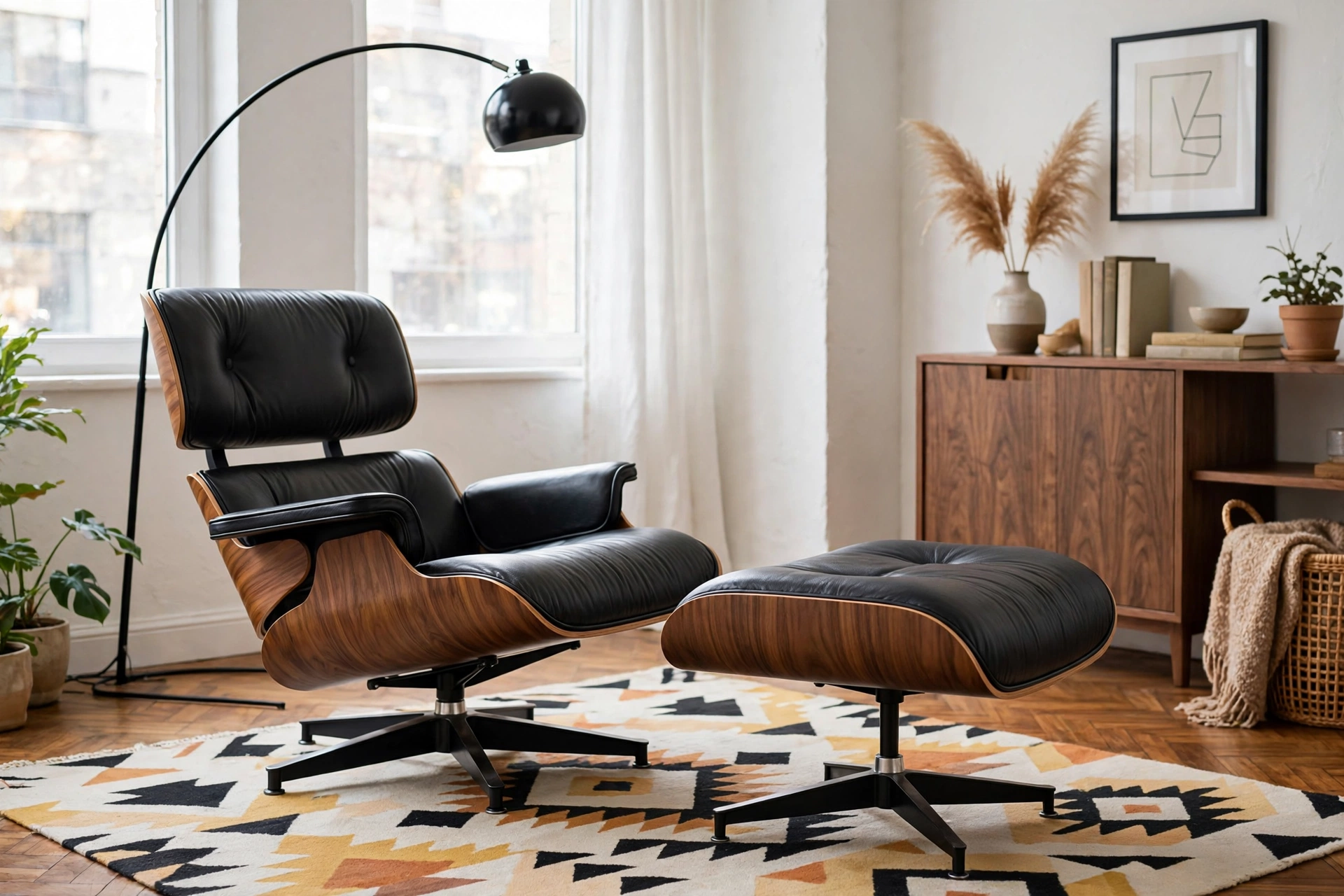
No piece says mid-century modern like the Eames lounge chair and ottoman — molded plywood shells, rich leather upholstery, and that unmistakable 1956 silhouette. Originals run $7,000+, but quality reproductions ($300–$800) capture the look and the legendary comfort. In a studio, one great chair in a corner with a floor lamp becomes a complete reading zone. Pro tip: buy the best reproduction you can afford — cheap versions sag within a year, while a solid mid-range one lasts a decade and holds its resale value.
2. Let Warm Walnut Wood Set the Tone
Walnut is the soul wood of mid-century modern — its deep chocolate-brown grain brings instant warmth to white walls and pale floors. A walnut coffee table, sideboard, or media console ($150–$600) anchors a studio’s palette the way nothing else can. If solid walnut is out of budget, walnut-veneer pieces deliver the same visual warmth for half the price. Pro tip: keep walnut pieces in the same undertone family — mixing red-walnut and gray-walnut finishes in one small room creates visual static instead of harmony.
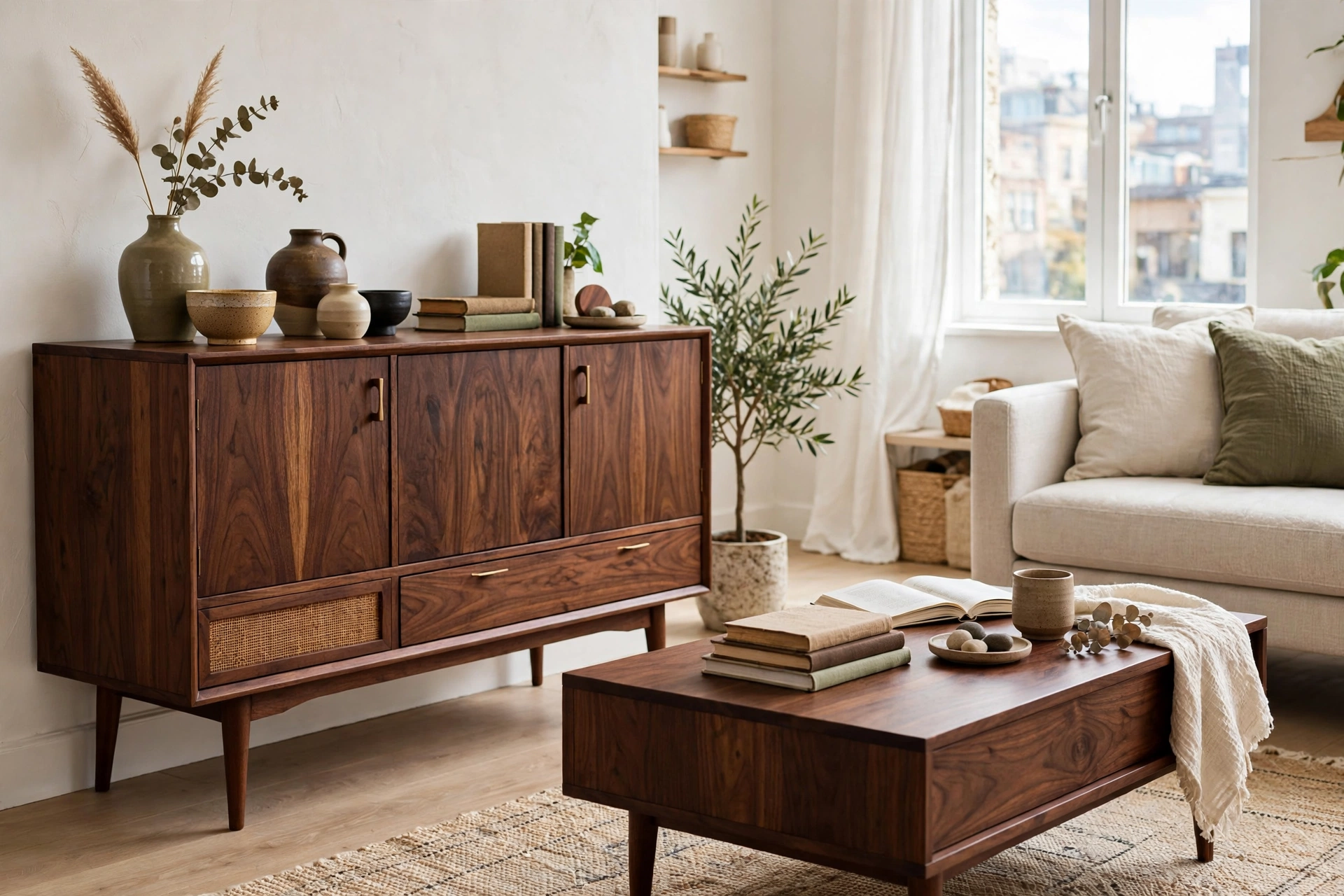
3. Hang a Starburst Wall Clock
George Nelson’s starburst clock is mid-century’s most joyful wall accent — radiating wood or brass rays around a simple face. Reproductions run $25–$60 and instantly telegraph the era on any blank wall. Hang one above a credenza or in the dining nook where it reads as art, not just a timepiece. Pro tip: choose a silent-sweep movement if the clock hangs near the bed — ticking starbursts are charming by day and maddening at 3 a.m.
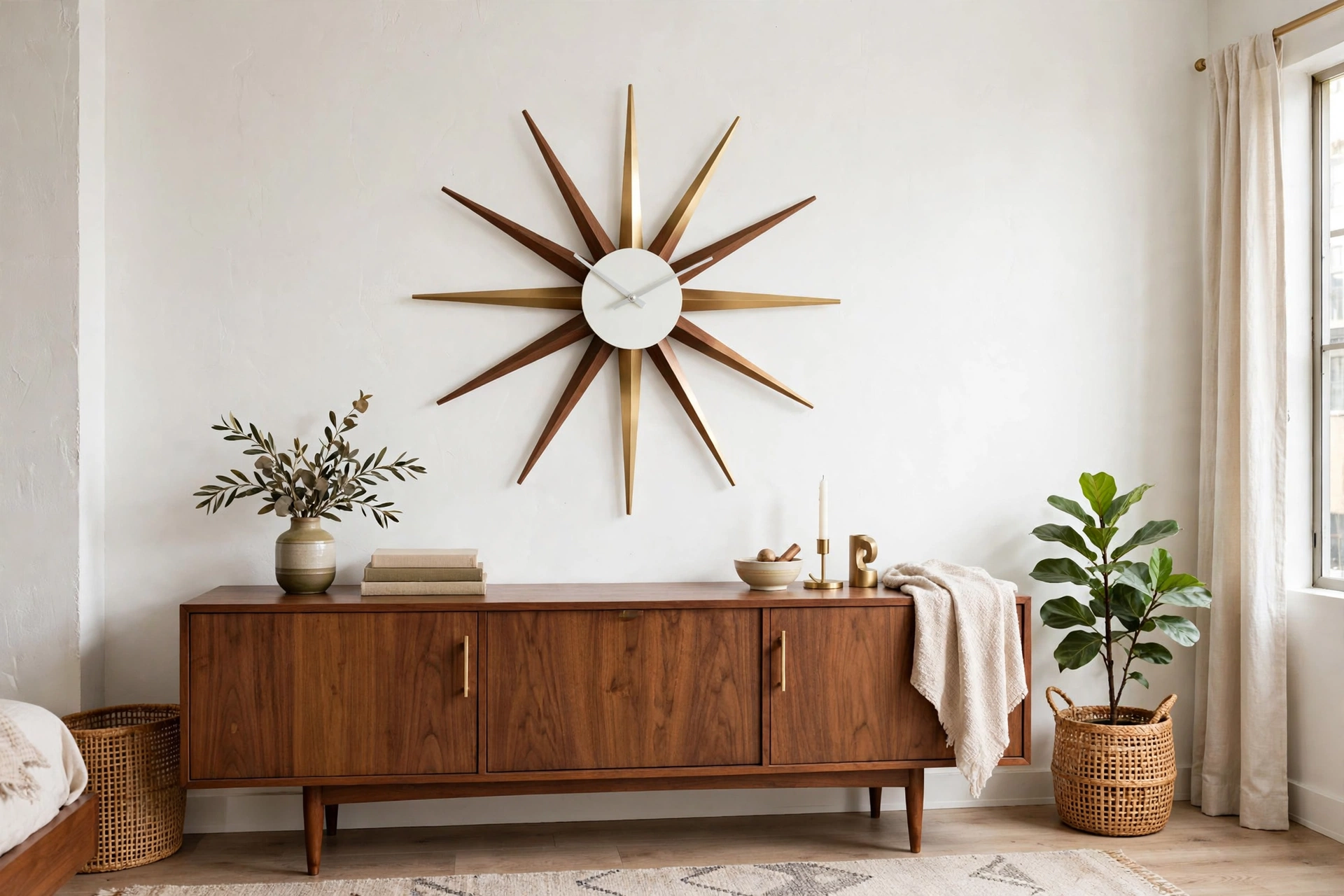
4. Ground the Room With a Geometric Rug
Mid-century rugs speak in geometry — atomic boomerangs, bold diamonds, abstract grids in mustard, rust, and teal. A 5×7 geometric rug ($80–$200) defines the living zone and sets the room’s entire color story. Pull your palette from the rug (a trick our studio apartment color schemes guide also recommends), and every later choice gets easier. Pro tip: in a studio, the rug should be large enough that the front legs of the sofa and main chairs sit on it — a floating postage-stamp rug shrinks the room visually.
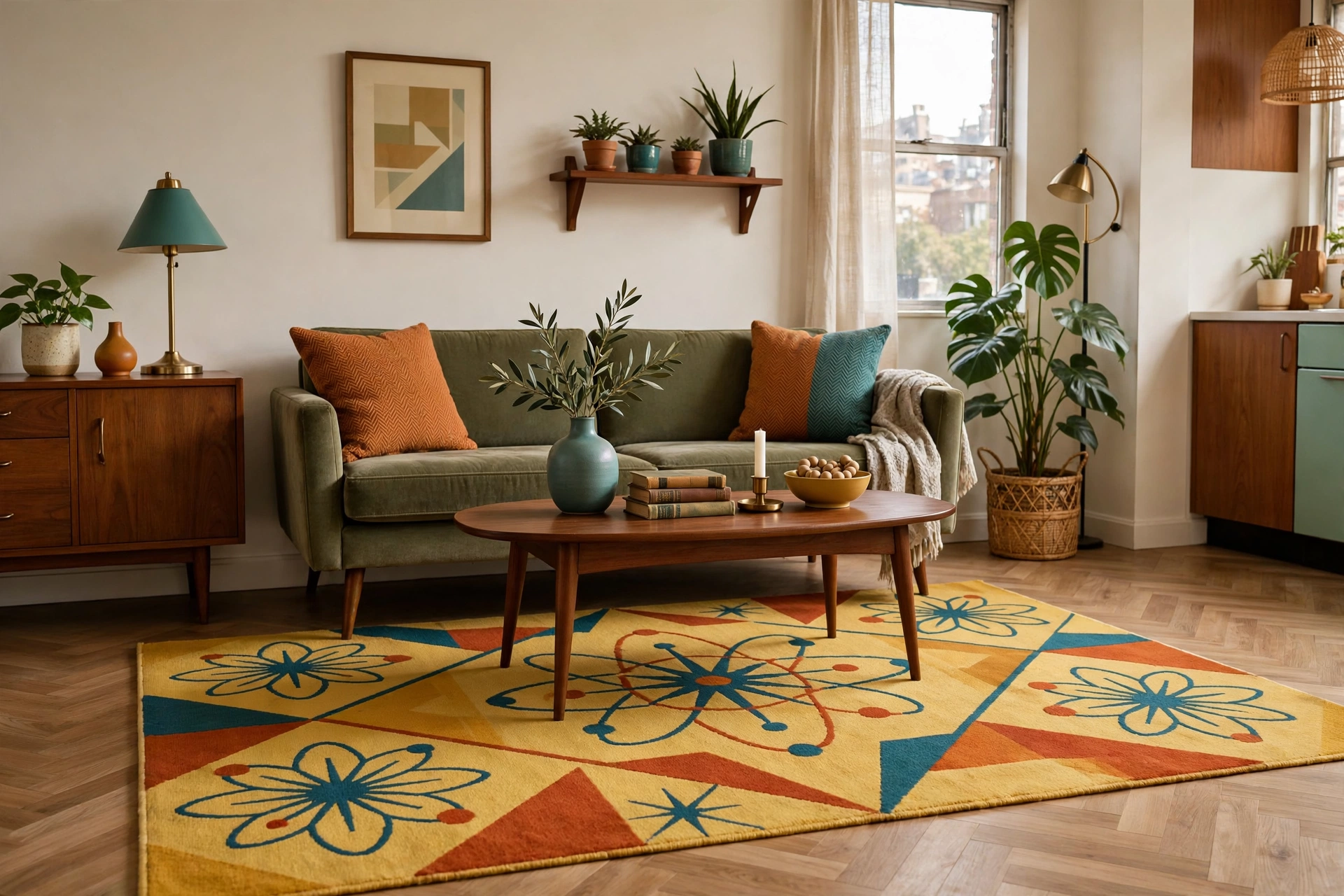
5. Choose Tapered-Leg Furniture Everywhere
The tapered peg leg is mid-century’s signature silhouette — sofas, chairs, dressers, and tables all raised on slim angled legs. Beyond the look, those legs are a small-space superpower: visible floor underneath makes every piece feel lighter and the room feel bigger. When shopping, favor pieces with 5–7 inches of clearance so light flows under them. Pro tip: tapered legs also make cleaning easier — a robot vacuum glides straight under mid-century furniture, which is more than you can say for skirted modern sofas.
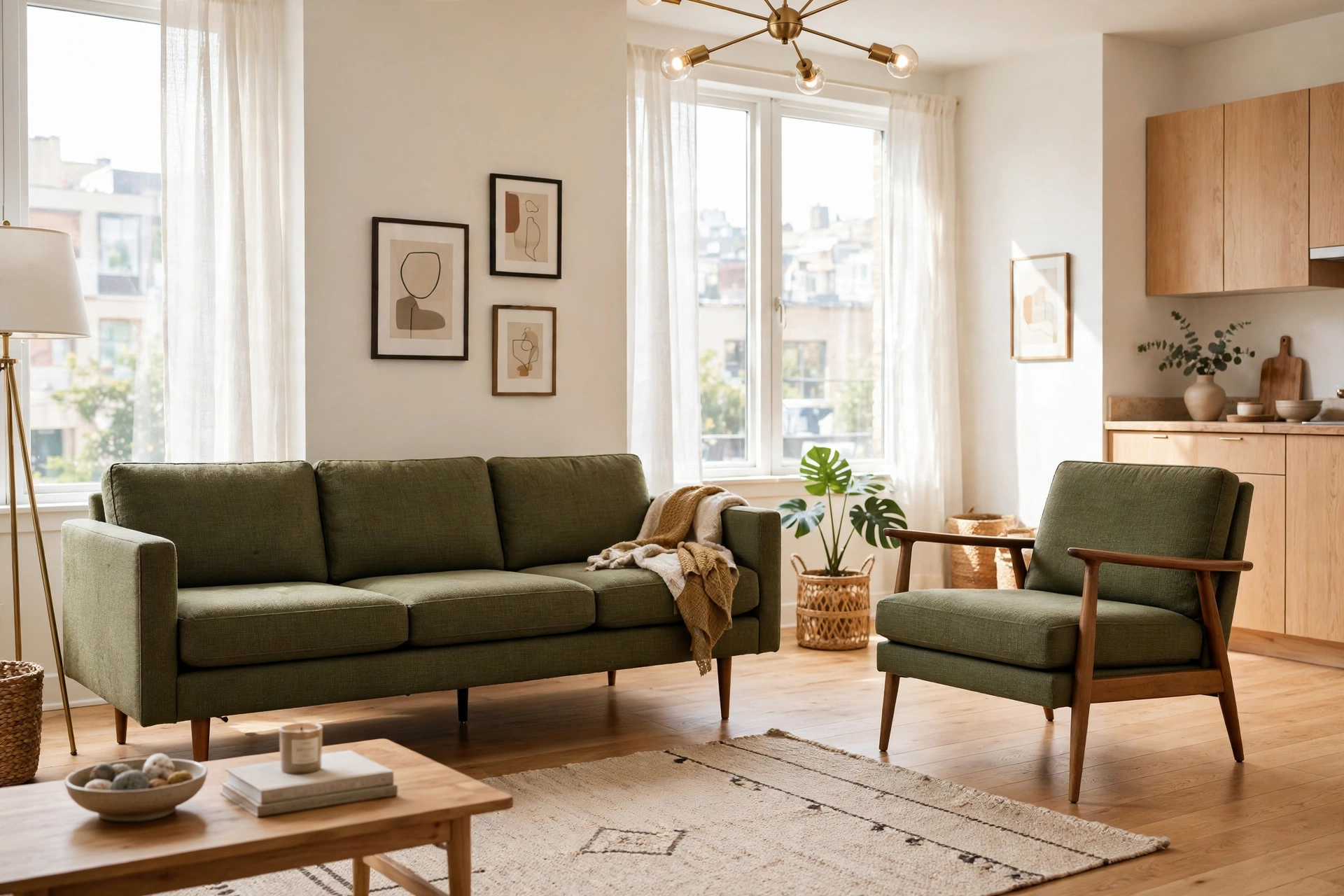
6. Embrace Atomic-Age Lighting Shapes
Mid-century lighting looked to the space age — sputnik chandeliers, saucer pendants, and globe clusters in brass and opal glass. A sputnik-style pendant ($60–$150) over the dining nook or reading corner is the single fastest way to declare the era. These sculptural fixtures double as ceiling art in studios with plain white ceilings. Pro tip: hang statement pendants 30–36 inches above tables — low enough to feel intentional, high enough to see under across the small room.
7. Reflect Light With a Sunburst Mirror
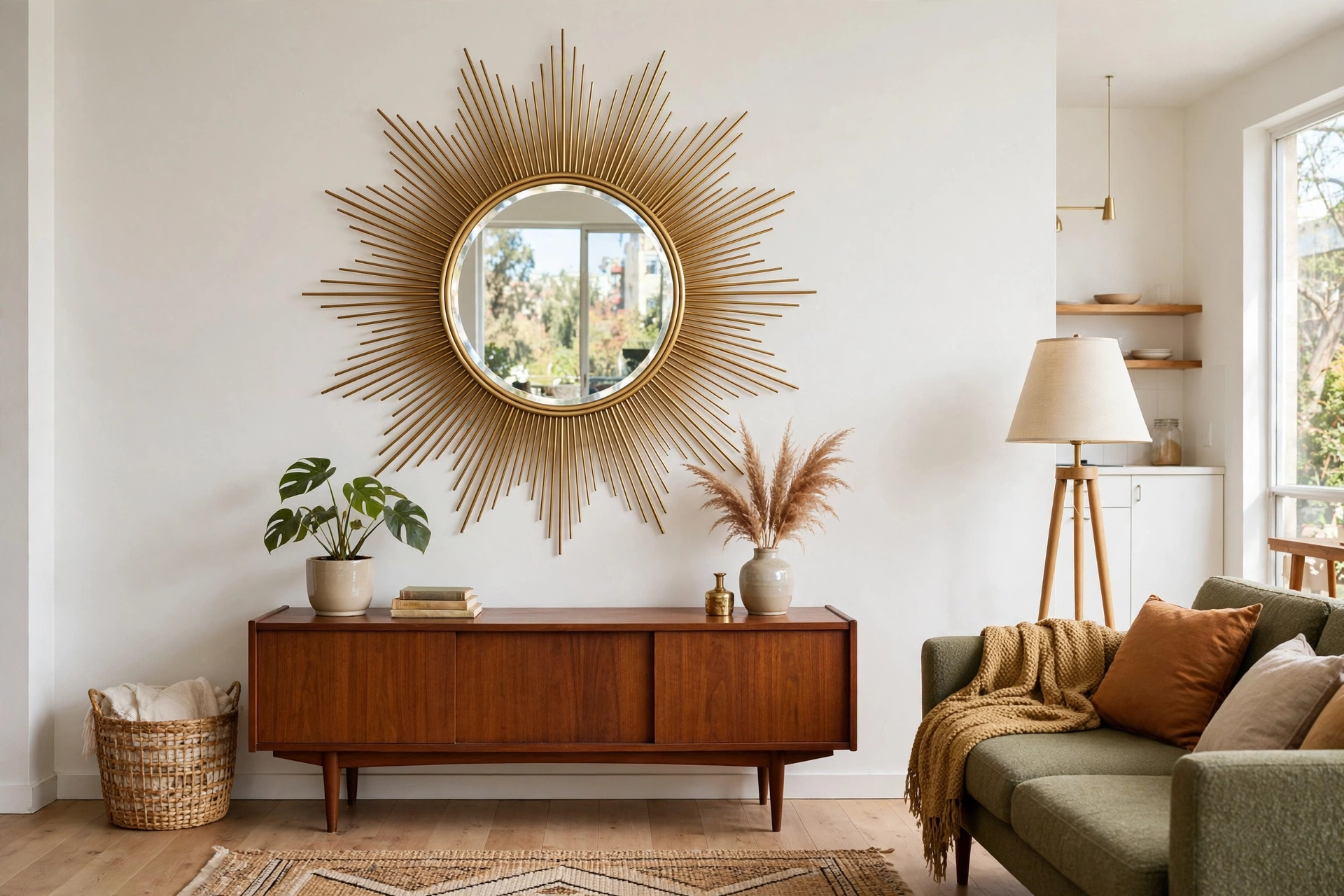
The sunburst mirror — rays of wood, brass, or rattan radiating from a round mirror — is mid-century’s answer to small dark walls. At $40–$100, it bounces light, adds sculpture, and fills a wall that a flat mirror never could. Hang one opposite a window to double your daylight. Pro tip: sunburst mirrors photograph beautifully for listings and socials, but live even better — angle yours to reflect the prettiest part of the room, never the clutter zone.
8. Warm Up With Teak Accents
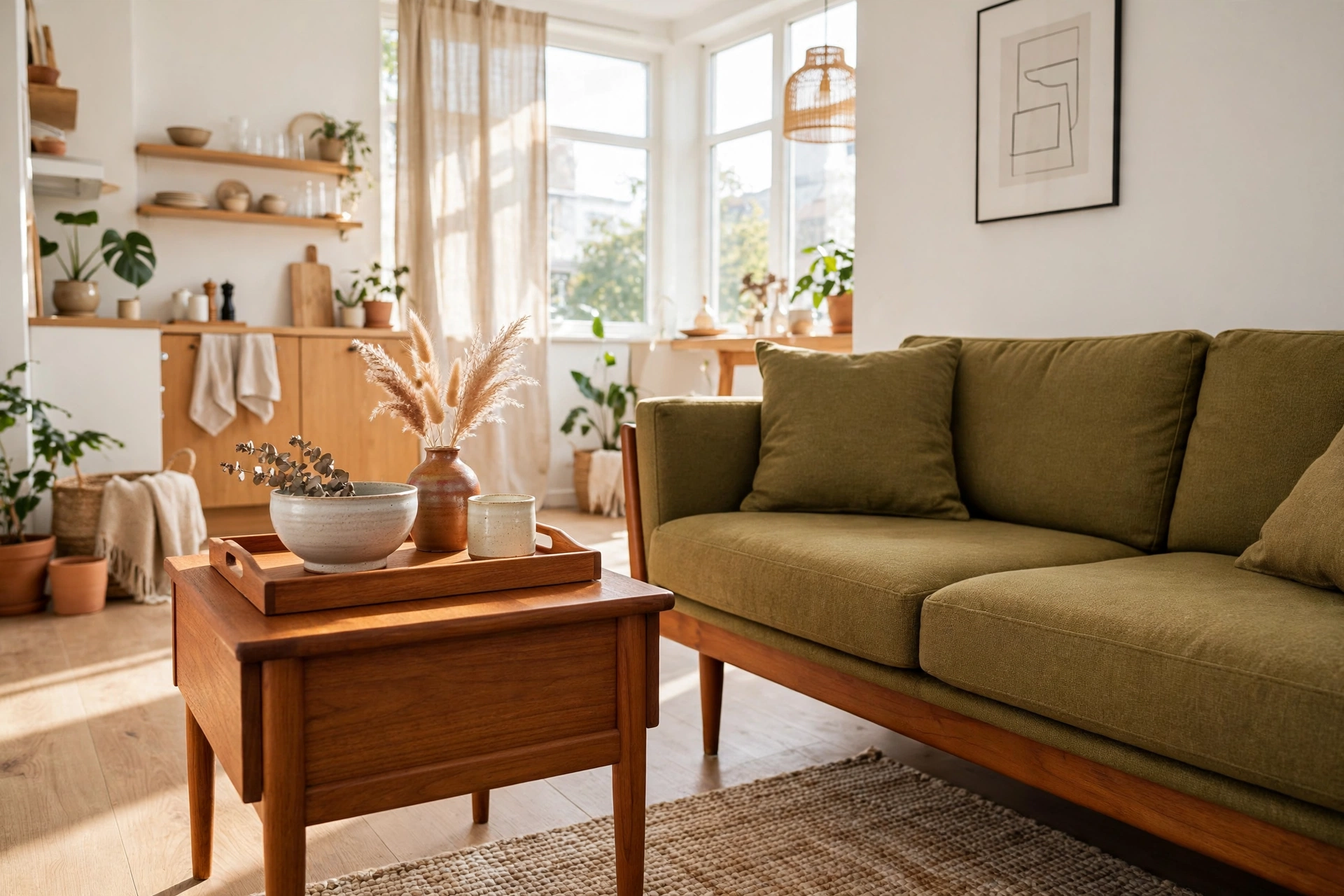
Teak is walnut’s lighter, honey-toned sibling — the wood of Danish modern dining sets and side tables. Teak trays, side tables, and small stools ($40–$120) add golden warmth without the visual weight of darker woods. A teak tray on the coffee table or a teak stool as a plant stand introduces the material in small, affordable doses. Pro tip: vintage teak often looks dry and gray — rub it with teak oil ($12) and the honey color floods back in minutes, making a $30 thrift find look like $300.
Iconic Furniture Pieces
9. Dine on Wishbone-Style Chairs
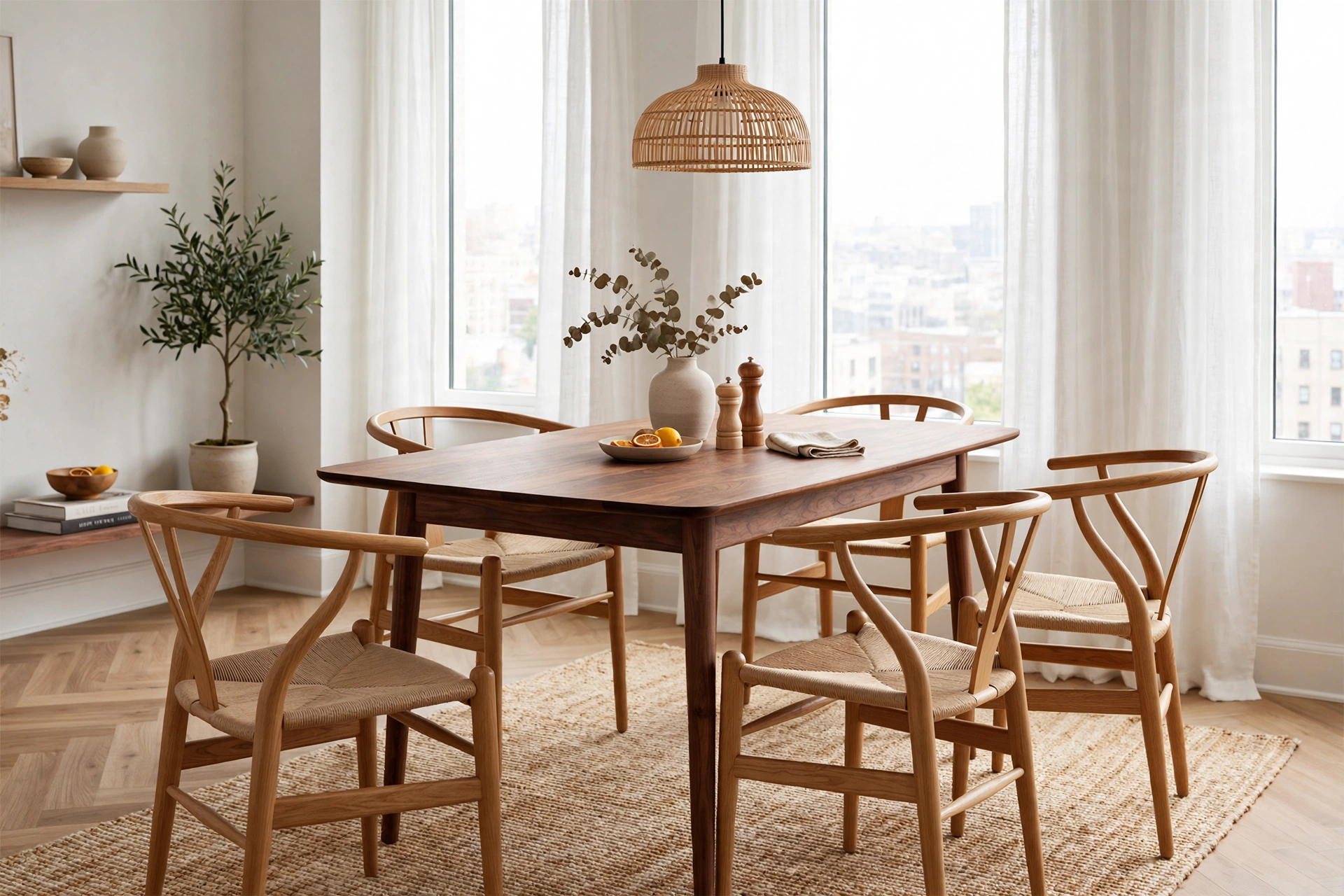
Hans Wegner’s wishbone chair — the Y-shaped back splat, the steam-bent frame — is the most copied dining chair in history for good reason: it’s beautiful, stackable-ish, and surprisingly comfortable. Originals are $1,000+ each, but solid reproductions run $80–$200 per chair. Two or four around a small dining table give a studio instant design credibility. Pro tip: wishbone-style chairs look best with seat pads in the off-season — the bare wood seat is authentic but unforgiving during long dinners, and pads add a color accent.
10. Center the Room With a Noguchi-Style Coffee Table
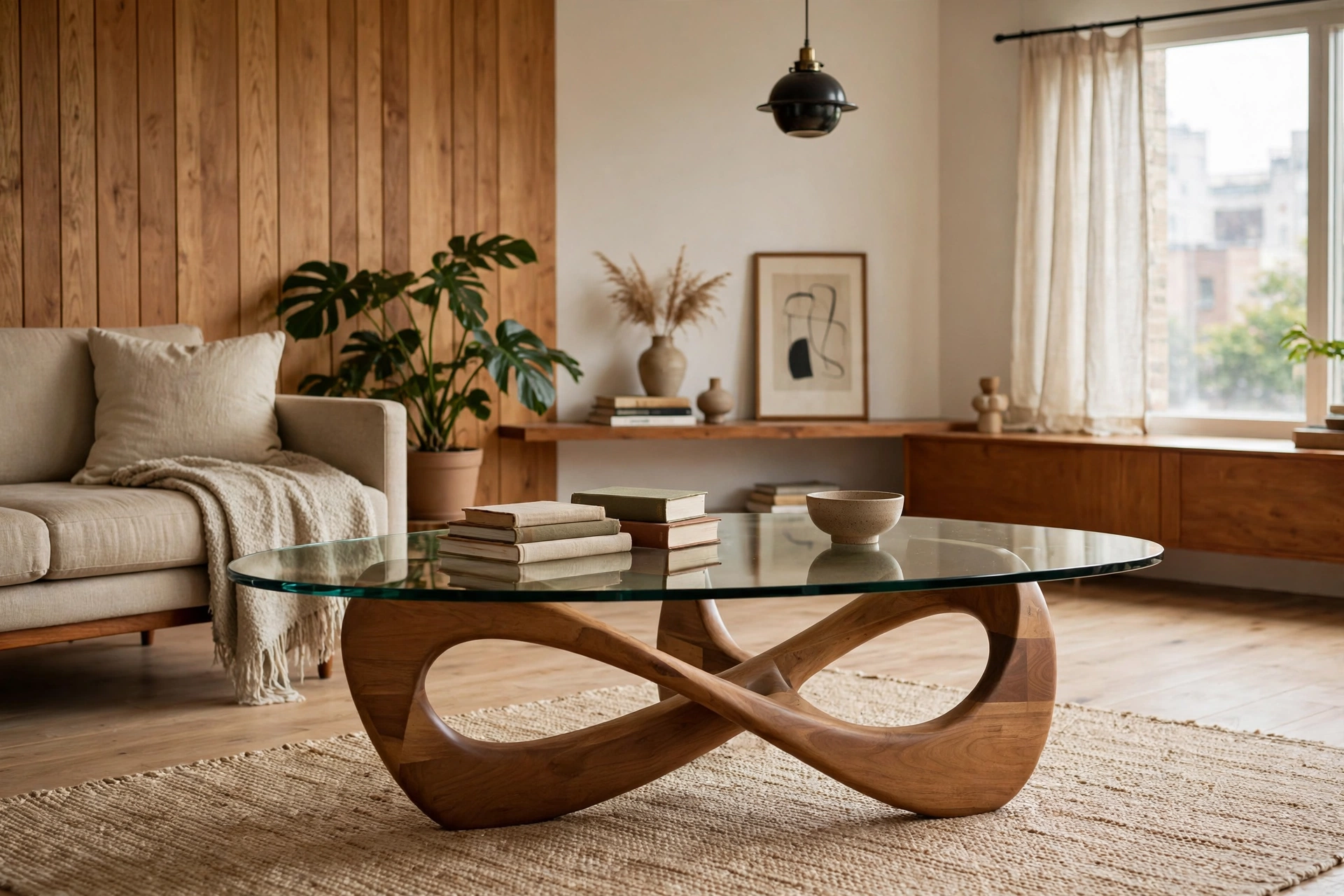
Isamu Noguchi’s sculptural coffee table — a thick glass top balanced on two interlocking wood bases — is functional art. At $150–$400 for a good reproduction, it’s cheaper than many ordinary coffee tables and infinitely more interesting. The glass top keeps it visually light, which matters enormously in a small studio. Pro tip: style the glass top minimally — one stack of books, one sculptural object — because every fingerprint shows, and clutter on glass reads twice as messy.
11. Store Media in a Low Credenza
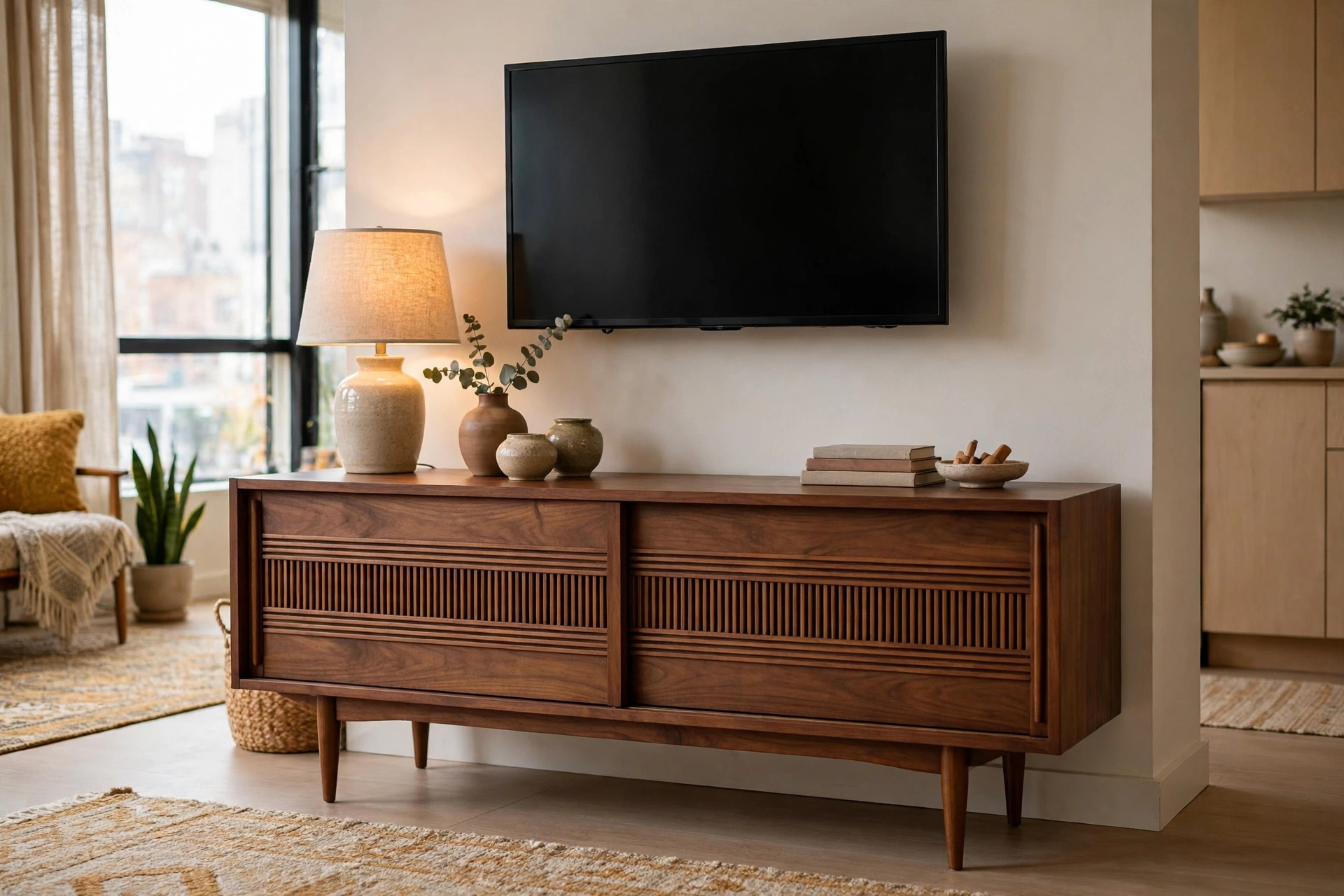
The long, low credenza is mid-century’s storage hero — sliding doors, tapered legs, and a top surface made for styling. At $200–$600, it swallows media gear, board games, and daily clutter while looking like a museum piece. In a studio, one credenza can serve as TV stand, entry console, and linen storage all at once. Pro tip: measure your media components before buying — vintage-style credenzas sometimes have shallow interiors, so confirm your receiver or game console actually fits.
12. Hunt a Danish Teak Sideboard
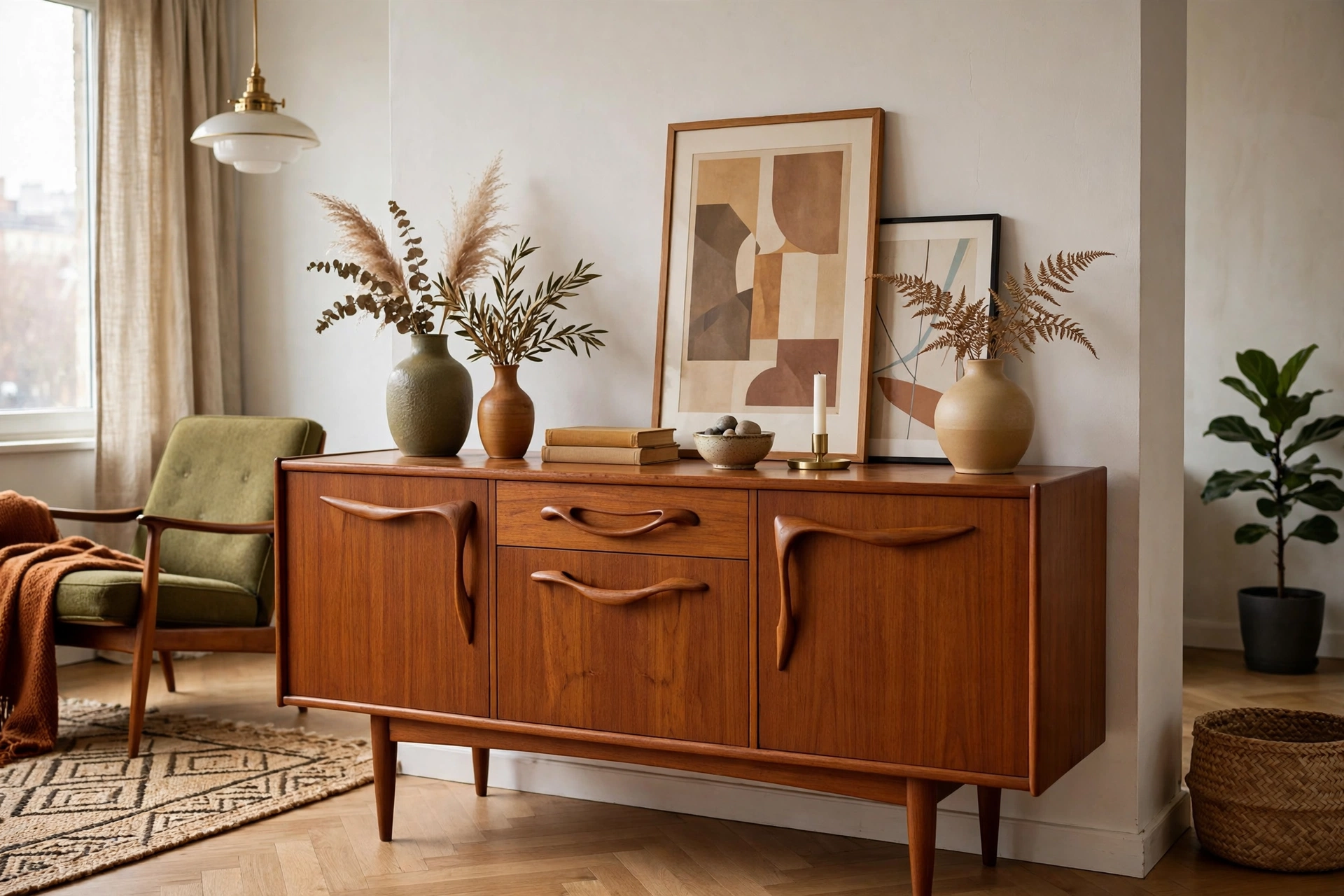
A genuine Danish teak sideboard — clean lines, sculpted handles, impossibly smooth drawers — is the thrift find of dreams, and they’re still out there for $150–$500 at estate sales, flea markets, and Facebook Marketplace. These pieces were built to last generations, and the patina only improves. In a studio, a sideboard works as a room divider, bar station, or entry drop zone. Pro tip: check drawer construction — dovetailed drawers that glide smoothly signal quality Danish work, while stapled particle-board drawers mean a cheap reproduction wearing a vintage costume.
13. Pull Up Molded Plastic Shell Chairs
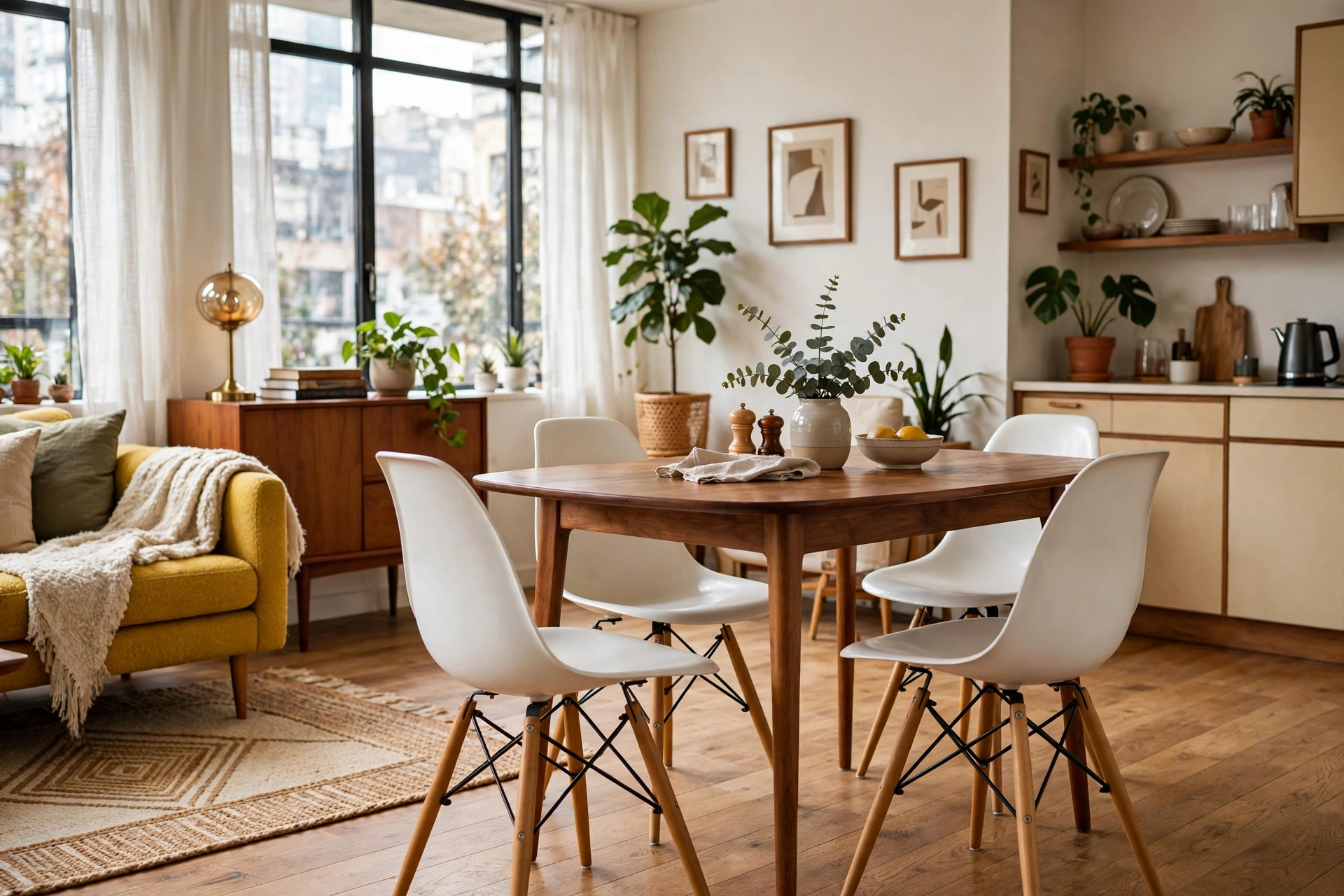
Eames molded shell chairs — the fiberglass or plastic scoop on dowel or wire legs — are the workhorses of mid-century style: dining chairs, desk chairs, accent seats, all in one $50–$120 design. Buy a set of four for the dining nook and steal one for the desk when working from home. They stack, they wipe clean, and they come in every era-correct color. Pro tip: the wire-base “Eiffel” version looks iconic but wobbles on uneven floors — the four-legged dowel base is sturdier for daily dining use.
14. Sleep and Lounge on a Mid-Century Daybed
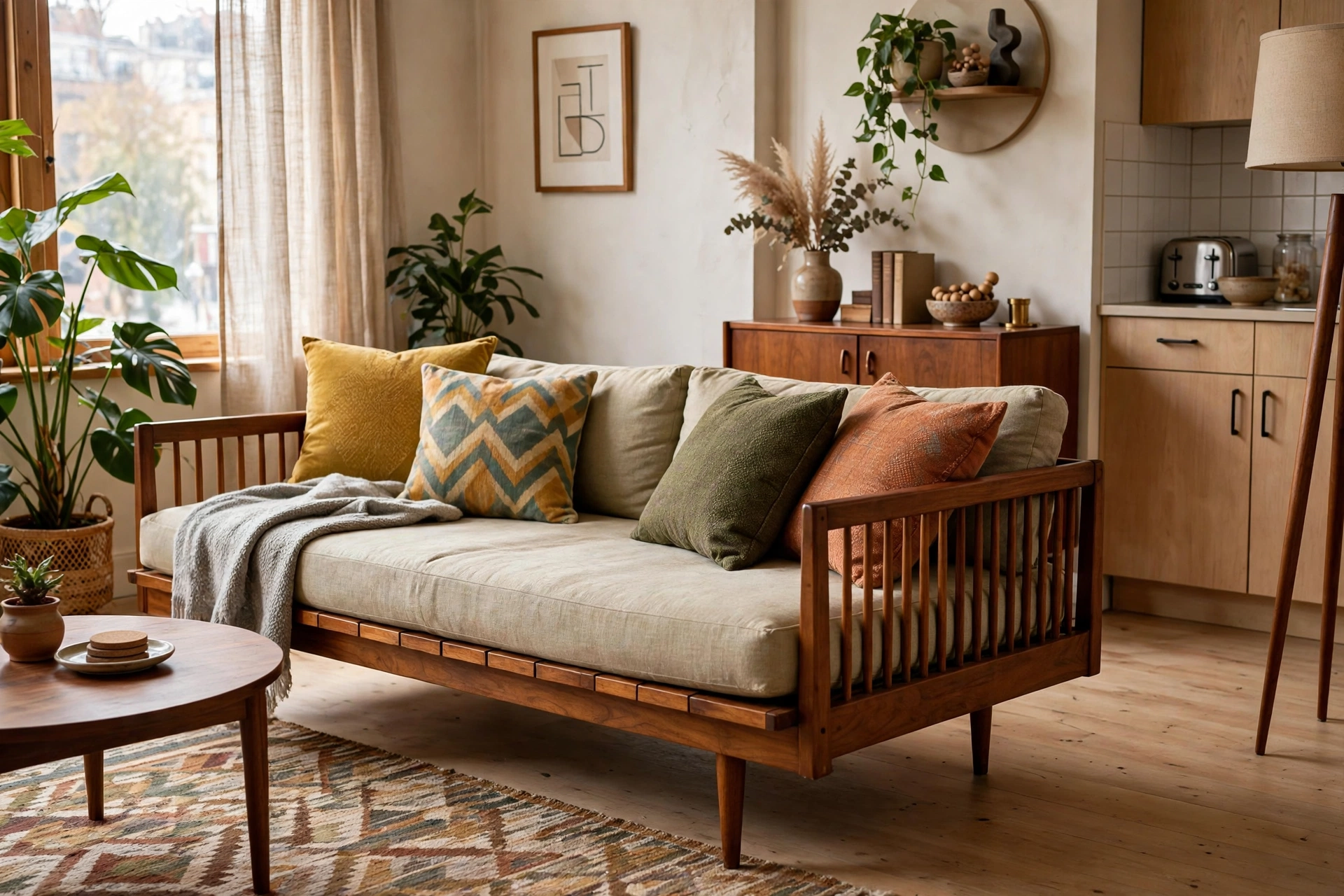
The mid-century daybed — a deep, low platform with a simple bolster back — is the ultimate studio sleeper: a proper sofa by day, a real bed by night, with clean lines that never scream “convertible.” Quality daybeds with good mattresses run $300–$800, and the low profile keeps the sleeping zone visually calm. This dual-purpose logic is pure space-saving furniture thinking. Pro tip: dress the daybed like a sofa (throw pillows across the back, a throw across the seat) rather than like a bed — the styling is what keeps it reading as living room all day.
15. Tuck in a Tulip Side Table
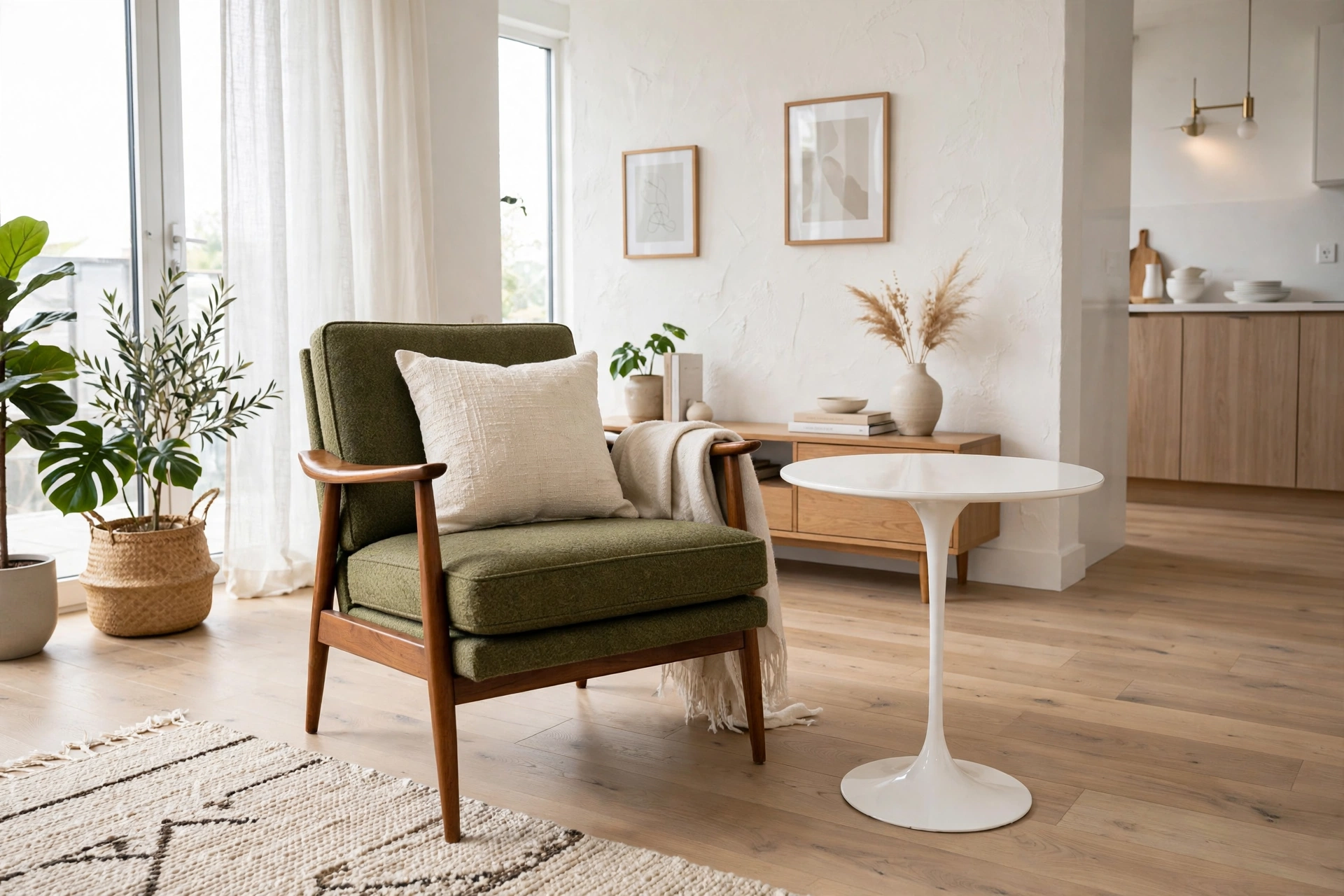
Saarinen’s tulip table — a single pedestal base blooming into a round top — eliminates the forest of table legs that clutters small rooms. A 20-inch side-table version ($80–$200) tucks beside any chair or sofa, and the smooth cast-aluminum base is nearly indestructible. White tops keep it light; walnut tops add warmth. Pro tip: the tulip base is top-heavy by design — keep it away from high-traffic bump zones in a tight studio, or opt for the marble-top version whose weight anchors it.
Warm Wood & Natural Materials
16. Divide Zones With a Walnut Slat Screen
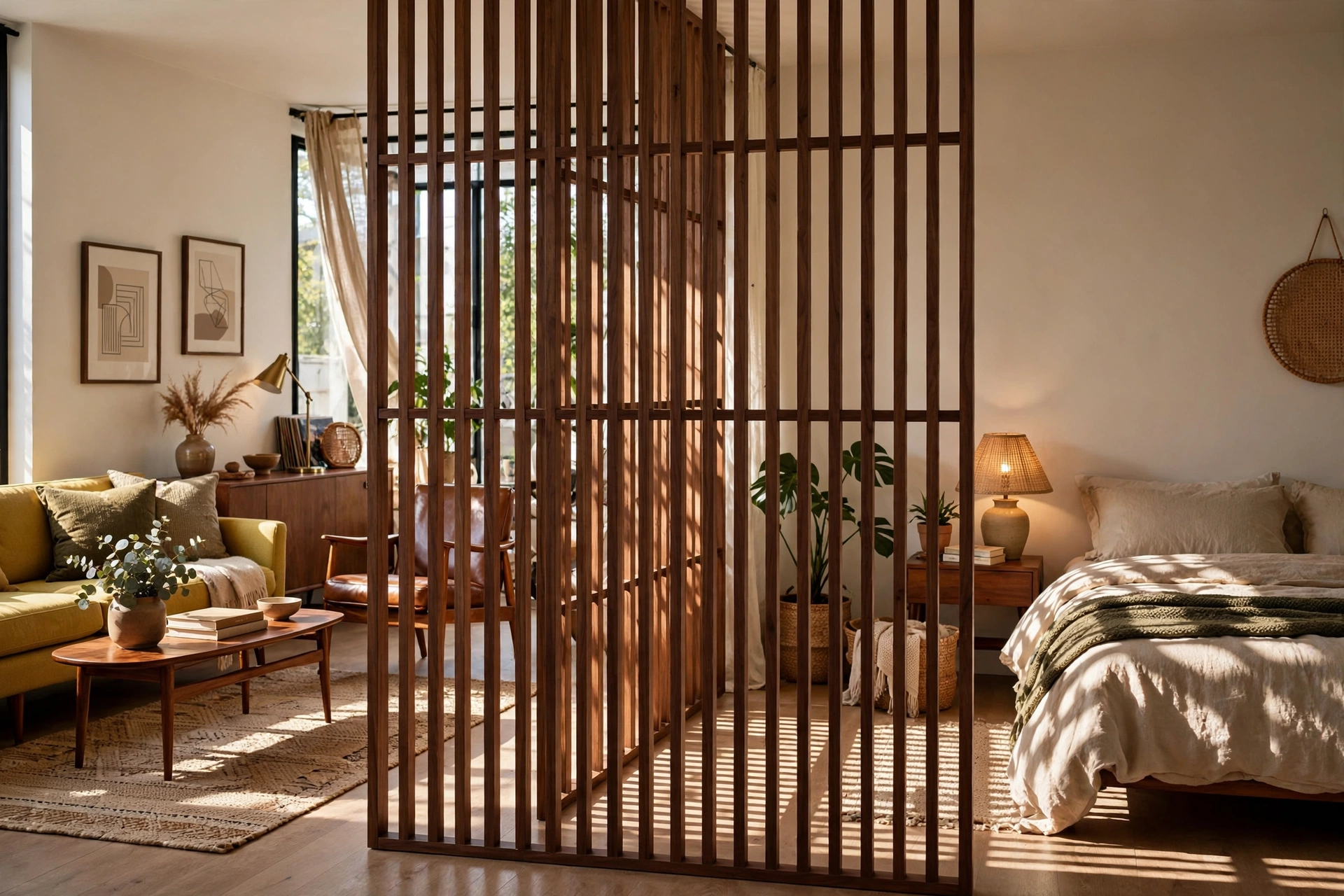
A freestanding slatted-wood room divider ($150–$400) is the mid-century way to carve a sleeping zone out of a studio — vertical walnut or teak slats that filter light and air while creating real visual separation. Unlike a curtain, it stands as furniture, adding architectural presence. Angle it slightly for a more organic feel than a hard perpendicular wall. Pro tip: leave 2–3 inches between slats — tight enough for privacy, open enough that light still flows through to the sleeping zone.
17. Display on a Teak Open Bookshelf
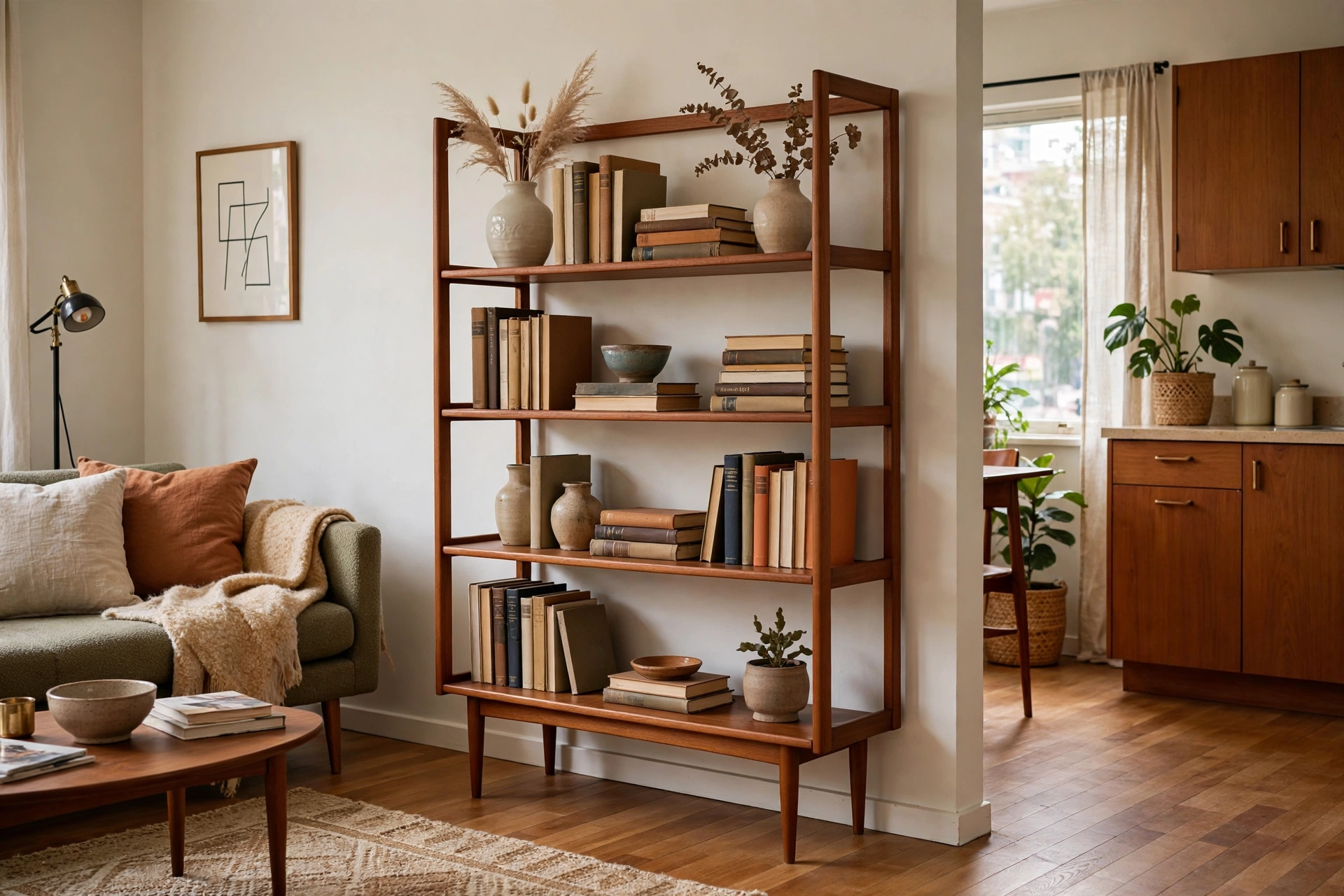
Danish modern bookshelves — teak frames with open shelving, often in modular wall-mounted systems — turn storage into sculpture. A three- or four-tier teak shelf ($150–$400) holds books, ceramics, and plants while its open back keeps the room feeling airy. Use one perpendicular to the wall and it doubles as a room divider. Pro tip: style open shelves with the 30% rule — leave nearly a third of each shelf empty, because breathing room is what separates a styled shelf from a crowded storage wall.
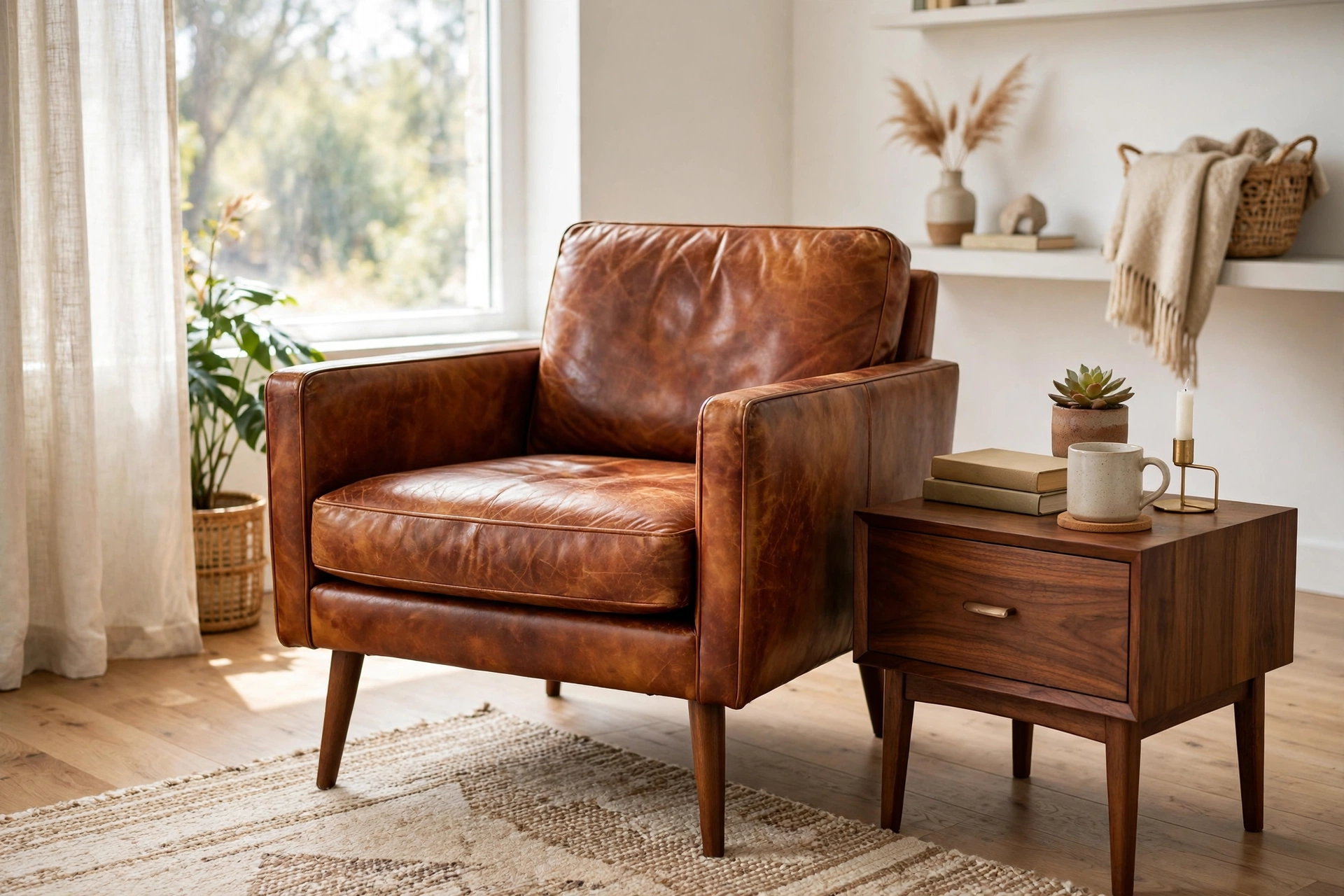
18. Sink Into a Cognac Leather Accent Chair
Cognac leather is mid-century’s warmest material — a leather sling or lounge chair ($300–$700) develops a gorgeous patina that makes it more beautiful every year. The rich caramel tone plays perfectly against walnut wood and mustard textiles. One leather chair is enough; it becomes the room’s heirloom piece. Pro tip: condition leather twice a year with a quality cream ($12) — studio sunlight and dry heating air are leather’s enemies, and ten minutes of care prevents cracking for decades.
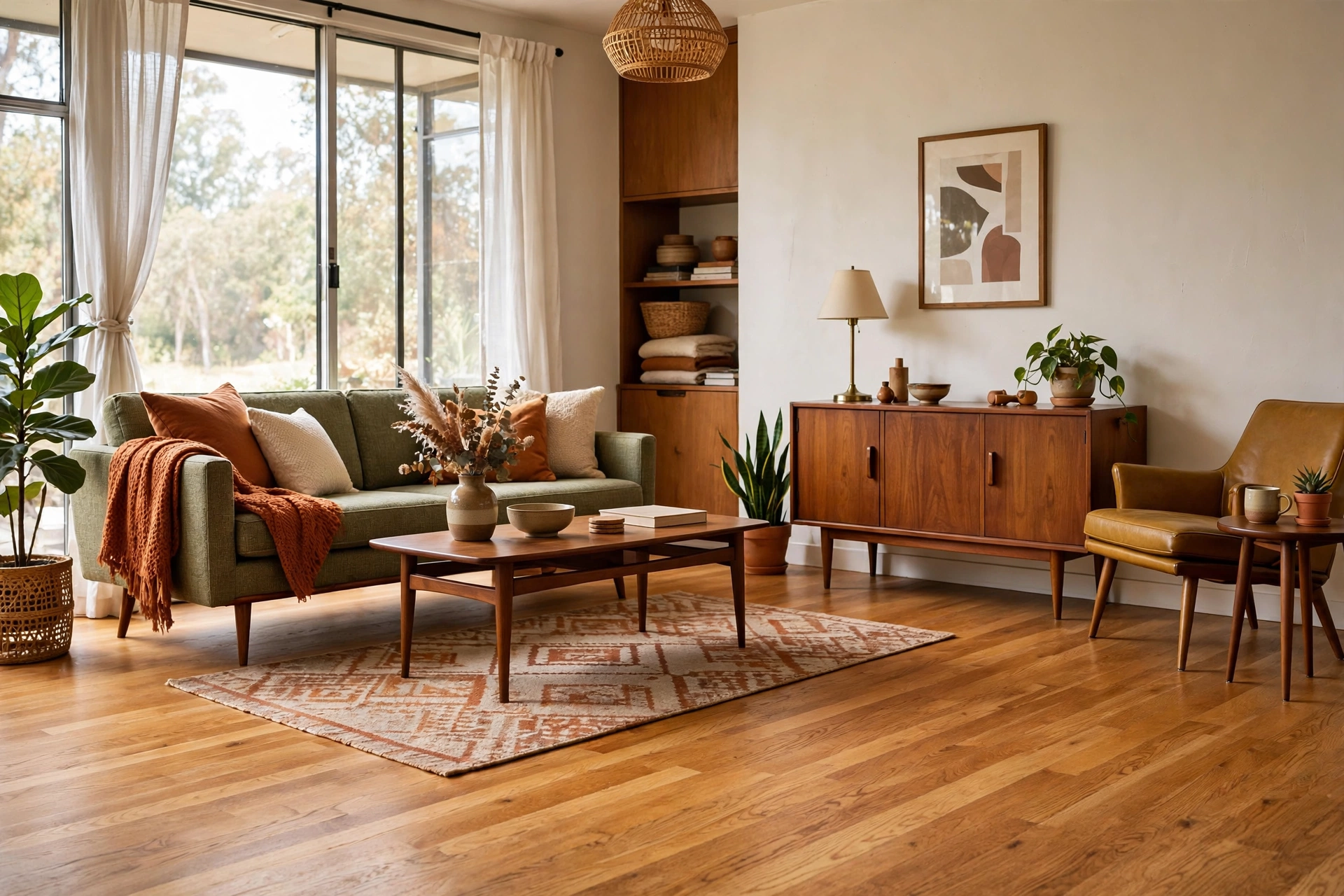
19. Choose Oak or Warm-Tone Flooring
Mid-century floors were warm — honey oak, warm-toned laminate, or cork. If you’re choosing flooring (or a rental has decent bones), warm wood tones ($2–$5 per square foot for laminate or LVP) complete the era’s look from the ground up. Renters can fake it with a large warm-toned area rug layered over cool gray floors. Pro tip: run flooring planks toward the main window — the lines draw the eye toward the light and make a studio feel longer.
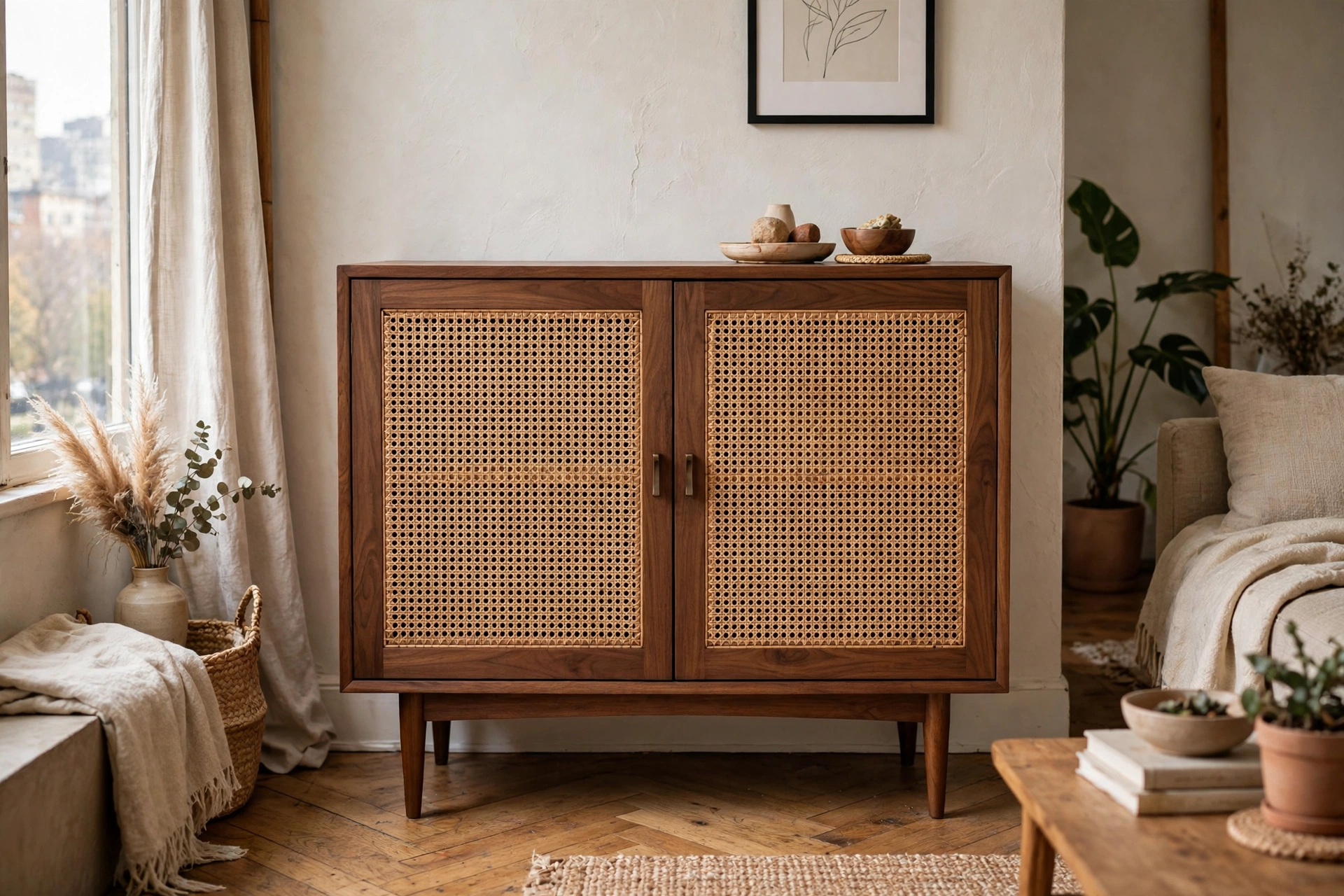
20. Hide Storage in a Cane-Webbing Cabinet
Cane webbing — the open rattan weave on cabinet doors — is mid-century’s texture trick: it hides clutter behind doors while letting air (and a hint of what’s inside) through. A cane-front credenza or cabinet ($200–$500) stores everything from linens to board games while reading as pure decor. Pro tip: keep cane away from direct daily sun — prolonged UV dries and brittles the weave over time, so position cane cabinets on shaded walls.
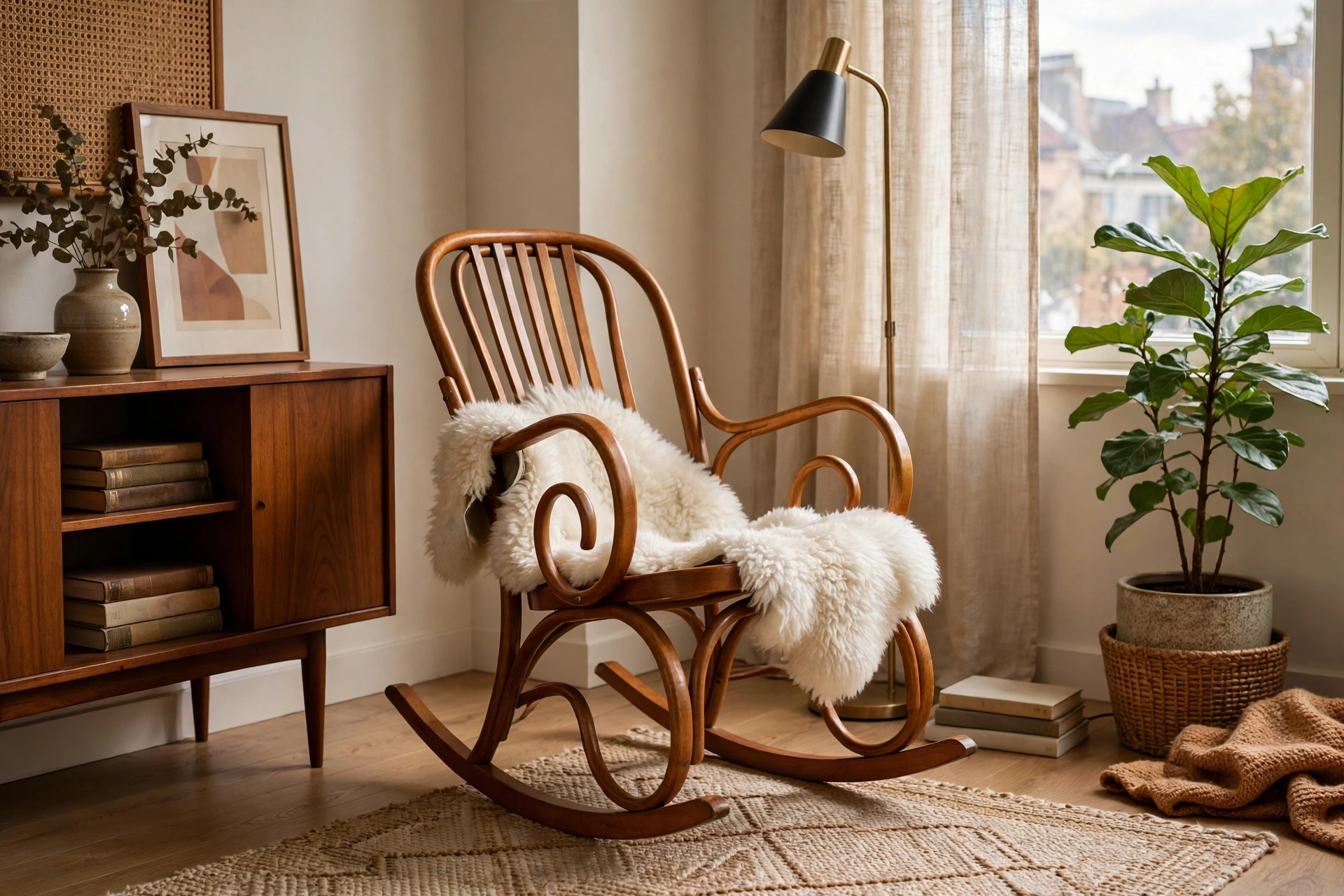
21. Rock in a Bentwood Rocker
Thonet-style bentwood rocking chairs — steam-bent wood in continuous curves — are mid-century’s most graceful seat, and they rock without the bulk of an upholstered glider. At $150–$350, a bentwood rocker fits the reading corner, the nursery corner, or the “just because it’s beautiful” corner. The open frame keeps it visually weightless. Pro tip: add a sheepskin throw ($25–$40) over the seat — it softens the wood, adds hygge, and makes the rocker the most fought-over seat in the studio.
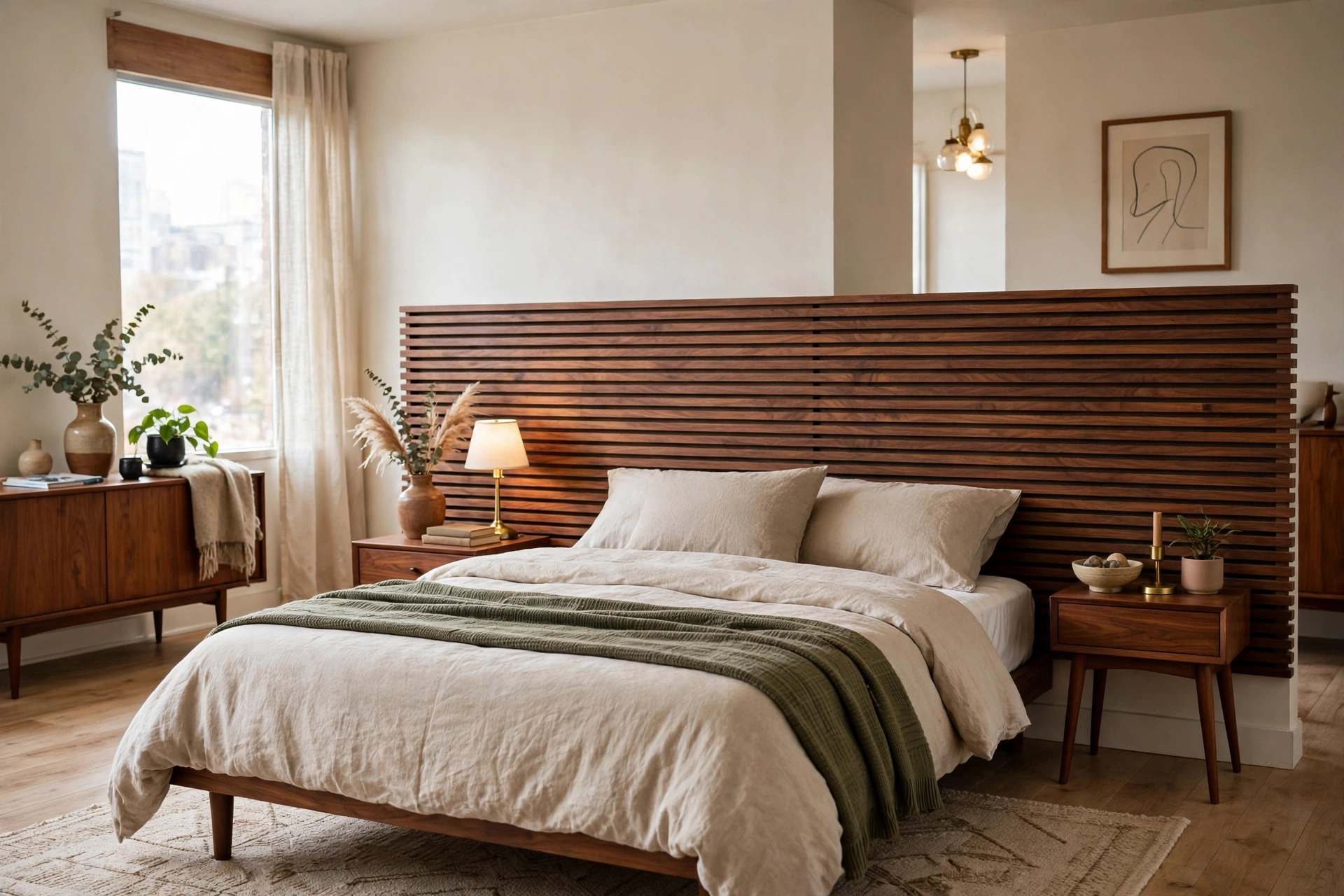
22. Headboard: Go Slatted Wood
A slatted wood headboard — horizontal teak or walnut slats mounted on the wall — gives the sleeping zone mid-century structure for $80–$250 (or a weekend DIY with lumber). It adds architectural interest without the visual weight of an upholstered headboard, and the gaps between slats keep it airy. Extend it wider than the bed for a built-in, custom look. Pro tip: mount the slats on a plywood backing panel first, then hang the whole panel — it’s far easier to level one panel than thirty individual slats.
Retro Patterns & Textiles
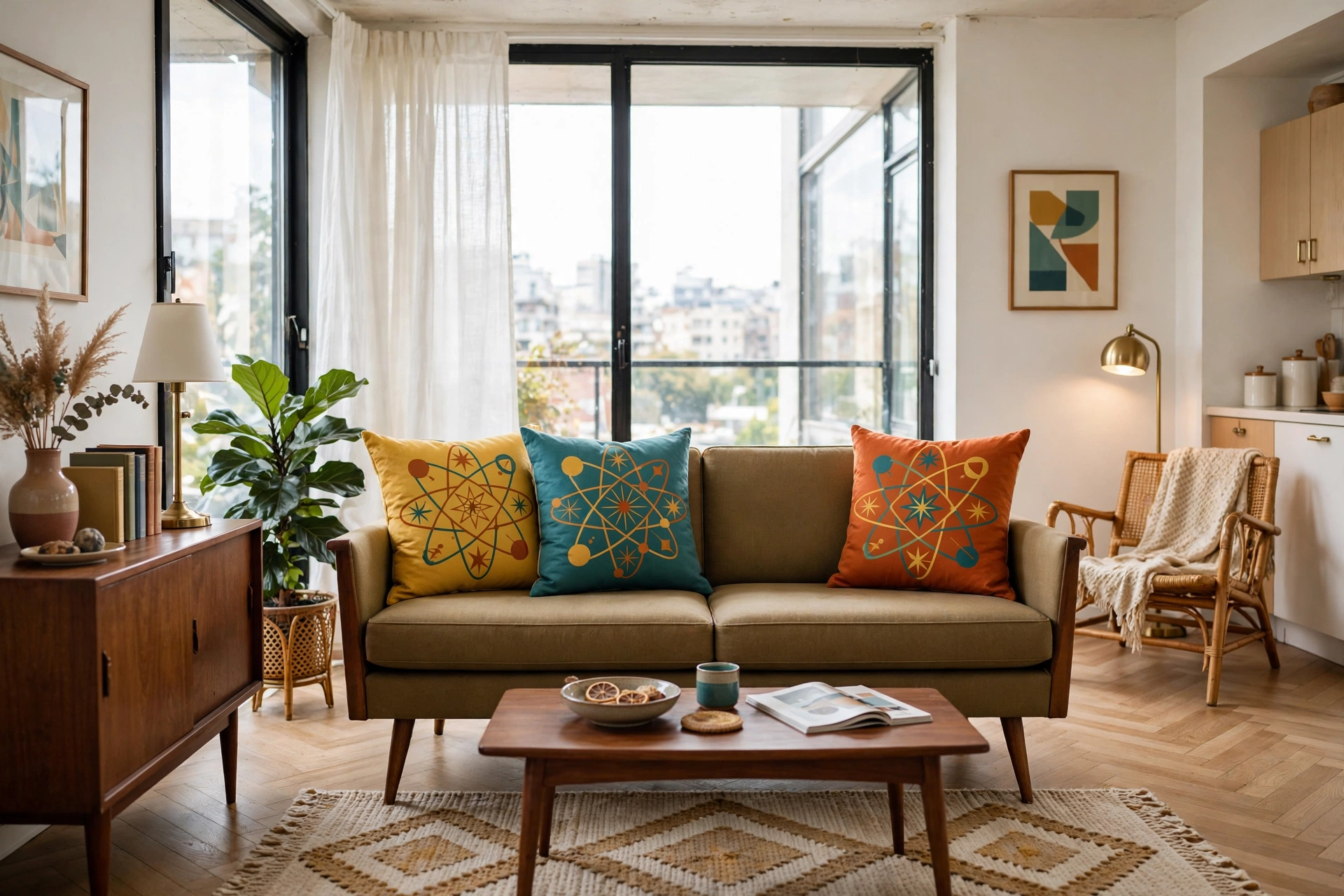
23. Mix Geometric Throw Pillows
Mid-century pillows speak in bold geometry — atomic starbursts, mod circles, abstract grids in mustard, teal, and burnt orange. Covers run $12–$30 each; four or five on the sofa in a shared palette instantly period-dresses the room. Mix one large-scale print with smaller patterns and one solid texture. Pro tip: buy quality inserts once ($15–$25 for down-alternative) and swap only the covers seasonally — the pillows always look plump and expensive regardless of cover price.
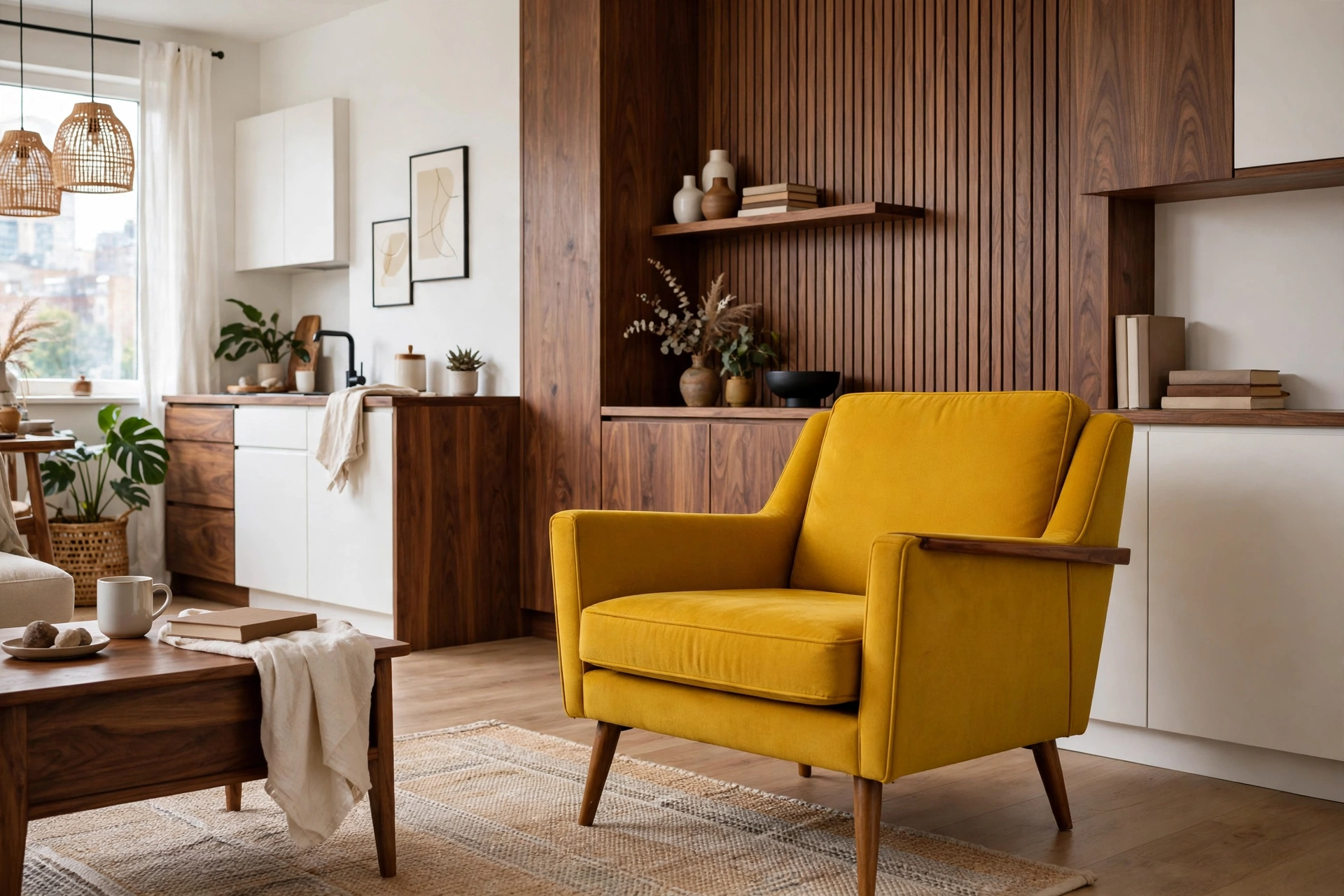
24. Pop Mustard Yellow Accents
If mid-century modern had a signature color, it’s mustard yellow — that deep, golden ochre that glows against walnut wood and white walls. Introduce it through one armchair, a throw, or a set of cushions ($20–$200 depending on scale). Mustard is the era’s exclamation point: a little goes a long way. Pro tip: keep mustard to roughly 10% of the room’s visual field — one chair or a few textiles. More than that and the accent becomes the whole story.
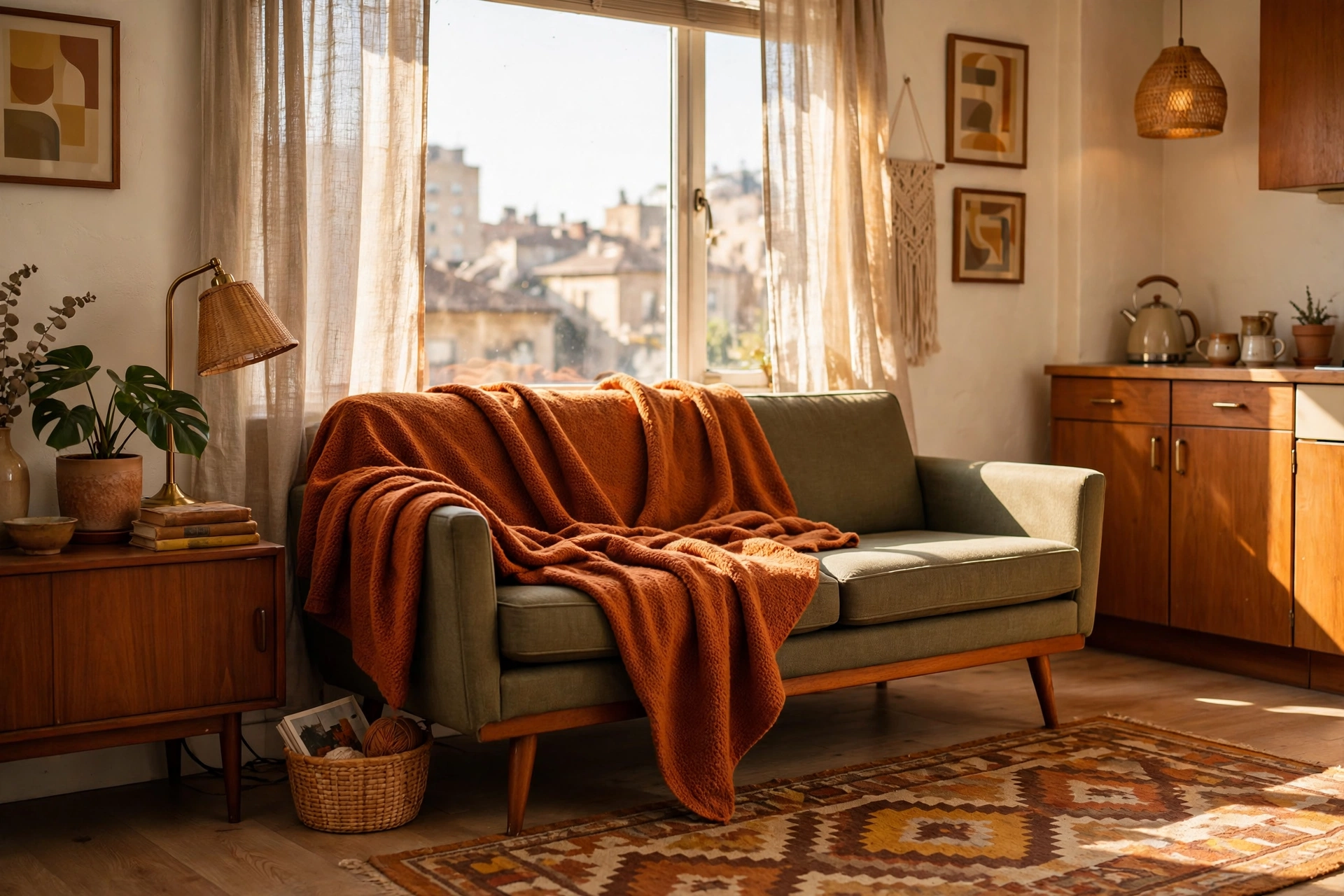
25. Layer Burnt Orange Throws
Burnt orange — terracotta’s moodier sibling — is the textile color of the 1960s living room. A burnt-orange throw ($25–$60) draped over the sofa or bed adds sunset warmth that photographs beautifully and feels like autumn year-round. Pair it with mustard and olive for the full retro triad. Pro tip: burnt orange loves natural light — drape it where afternoon sun hits and the color practically glows; in dark corners it can read muddy instead of rich.
26. Upholster in Olive Green
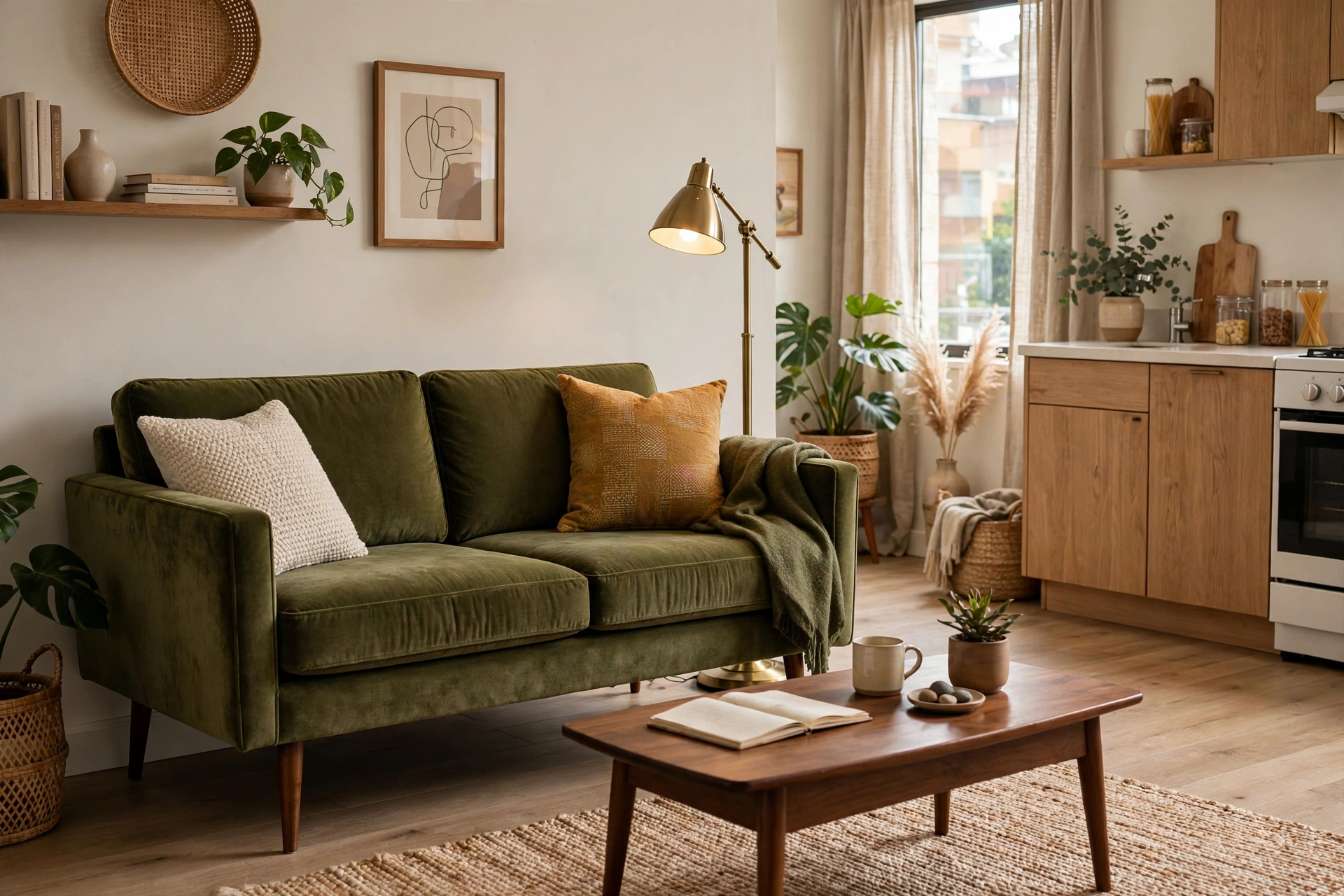
Olive green is mid-century’s sophisticated neutral — the color of 1960s velvet sofas and Danish lounge chairs. An olive accent chair or loveseat ($200–$600) grounds a room the way gray never could, adding depth without darkness. It pairs beautifully with walnut, brass, and mustard. Pro tip: olive velvet shows every impression — vacuum it with an upholstery attachment monthly and the nap stays even; neglected velvet develops shiny worn patches.
27. Hang Abstract Atomic Art Prints
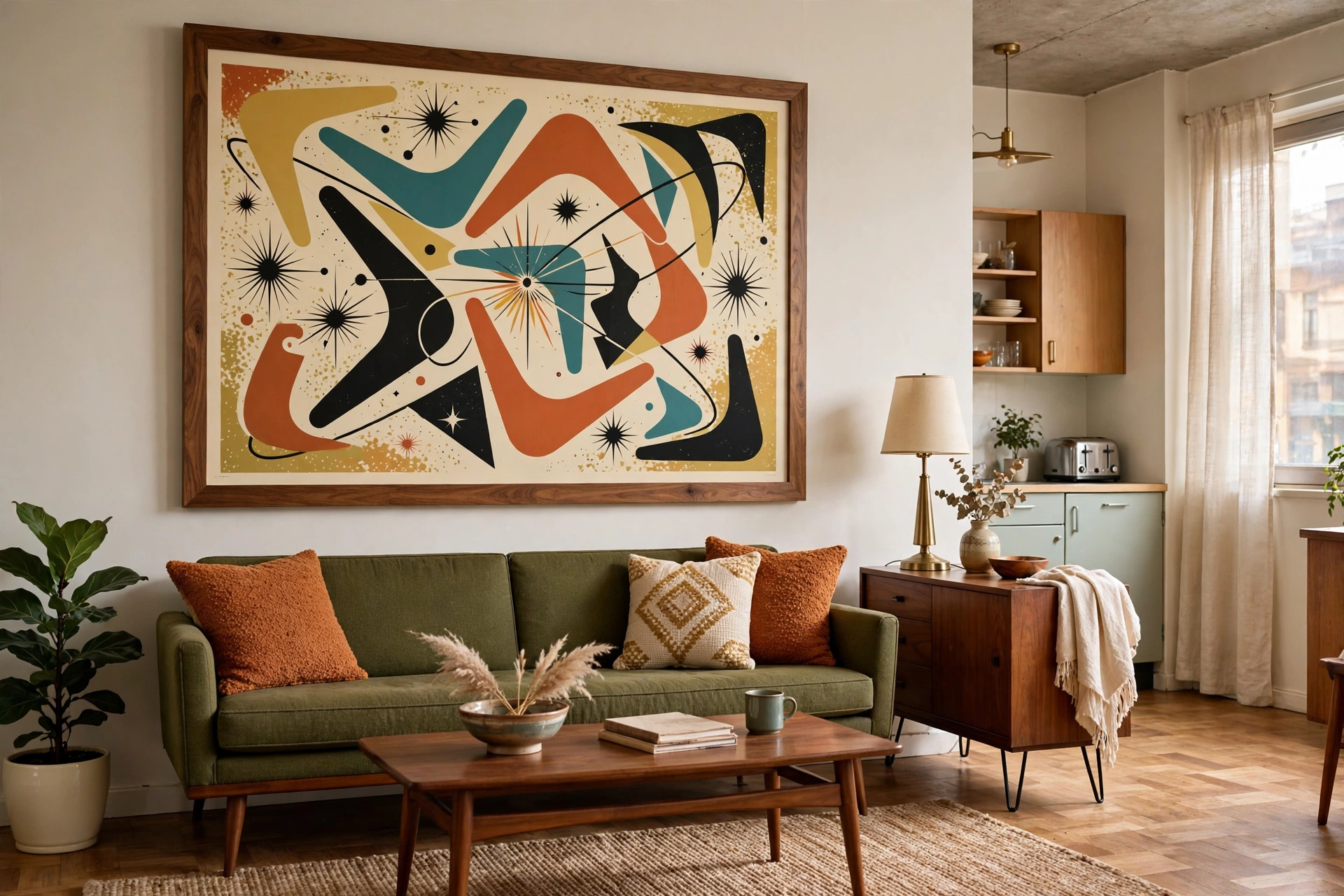
Mid-century wall art went abstract — boomerang shapes, atomic bursts, bold color-field compositions. Large-format prints run $10–$30; frame them in thin black or walnut frames ($15–$30) for the gallery look. One oversized abstract print above the sofa anchors the whole room. Pro tip: include one piece with a touch of the room’s accent color — the visual echo between art and textiles is what makes a room feel designed rather than decorated.
28. Choose Retro-Print Curtain Panels
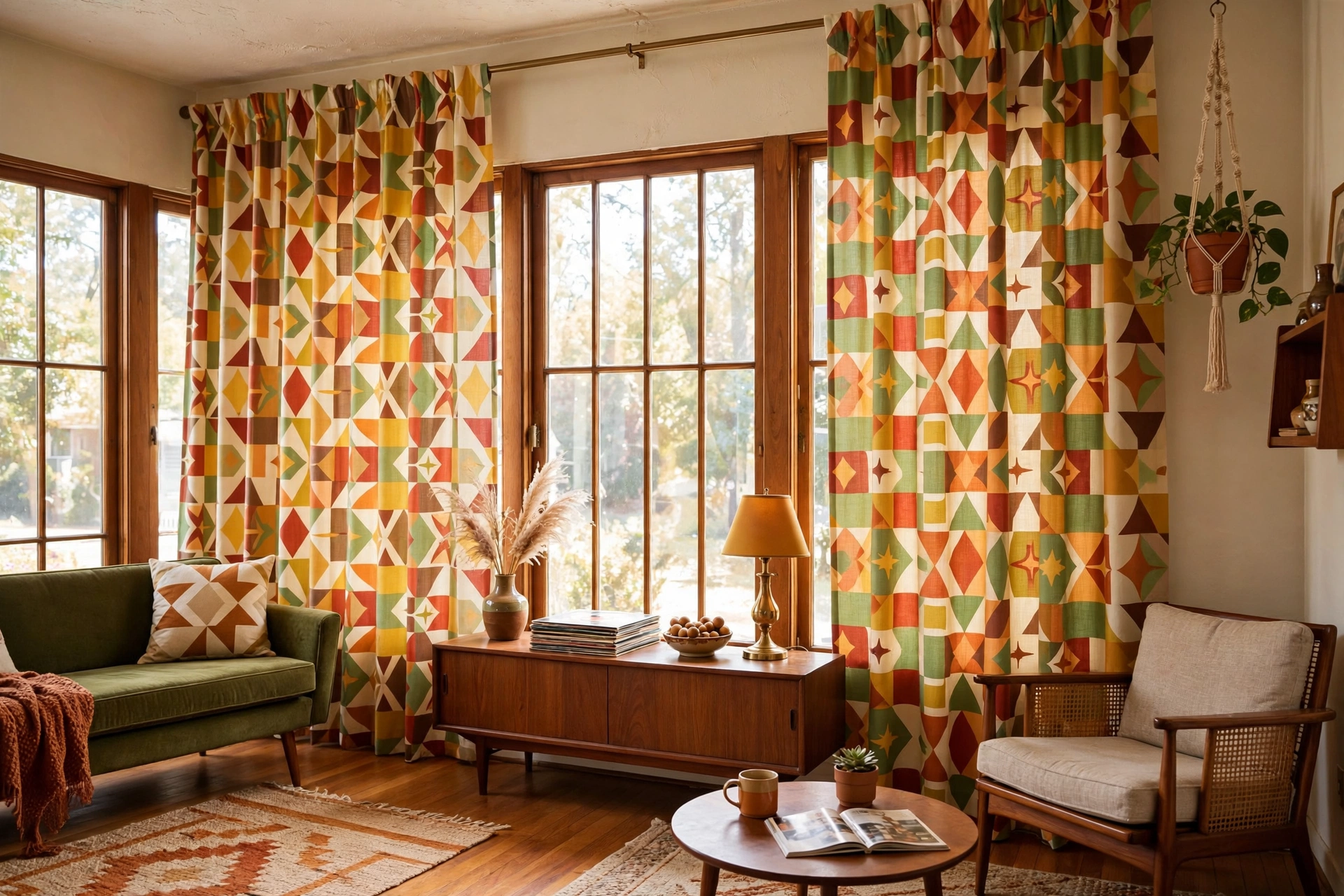
Curtains are the largest textile in most studios — make them count with a retro geometric or barkcloth-style print ($25–$50 per panel). Hang them high and wide to add height, and let them just kiss the floor. In a mid-century room, curtains in a period print do more thematic work than any small accessory. Pro tip: if the print is bold, keep the rest of the room’s patterns quiet — one statement textile per room is the rule that keeps retro from becoming circus.
29. Layer a Vintage-Style Patterned Rug
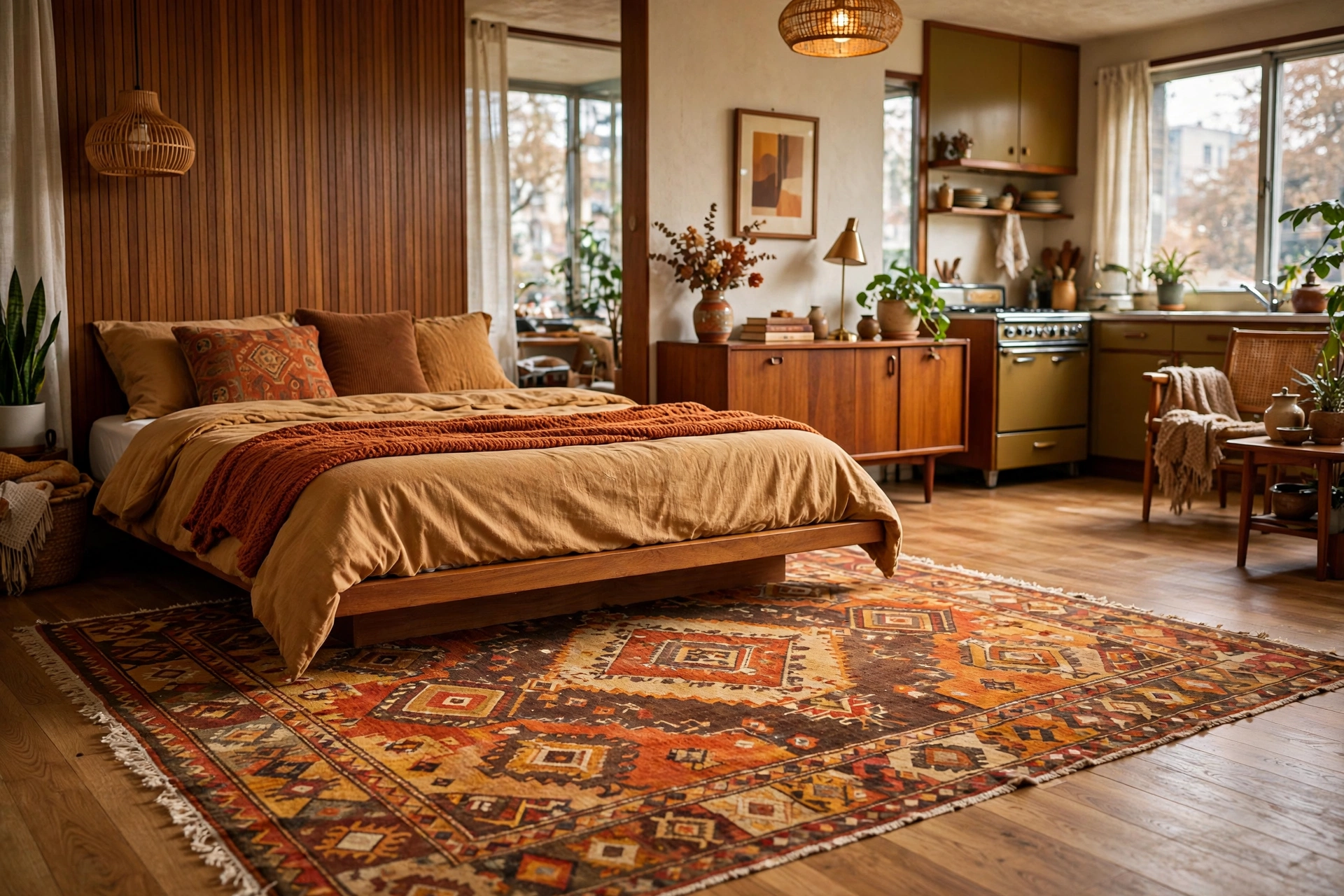
Beyond the geometric statement rug, a second smaller vintage-style patterned rug ($60–$150) can zone the sleeping area or entry — different pattern, same color family. Two rugs in conversation define two zones without a single wall. Keep both low-pile for the authentic mid-century feel and easy cleaning. Pro tip: leave 12–18 inches of bare floor between zone rugs — the breathing room reads as intentional separation, while rugs that touch look like one big accident.
Lighting & Decor Accents
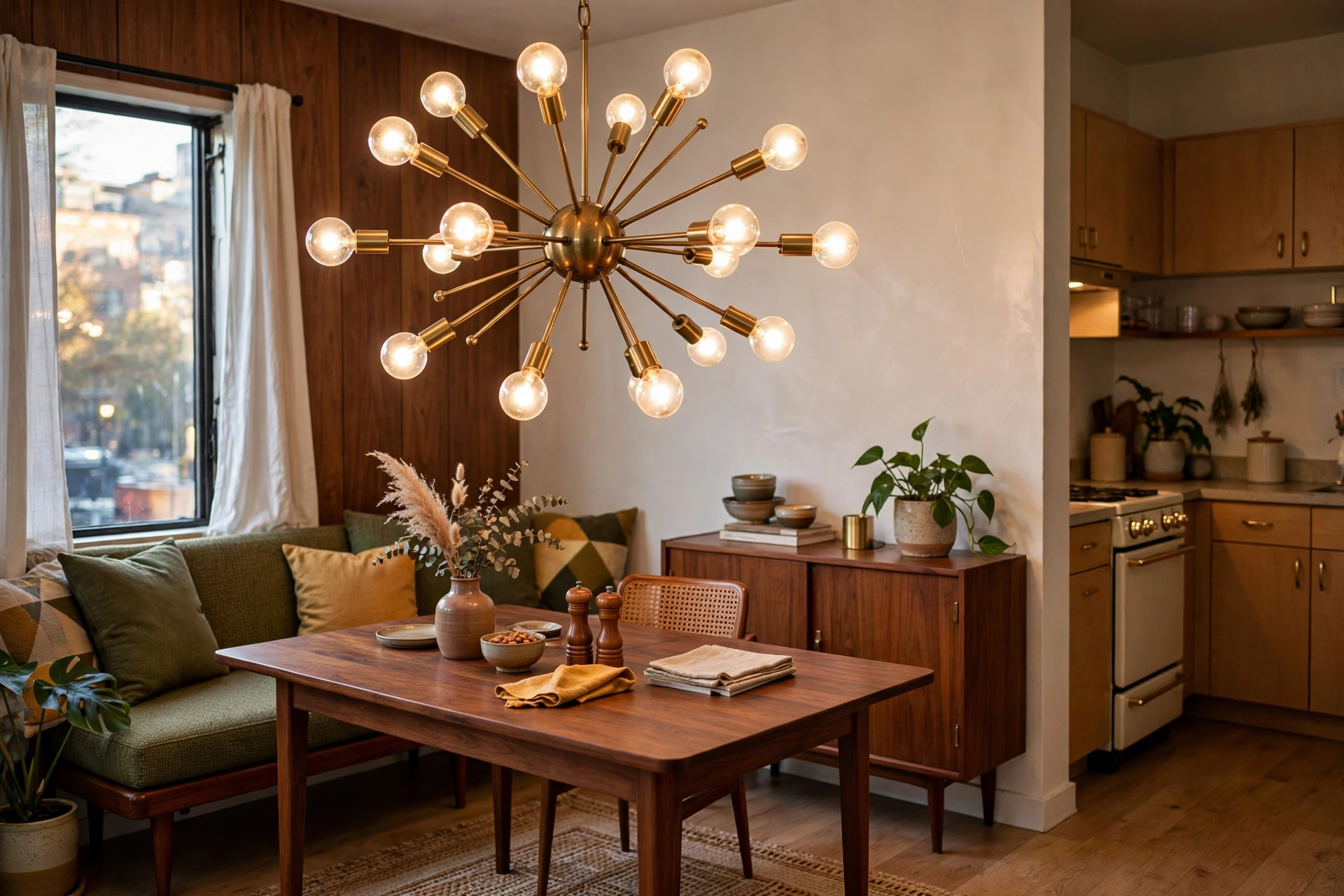
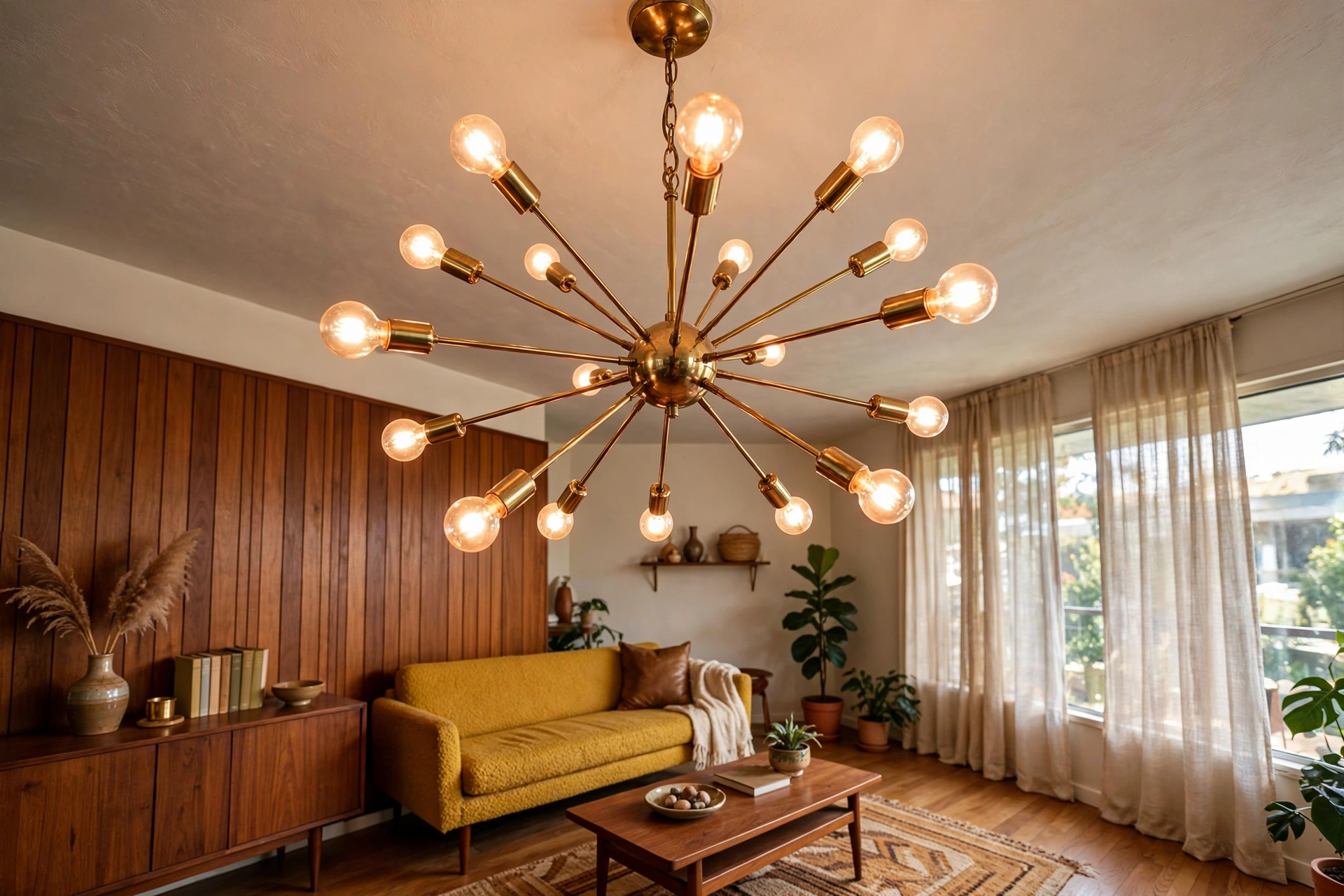
30. Hang a Sputnik Chandelier
The sputnik chandelier — brass arms radiating from a central sphere, each tipped with a globe bulb — is the crown jewel of mid-century lighting. At $80–$250, it delivers more drama per dollar than almost any other fixture. Hang it over the dining nook or as the studio’s single statement ceiling piece. This kind of sculptural lighting is the heart of our studio apartment lighting ideas. Pro tip: use warm 2700K globe bulbs — cool white bulbs in a sputnik read as office lighting, while warm bulbs make the brass glow like 1962.
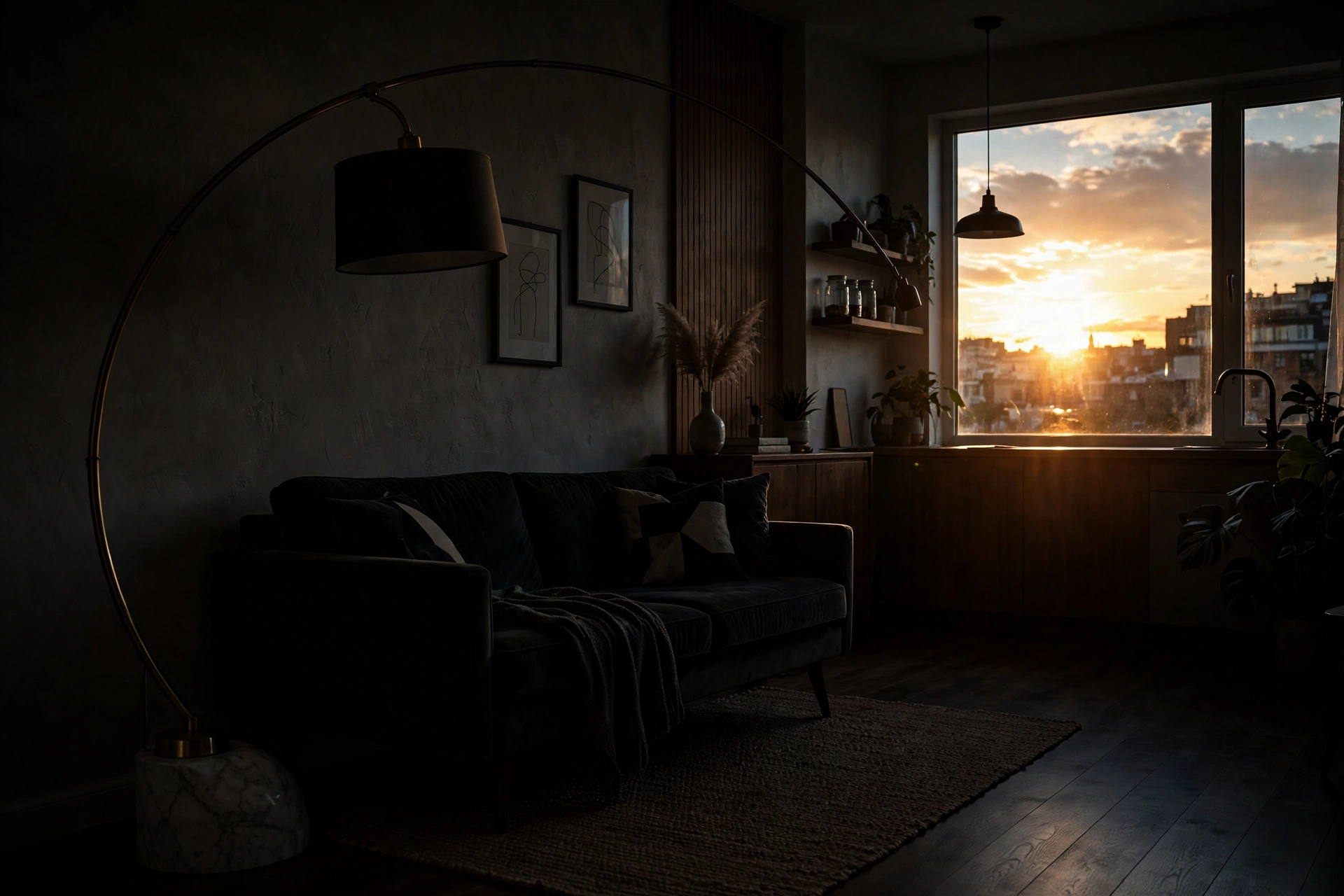
31. Arc a Floor Lamp Over the Sofa
The arc floor lamp — a dramatic curved arm reaching over the seating area — brings overhead light without ceiling wiring, perfect for renters. At $120–$300, it creates a reading spotlight exactly where you want it and a sculptural silhouette the rest of the time. The heavy marble base keeps it stable in tight quarters. Pro tip: position the arc so the shade hangs 5–6 feet off the floor — high enough to stand under comfortably, low enough to feel like a pendant.
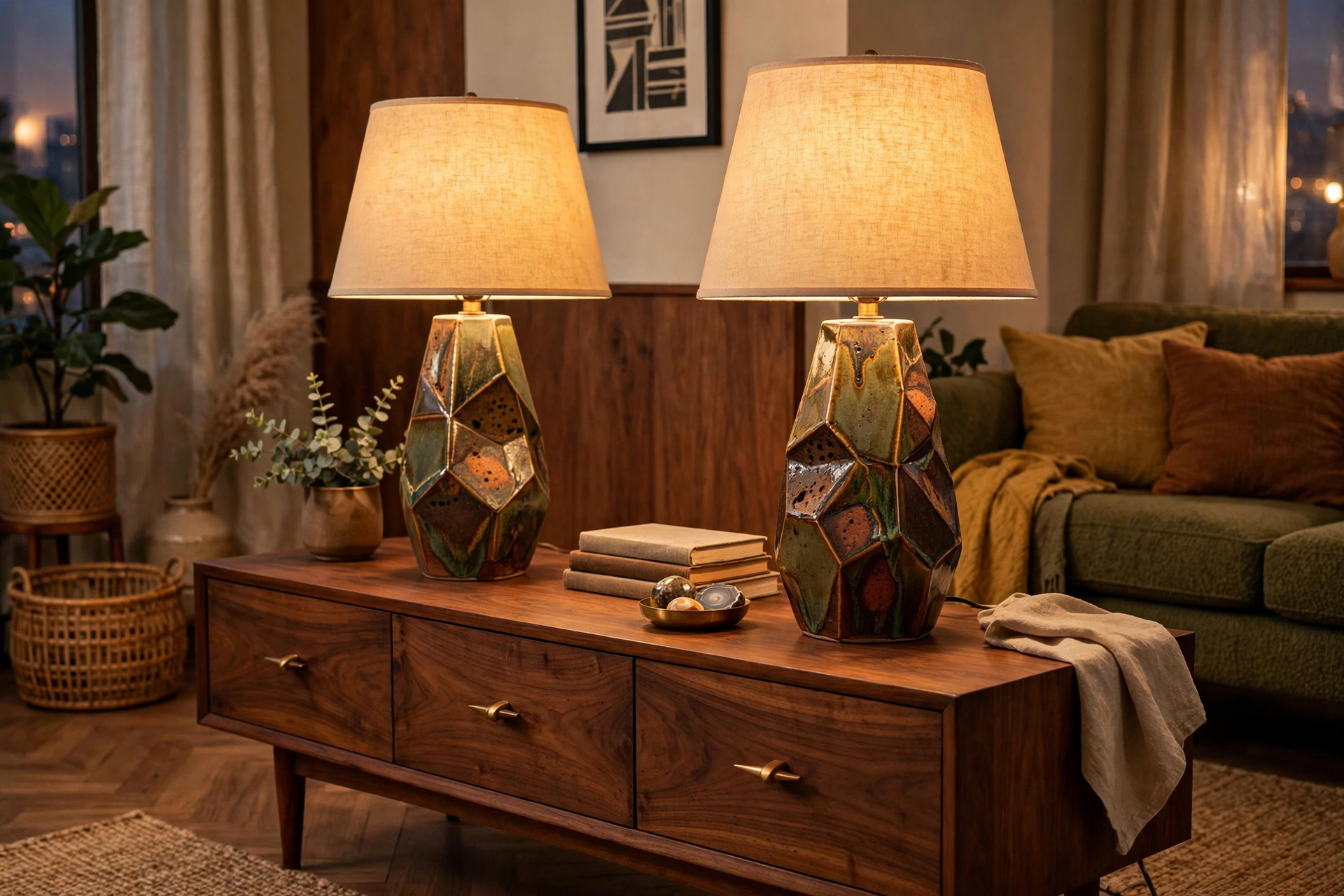
32. Pair Ceramic Table Lamps
Mid-century ceramic table lamps — lava glazes, geometric reliefs, sculptural silhouettes — are thrift-store gold, often $15–$40 for the pair. Two matching lamps on the credenza or nightstands add symmetry and warm pools of light. Even new reproductions ($30–$80 each) capture the handmade feel. Pro tip: replace old wiring on vintage lamps ($10 rewiring kit, twenty minutes) — 1960s cords are often cracked and unsafe, and fresh wiring makes a $20 find genuinely usable.
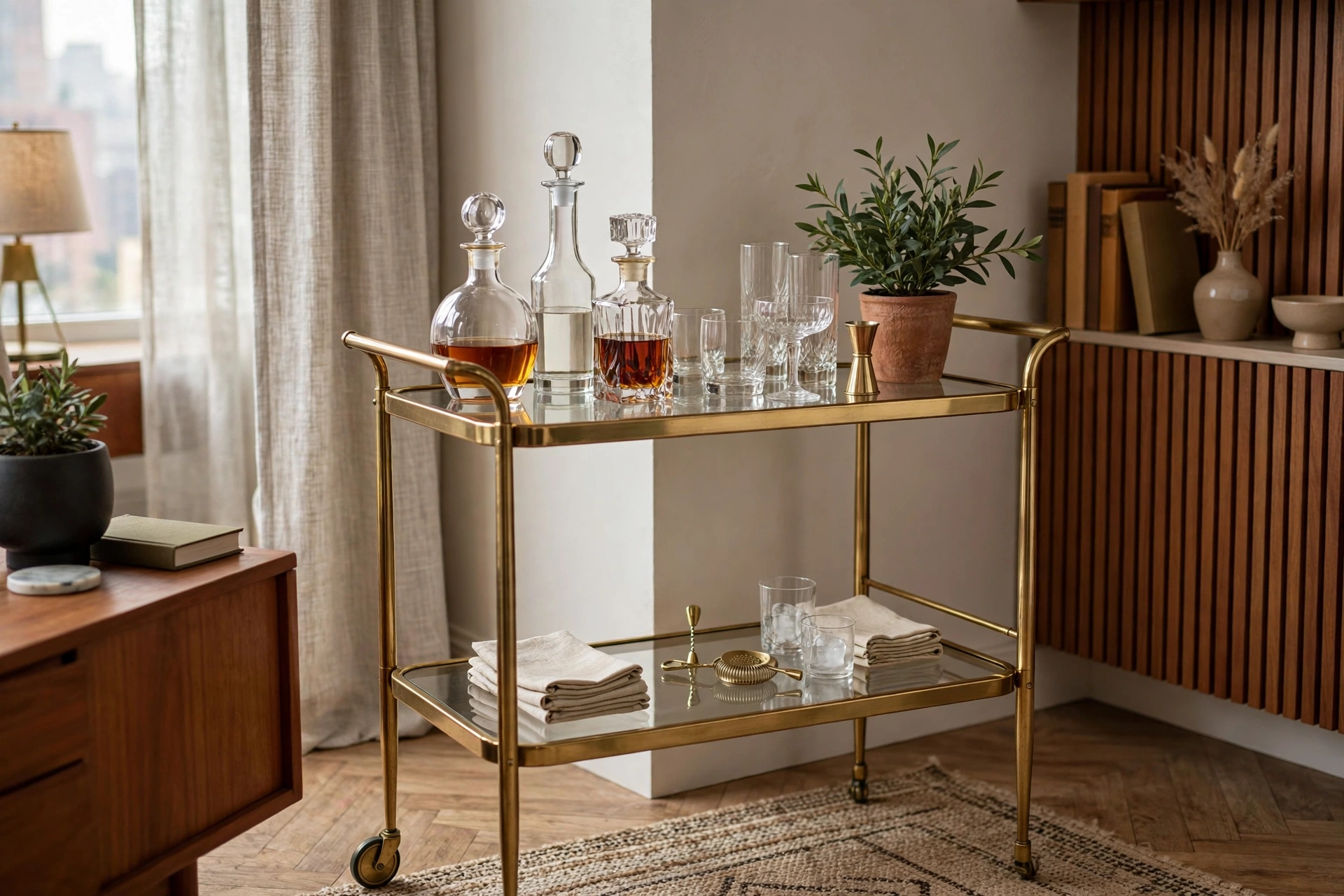
33. Style a Rolling Bar Cart
The brass-and-glass bar cart is mid-century entertaining in miniature — and in a studio, it doubles as a side table, plant stand, or coffee station. At $80–$200, it rolls wherever the party (or the morning light) is. Style the top with decanters and a small plant, the bottom with books and glassware. Pro tip: lock the casters once it’s positioned — a bar cart that drifts across a small studio at 2 a.m. is a shin-bruise waiting to happen.
34. Display Vinyl Records as Art
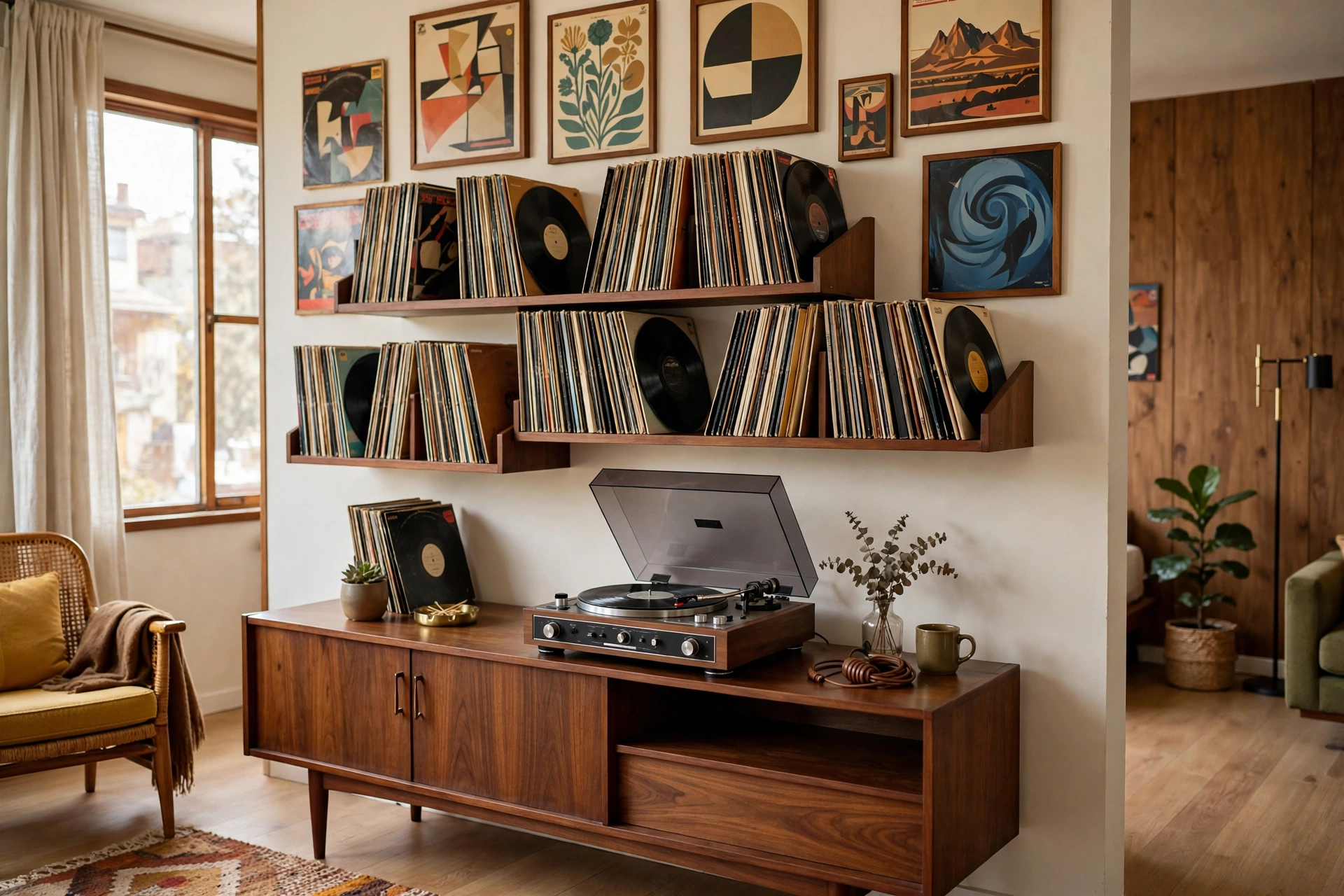
Mid-century modern and vinyl culture grew up together — so display the collection. A record console or simple wall-mounted record shelves ($15–$40) turn album covers into rotating wall art. A vintage-style turntable on the credenza ($100–$300) completes the scene and actually gets used. Pro tip: frame three favorite album covers in thin black frames ($8–$12 each) as permanent art, and rotate the shelf display monthly — the wall never gets stale.
35. Create a Retro Telephone Nook
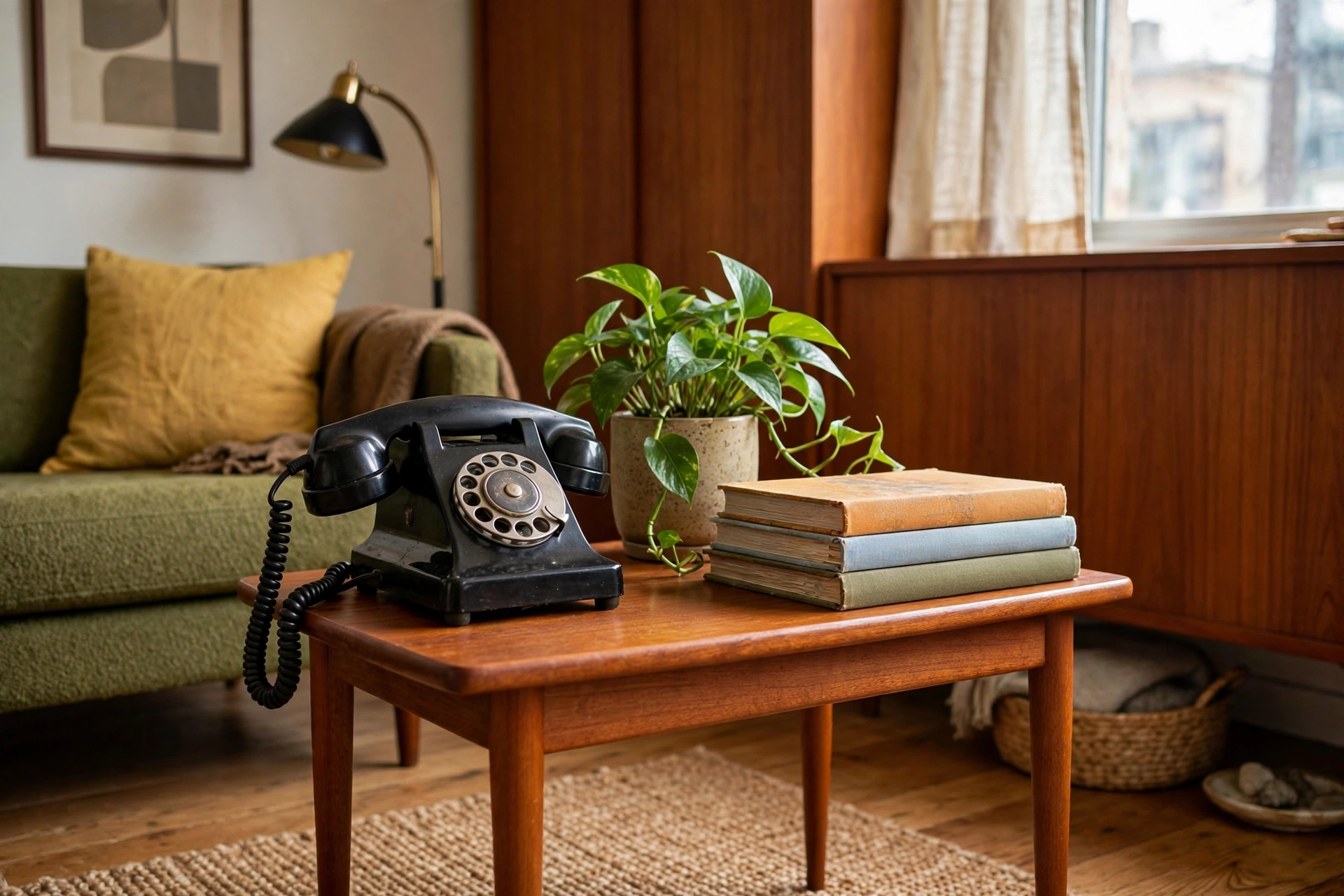
A vintage rotary telephone ($30–$80 at flea markets) on a small teak table is the kind of detail that makes guests smile — pure 1960s, fully decorative, and endlessly photographable. It doesn’t need to work; it needs to sit there looking perfect next to a small plant and a stack of design books. Pro tip: choose the classic Western Electric 500 shape in black or ivory — it’s the most recognizable silhouette, and reproductions in odd colors often look cheap rather than charming.
36. Finish With Brass Accents
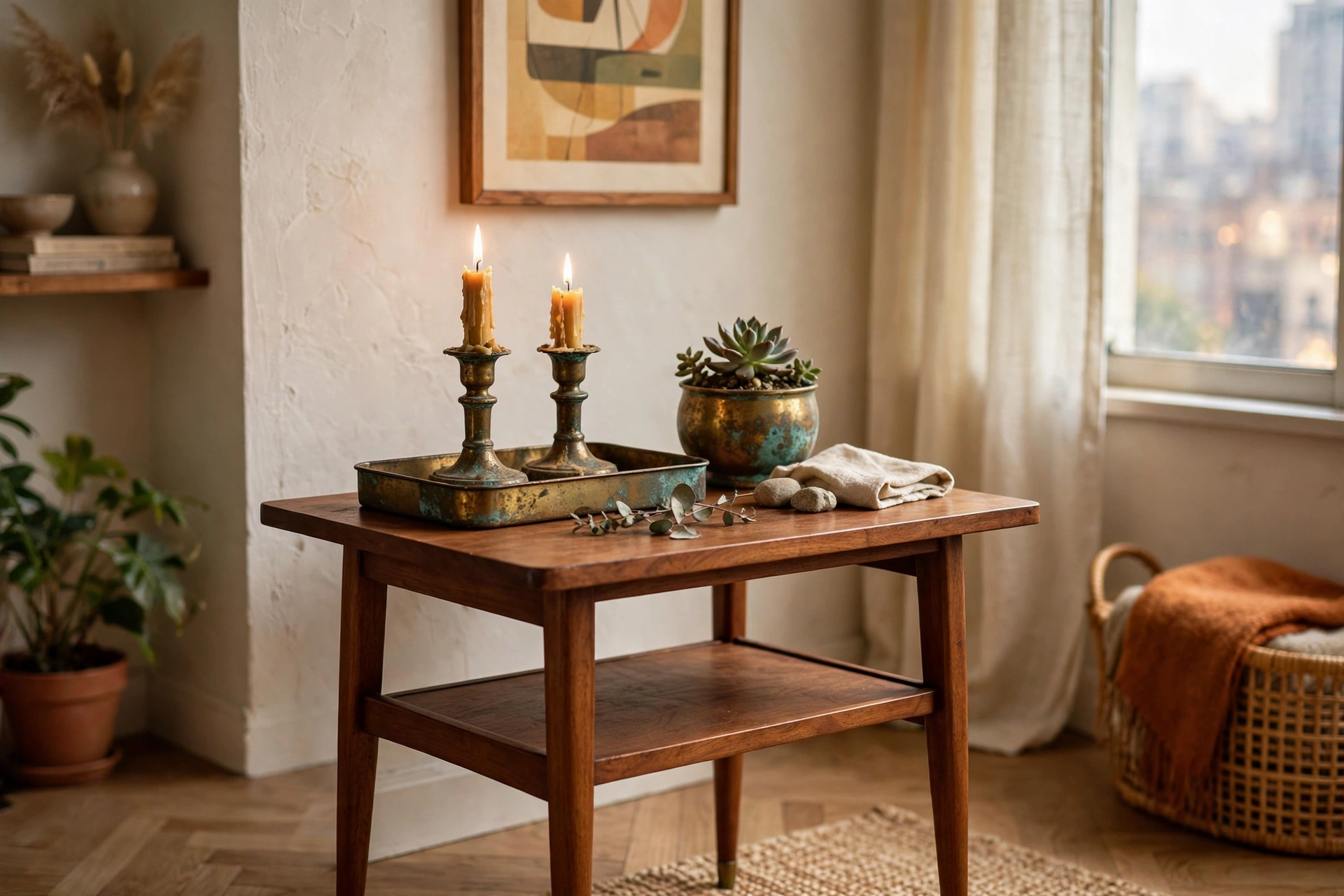
Brass is mid-century’s jewelry — candle holders, small trays, picture frames, and planters ($15–$40 each) that catch light and add warm metallic notes. Keep the finish aged or brushed rather than mirror-polished; patina is the point. Scatter brass in small doses across zones so the whole studio glints. Pro tip: never polish vintage brass to a shine — the aged finish is what makes a $10 thrift find look like a $100 antique, and polishing actually reduces its character.
Small-Space Mid-Century That Works
37. Make the Credenza Work Triple Duty
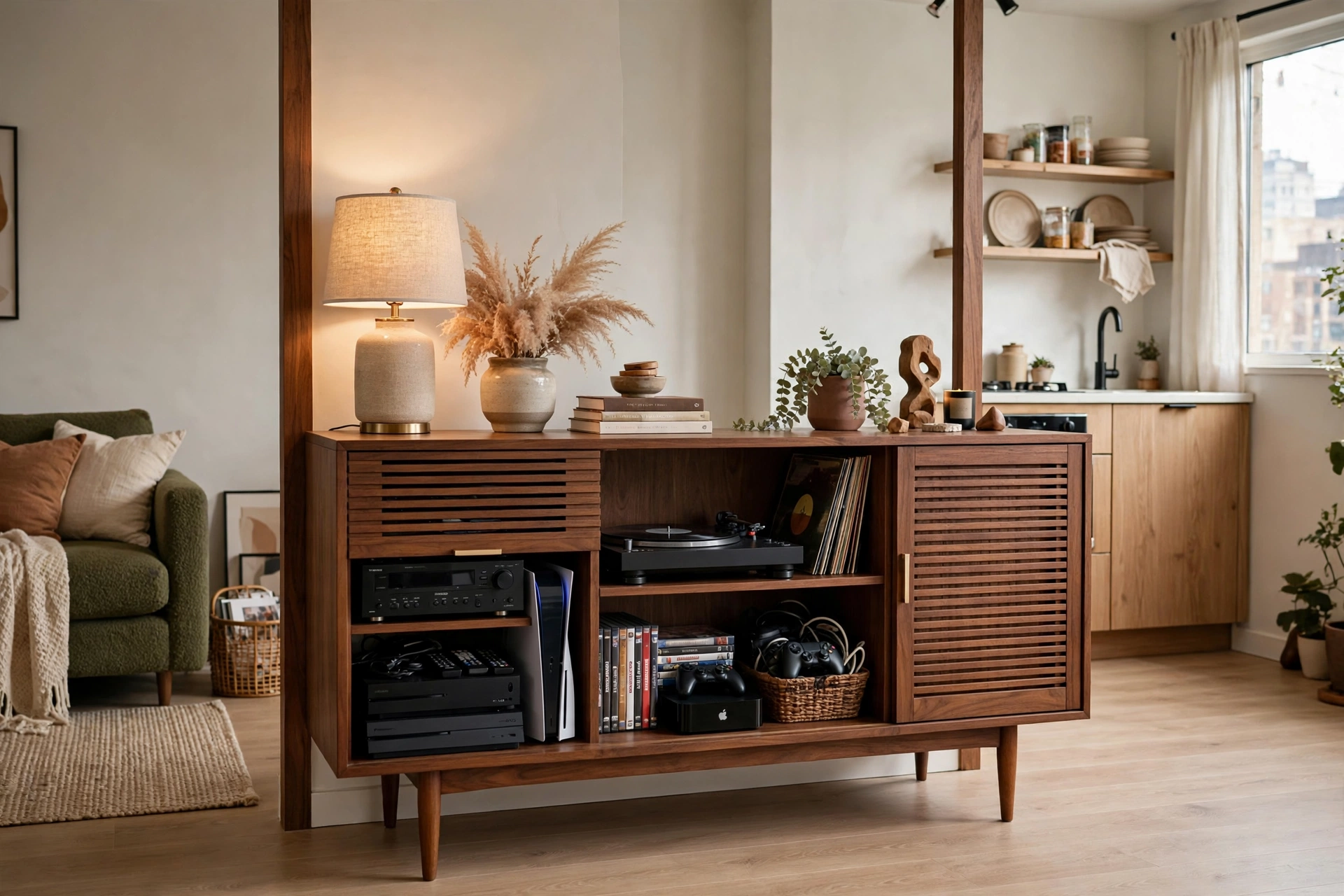
In a studio, the credenza shouldn’t just hold the TV — make it the hardest-working piece in the room. Top: styled decor and a lamp. Inside: media gear on one side, linens or office supplies on the other. Positioned perpendicular to a wall, it even becomes a room divider. One $300–$600 piece doing three jobs is the definition of mid-century efficiency. Pro tip: add felt pads under the credenza’s legs — you’ll slide it around to rezone the studio more often than you think, and pads protect floors silently.
38. Float Shelves for Display and Storage
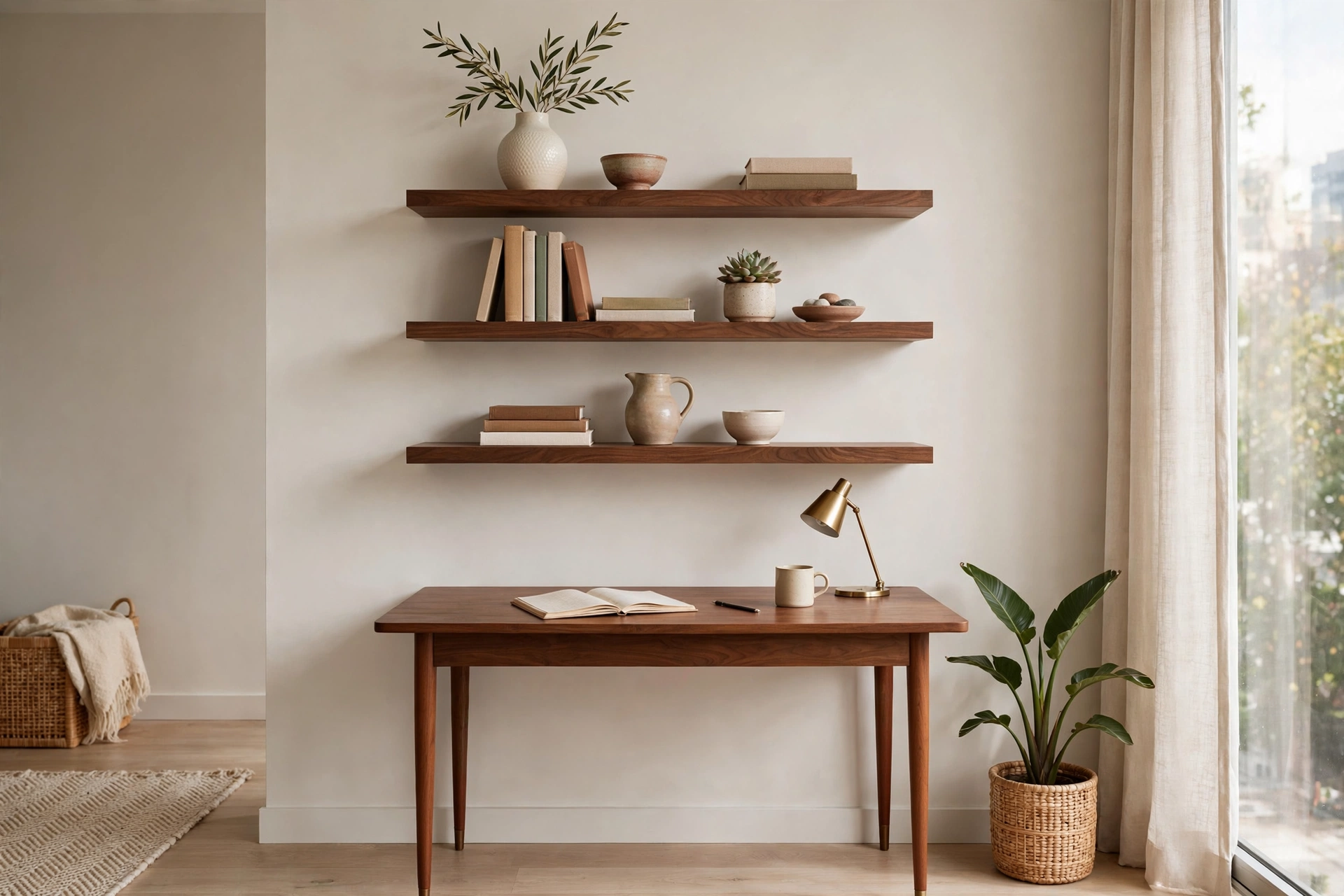
Floating walnut or teak shelves ($25–$60 each) add mid-century storage without a single inch of floor space — perfect above the desk, beside the bed, or in the dining nook. Two or three shelves hold books, plants, and ceramics while keeping surfaces clear. The floating look keeps walls feeling light. Pro tip: mount shelves into studs, not just drywall — books are heavier than they look, and a shelf of design books pulling out of drywall is a disaster no one needs.
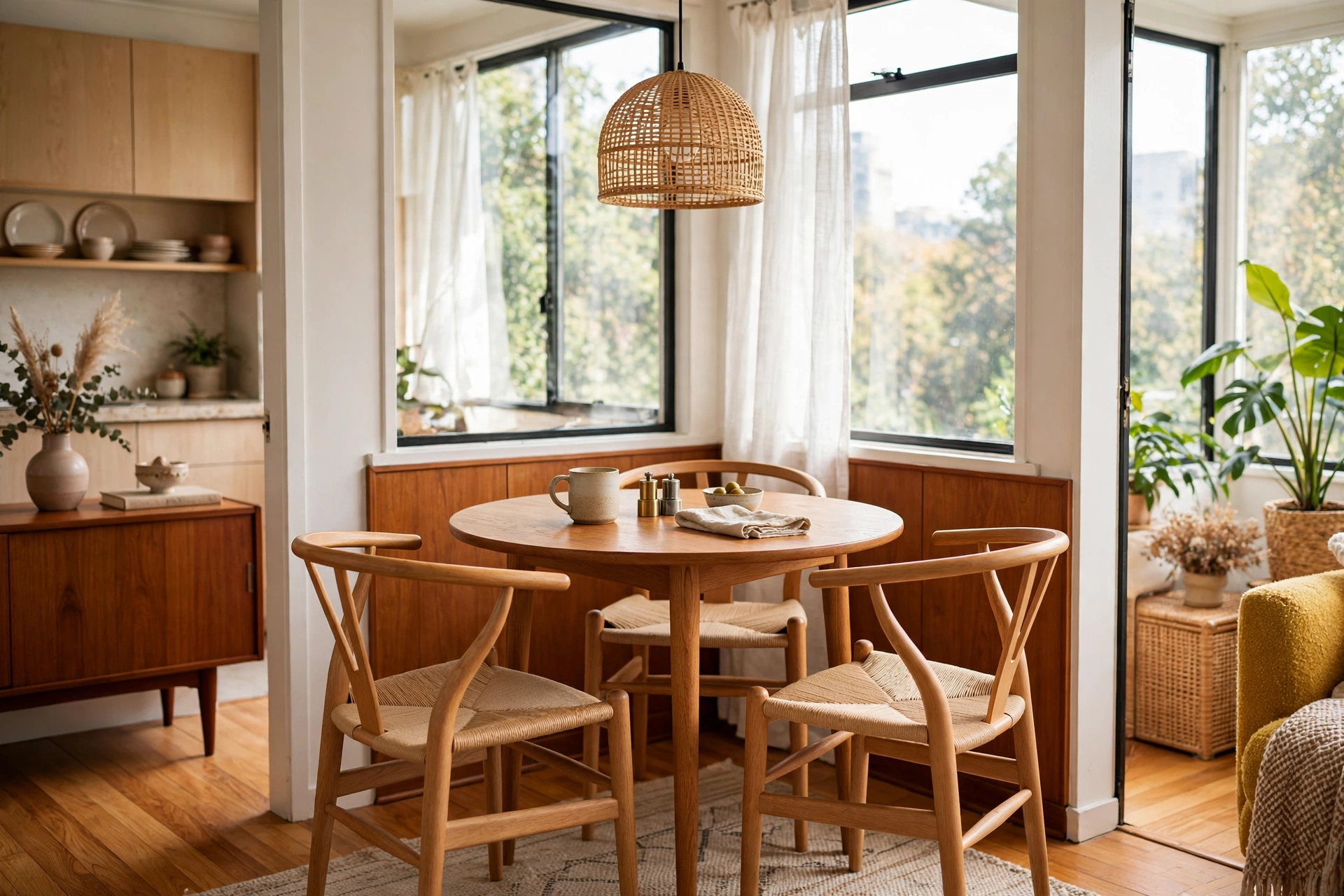
39. Build a Compact Dining Nook
Mid-century dining was made for small spaces — a 36-inch round tulip or drop-leaf table ($150–$350) with two wishbone chairs tucks into the brightest corner and seats four when you pull up the desk chair and a stool. Round tables are the studio secret: no corners to bump, better conversation, smaller footprint. Pro tip: hang the sputnik or a paper pendant low over the table (30 inches above the surface) — the nook instantly feels like a separate restaurant-worthy room.
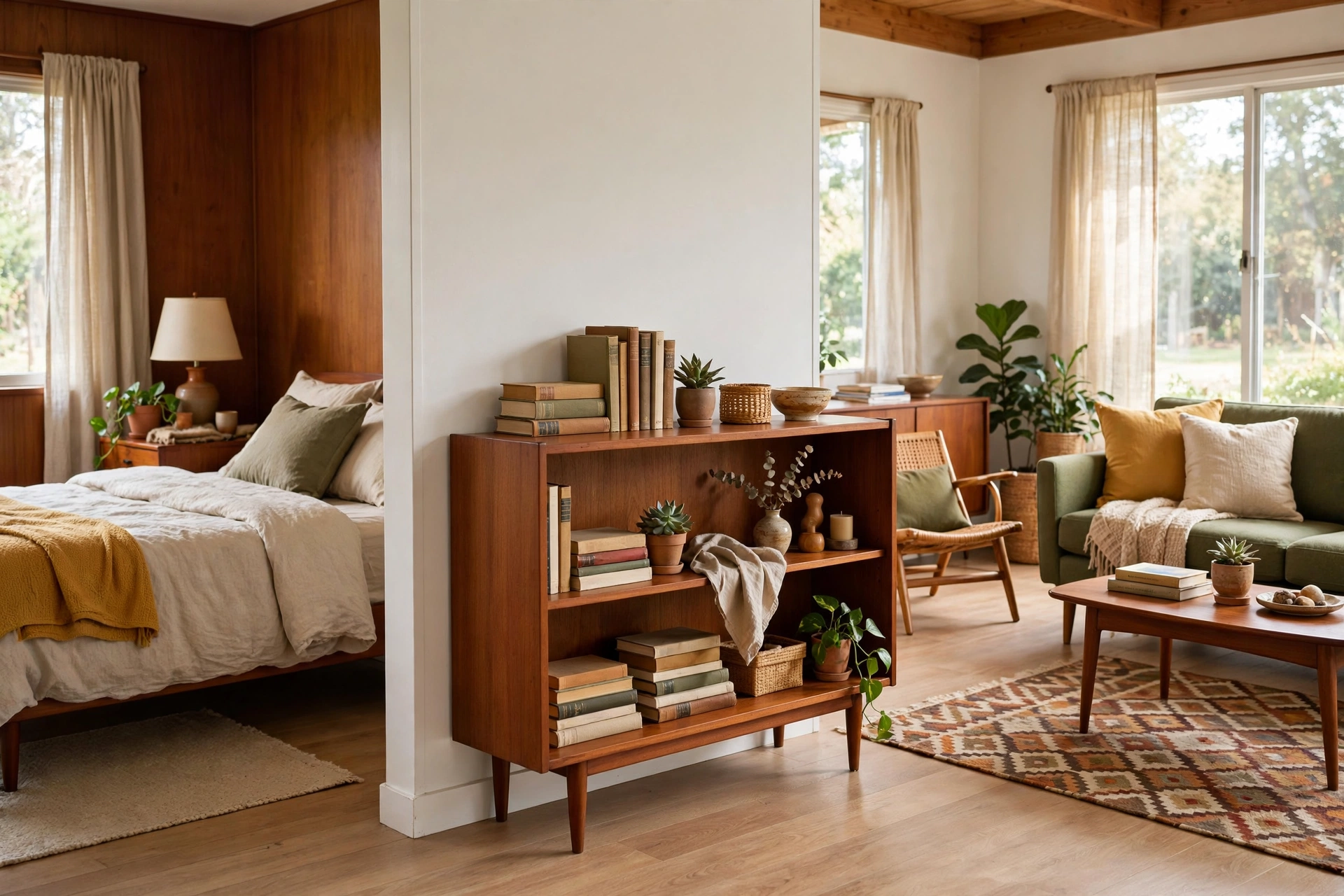
40. Zone the Bedroom With a Low Bookcase
A low teak bookcase (under 36 inches tall, $120–$300) placed perpendicular to the wall carves out a sleeping zone that feels separate without blocking light — the same zoning principle behind our studio apartment layout ideas, in period dress. Style the bed-facing side with books and the living-facing side with decor. Pro tip: anchor the bookcase to the wall with anti-tip hardware ($8) — in a studio you brush past dividers daily, and a loaded bookcase must never wobble.
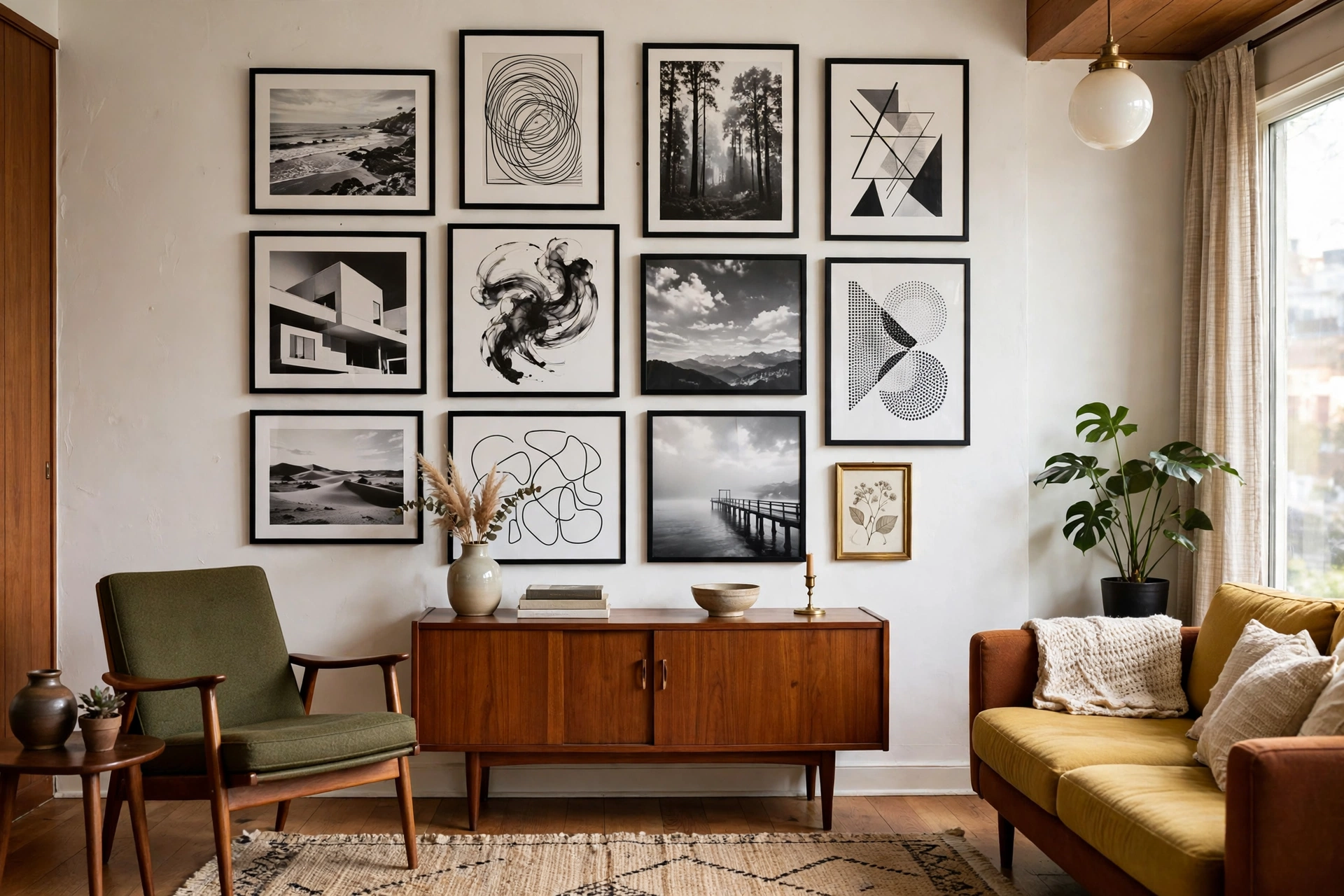
41. Frame a Black-and-White Gallery Wall
Mid-century gallery walls go graphic — black-and-white photography, abstract line drawings, and architectural prints in thin black frames ($8–$15 each). The monochrome palette keeps a busy wall calm, and the thin frames disappear into the composition. Plan the layout on the floor first, then hang with a level. Pro tip: include one small brass-framed piece among the black frames — the single warm accent keeps the wall from feeling cold and ties it to the room’s brass details.
42. Pot Plants in Ceramic Planters
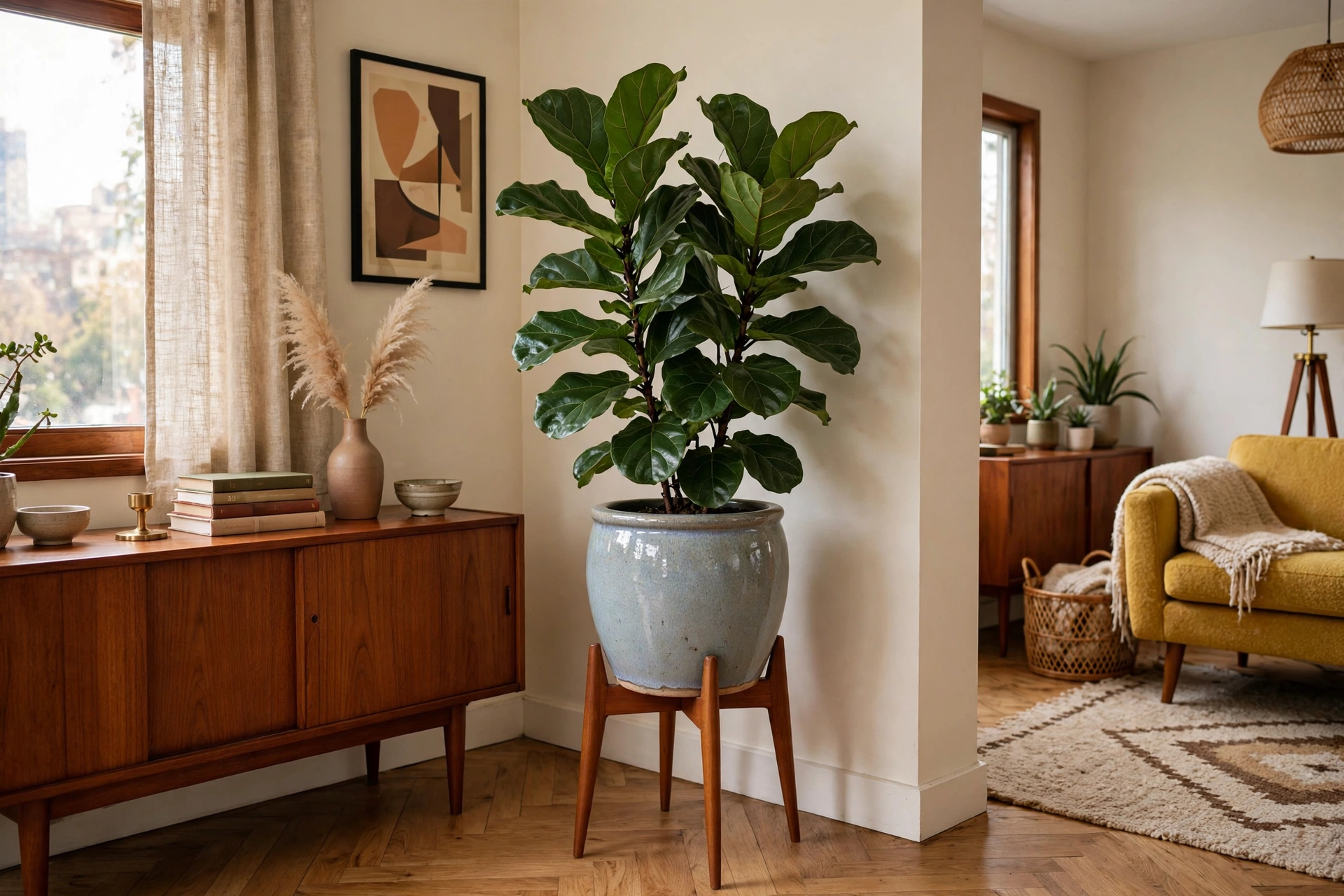
Mid-century rooms always had plants — a fiddle leaf fig or rubber plant in a glazed ceramic planter ($10–$30) on a teak plant stand ($25–$50) is the era-correct greenery formula. Plants soften all those clean lines and add living contrast to wood and brass. One large plant beats five small ones in a studio. Pro tip: elevate plants on stands rather than the floor — the lift shows more floor, matches the leggy furniture, and makes watering easier on your back.
43. Refresh Textiles Seasonally
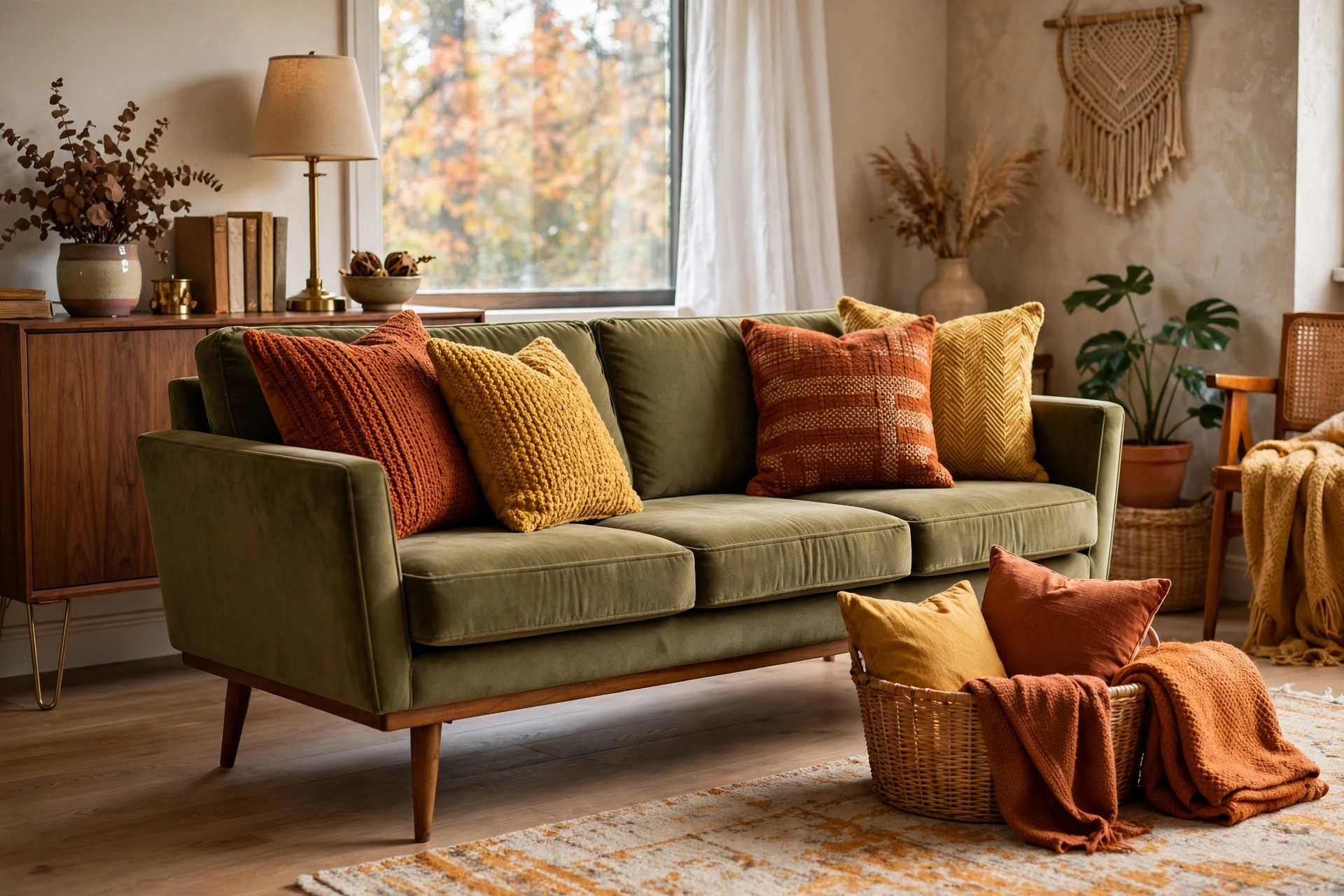
The cheapest mid-century refresh costs nothing — rotate textiles with the seasons. Lighter linens and airy cottons for summer, chunky knits and deep rusts for fall, all stored in one basket between swaps. The room feels brand new twice a year, and the same clean-lined minimalism underneath keeps it timeless. Pro tip: photograph each seasonal setup before packing it away — next year’s swap takes minutes instead of an afternoon of second-guessing.
Frequently Asked Questions
What defines mid-century modern style?
Mid-century modern (roughly 1945–1969) is defined by clean lines, organic curves, tapered legs, and an honest use of materials — teak, walnut, leather, brass, and molded plywood or plastic. The palette runs warm: mustard, burnt orange, olive, and teal against white walls and wood tones. Function leads: every piece is designed to work beautifully in real, often small, homes.
Is mid-century modern good for a small studio apartment?
It’s one of the best styles for studios — it was literally designed for compact postwar homes. Low profiles keep sightlines open, tapered legs show more floor, and pieces like credenzas, daybeds, and drop-leaf tables do double or triple duty. The warm woods also keep small spaces feeling cozy rather than stark, which is where pure minimalism sometimes fails.
How do I mix mid-century modern with other styles?
Anchor with one style and borrow from the other: keep 70% mid-century (the furniture silhouettes, the woods) and add 30% of something else — a boho textile, a Scandinavian sheepskin, an industrial lamp. Shared elements bridge the gap: warm wood tones work with almost everything, and a restrained palette keeps mixed pieces feeling intentional rather than random.
Where can I find affordable mid-century modern furniture?
Estate sales, flea markets, and Facebook Marketplace are goldmines for genuine vintage teak and walnut at $50–$300 per piece — often better made than new. For reproductions, IKEA, Article, and Wayfair carry solid mid-century-inspired lines. Always check joinery on vintage finds: dovetailed drawers and solid wood frames signal quality worth paying for.
What colors define mid-century modern decor?
The classic palette: warm white walls, walnut and teak wood tones, with accents of mustard yellow, burnt orange, olive green, and teal. Brass adds metallic warmth. Start with neutrals on big pieces and bring the retro colors in through textiles, art, and one statement chair — the era’s colors are powerful, so a little goes a long way.
Can renters pull off mid-century modern style?
Absolutely — mid-century is one of the most renter-friendly styles because its impact comes from freestanding furniture and decor: the credenza, the starburst clock, the sputnik pendant (many are plug-in or swap into existing ceiling boxes), layered rugs, and textiles. Use adhesive hooks for art and mirrors, and keep the landlord’s paint and fixtures untouched.
Final Thoughts
A mid-century modern studio apartment isn’t about living in a museum — it’s about borrowing the smartest design ideas of the 20th century for the realities of small-space life today. Clean lines that keep rooms calm, warm woods that keep them human, furniture that works twice as hard, and just enough atomic-age playfulness to make you smile every time you walk in.
Start with the foundations — the rug, the wood tones, one great chair — then let the hunt become part of the fun. The flea-market teak sideboard, the thrifted ceramic lamps, the starburst clock that was absolutely meant for your wall. Before long, your studio won’t just look mid-century. It will feel like the best-designed small room of its era — because you built it one timeless piece at a time.